


How AI Is Already Changing the Advisor-Client Meeting
The client meeting is where everything comes together.
It’s where plans turn into decisions. Where questions get answered. Where trust is built or reinforced.
That hasn’t changed.
What has changed is what clients expect from that conversation.
They don’t just want answers. They want clarity. They want to see how their risk, portfolio, income, and taxes all connect. And they want it explained in a way that actually makes sense in the moment.
That’s a tall order.
Because behind the scenes, advisors are often pulling from multiple systems, piecing together insights, and translating complex data into something a client can act on. Doing that smoothly, in real time, isn’t easy.
AI is starting to change that, not by replacing the advisor, but by doing the work that used to slow them down. The shift is happening across three key moments: before the meeting, during the meeting, and after.
Before the meeting: From fragmented prep to focused insight
Before the meeting even starts, most of the work has already happened.
Or at least, it’s supposed to.
For many advisors, preparation means pulling information from multiple places.
Notes from the last conversation, portfolio data, planning tools, and tax documents. Trying to stitch it all together into a clear picture of where the client stands today.
It works. But it takes time. And it keeps the focus on gathering information instead of thinking about what actually matters for that client right now.
That’s where AI starts to make a real difference.
When an AI engine is connected across a client’s full financial picture — risk, portfolio insights, income planning, and tax considerations — it doesn’t just surface information. It acts on it.
Upload a statement, and it builds a portfolio. Upload a tax return, and it highlights planning opportunities. Ask a question in plain language, and it pulls the right data and delivers a clear answer. All before the meeting begins.
Instead of jumping between systems, advisors can execute prep workflows and generate the outputs they need through a single conversation. Reports, insights, and talking points are ready for review, not waiting to be assembled.
That changes how advisors walk into the meeting. The admin work is handled. The data is connected. The story is already taking shape.
Less time is spent preparing the materials, leaving more time preparing for the conversation.
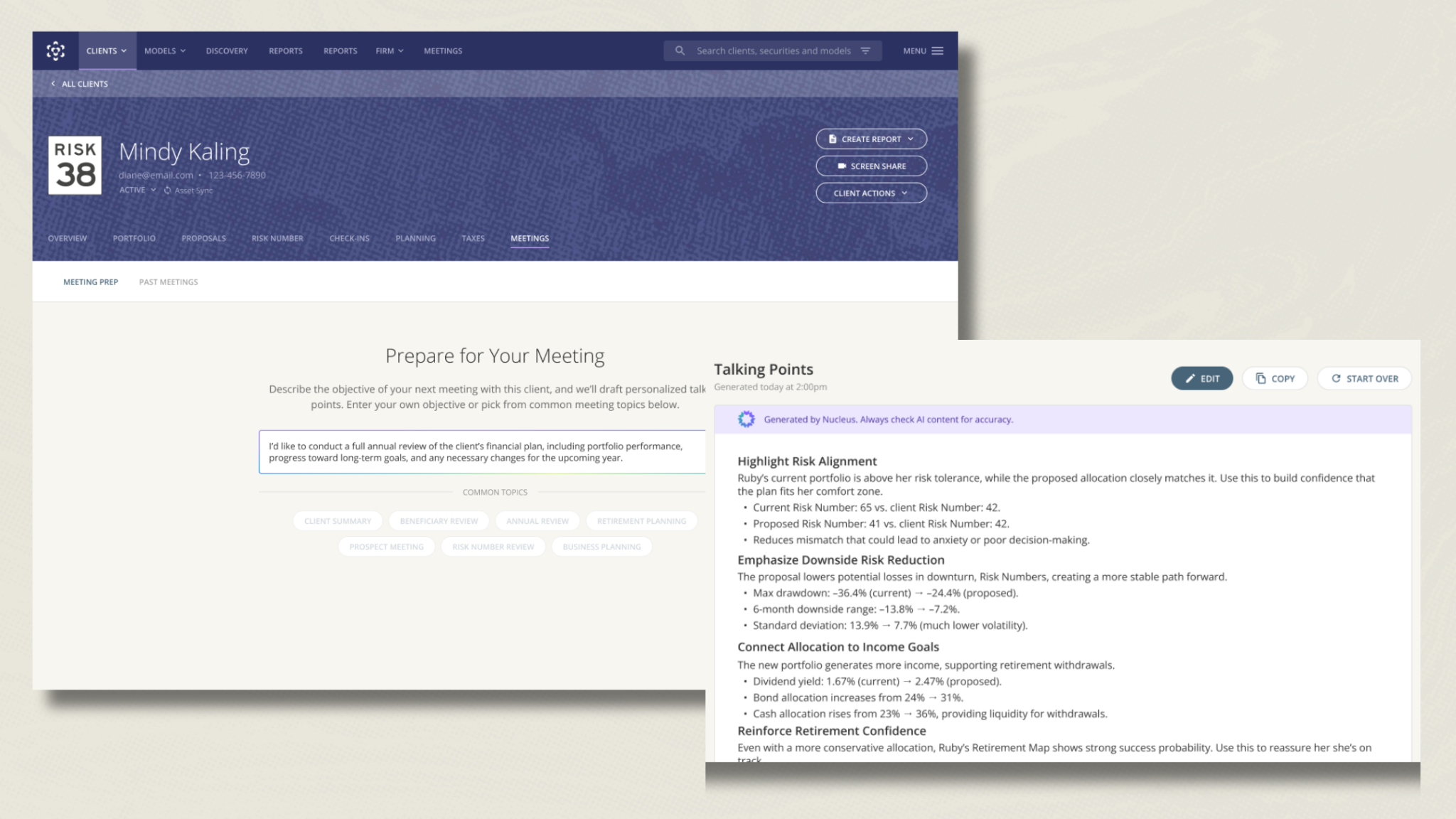
Nitrogen’s AI agent, Nucleus™ captures key context, organizes insights, and prepares what you need before the conversation starts.
During the meeting: From explanation to clarity
This is where the meeting either clicks… or it doesn’t.
Traditionally, this is the moment where advisors are doing a lot of explaining.
Walking through charts. Translating portfolio performance. Connecting risk to long-term outcomes. Trying to tie in tax considerations or income strategy along the way.
The challenge isn’t really a knowledge problem, but rather all about the delivery.
Because most tools weren’t built to work together in real time. So even when the advice is sound, it can feel fragmented to the client. One concept at a time. One screen at a time. The client is left trying to connect the dots.
AI changes that dynamic.
When risk, portfolio insights, income planning, and tax considerations are connected in the same view, tied to the same client, the conversation shifts from explaining isolated ideas to showing how everything fits together.
A client asks how a change in allocation affects their plan. You can show how it shifts their risk profile and what that means for their comfort with volatility, then connect it to income. What does that change do to their retirement income strategy? Then layer in taxes. What are the potential implications of making that adjustment today versus later?
All presented in one, connected flow.
And when new questions come up, as they always do, AI can respond in real time, pulling in the right data without breaking the conversation. Instead of “Let me get back to you on that,” advisors can stay in the moment.
The result is a clearer conversation, a more engaged client, and a meeting where everything finally connects.
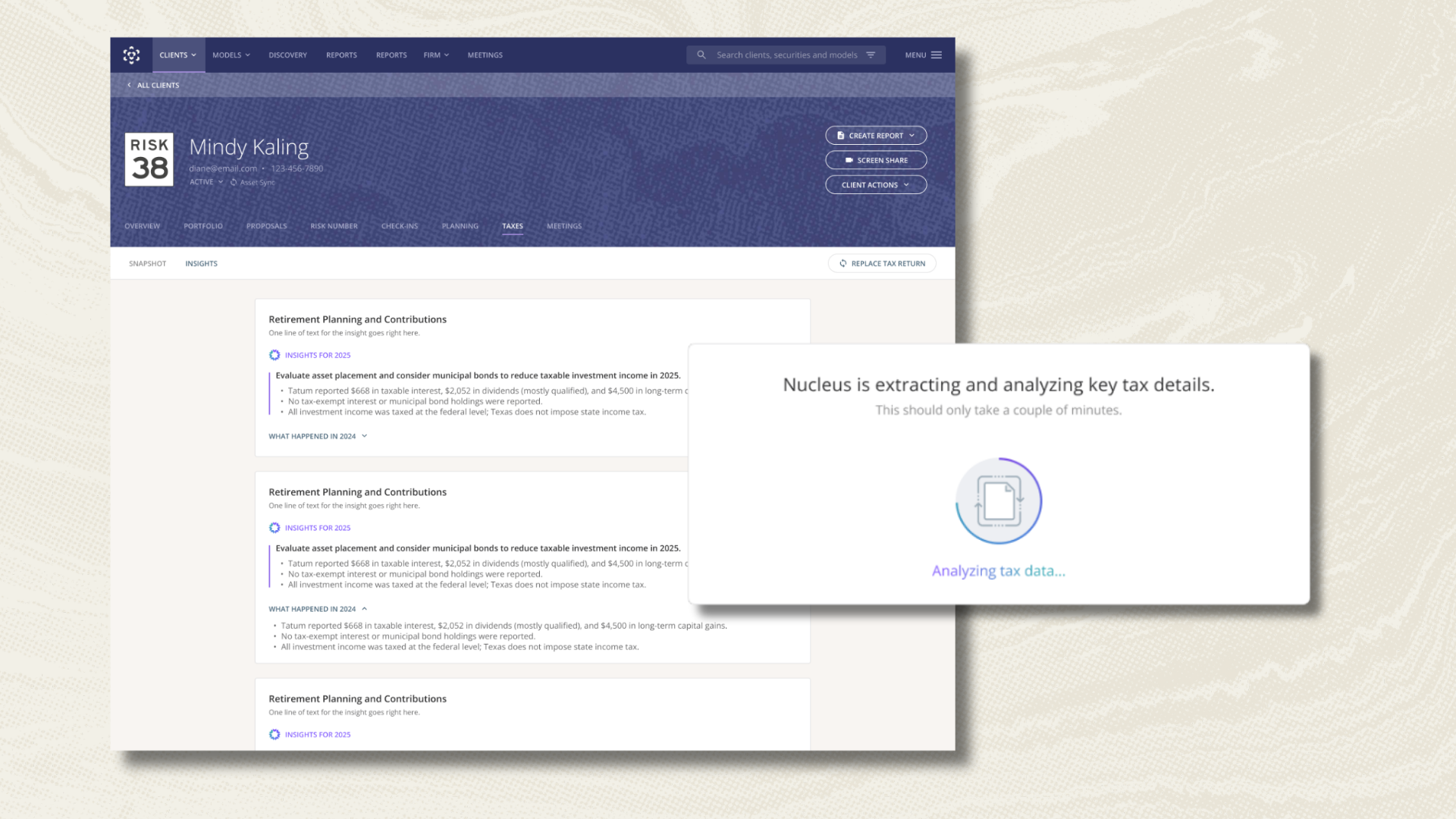
Nucleus can surface key insights by uploading a client’s1 040, helping you spot planning opportunities and uncover assets you might not see otherwise.
After the meeting: From manual follow-up to consistent execution
The meeting might be over. But the work isn’t.
For many advisors, what comes next is a familiar routine.
Write up notes. Update the CRM. Capture key decisions. Outline next steps. Send follow-ups. Maybe start preparing for the next conversation while everything is still fresh.
It’s important work. But it’s also time-consuming. And when things get busy, it can become inconsistent.
Details get missed. Follow-ups get delayed. Momentum from the meeting starts to fade.
AI can close that gap.
When conversations are captured as they happen, notes can be generated automatically. Key decisions, action items, and next steps are clearly outlined without needing to be recreated after the fact. And that output doesn’t stop at documentation, it can turn into follow-through.
Summaries prepared. Tasks organized. Workflows moving forward.
All with the advisor still in control.
That changes what happens after the meeting. Instead of spending time reconstructing the conversation, advisors can review, refine, and move quickly to the next step. Follow-ups are faster. Documentation is more consistent. Nothing important slips through the cracks.
And from the client’s perspective, that consistency matters. They leave the meeting with clarity and they see it reflected in what happens next.
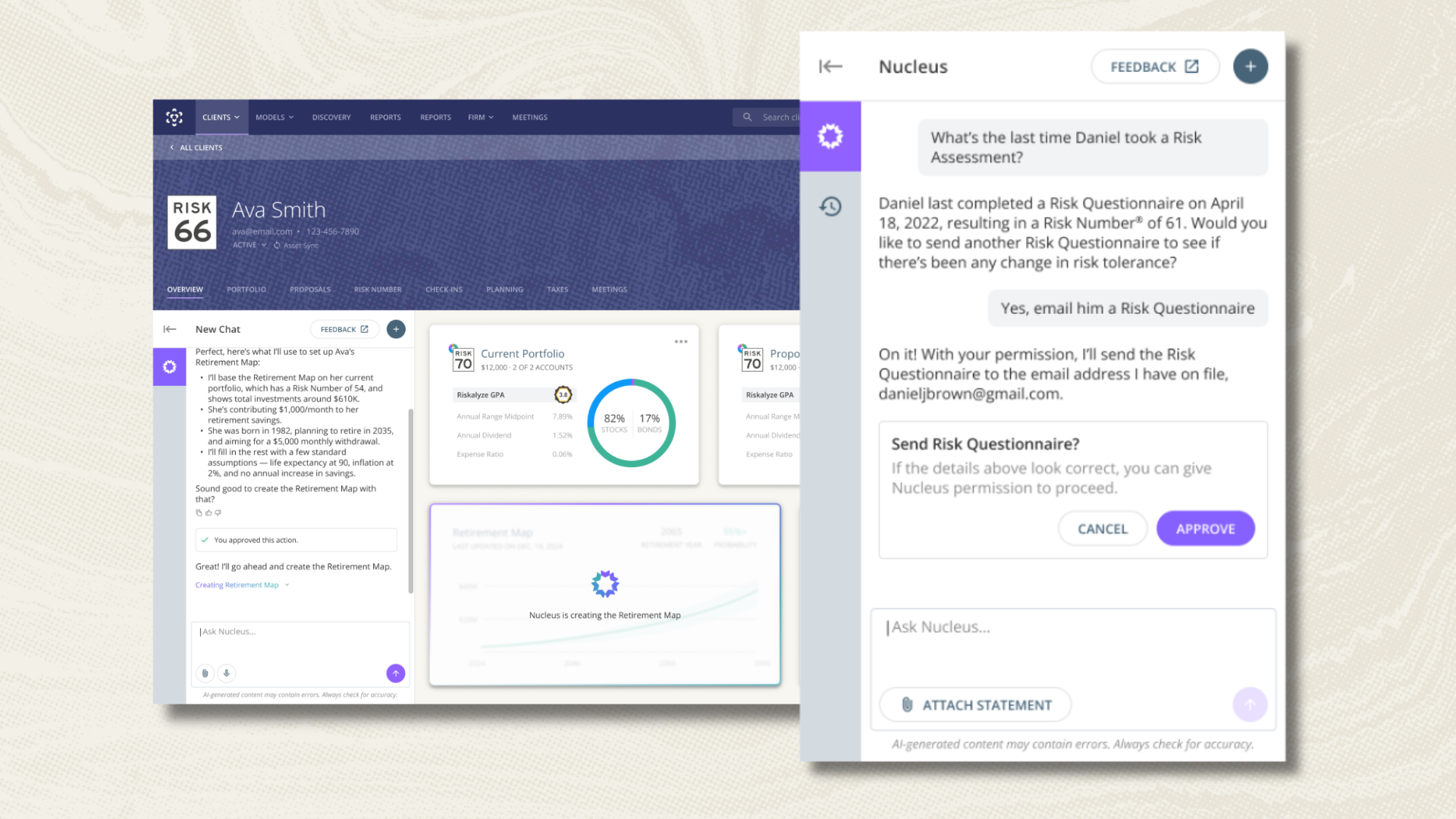
Use Nucleus to help you complete action items after your meeting, like sending the client a Risk Number® Questionnaire.
A better meeting creates better client outcomes
The client meeting hasn’t changed. But what a good meeting looks like has.
Clients expect clarity. They expect connection. They want to understand not just what you’re recommending, but how everything fits together.
That’s hard to deliver when your tools are disconnected, and your workflow is manual. It’s much easier when everything works as one system. Where AI handles the prep, connects the insights in real time, and keeps follow-through from falling apart.
The advisors doing this well aren’t necessarily working harder, they’re working with tools that are finally keeping up.
See how Nitrogen’s connected suite of AI-powered advisor products supports every stage of the client meeting. Book a demo.
FAQ: AI in Financial Advisor-Client Meetings
How is AI being used in financial advisor meetings?
AI is showing up across the full meeting lifecycle — before, during, and after. Before the meeting, it helps advisors prepare faster by connecting client data and surfacing what matters. During the meeting, it responds to questions in real time and connects insights across risk, portfolio, income, and tax. After the meeting, it captures notes, outlines action items, and supports follow-through.
Does AI replace the financial advisor in client meetings?
No. AI handles the work that slows advisors down like data prep, documentation, real-time lookups, so advisors can stay focused on the client. The judgment, the relationship, and the advice still come from the advisor. AI just removes the friction that gets in the way of delivering it well.
What’s the difference between AI that summarizes and AI that acts?
Most AI tools summarize information or surface suggestions. Agentic AI goes further. It can take action on behalf of the user. In an advisor context, that means uploading a statement and automatically building a portfolio, sending a client a risk assessment, or generating a meeting summary with action items. The difference is between AI that tells you what to do and AI that helps you do it.
How does AI help advisors prepare for client meetings faster?
By connecting client data across risk, portfolio, income, and tax in one place, AI can answer prep questions in plain language, generate reports, and organize talking points before the meeting starts. Instead of pulling from multiple systems and assembling everything manually, advisors can walk in with the work already done.
Can AI help with client meeting follow-up?
Yes. AI can capture key moments from a meeting, generate notes, and outline next steps automatically, reducing the time advisors spend on post-meeting documentation. That consistency also improves the client experience: follow-ups go out faster, nothing gets missed, and the momentum from the meeting carries forward.
What should advisors look for in AI tools for client meetings?
Look for AI that’s connected across the full planning picture, not just one data source. The most useful tools work across risk, portfolio, income, and tax simultaneously. Also look for AI that’s been built specifically for the advisory context, with appropriate governance and compliance considerations built in, rather than a general-purpose model pointed at financial data.