


How Modern Advisors Are Using Technology to Transform Client Meetings
Advisors today have access to more sophisticated tools than ever before. Yet many client meetings still feel like they did decades ago.
Spreadsheets drive projections. Static PDFs recap discussions. Risk tolerance is reduced to broad labels like “moderate” or “aggressive.” Advisors explain the strategy. Clients receive the report after the fact.
Investor expectations, however, have changed. In Nitrogen’s 2025 Firm Growth Survey, nearly 8 in 10 investors said it’s important that their advisor use modern, user-friendly technology to present financial information. More than two-thirds said they would consider switching to an advisor who does it better.
Clients expect great digital experiences in every other part of their lives. Now they demand the same from their financial advisor. In response, firms seeking to grow in 2026 will need to consider their entire client experience to remain competitive.
Nitrogen’s platform was built for the modern advisor. It turns advice from something clients are told into something they can see and interact with. And when clients can see it, advisors spend less time defending decisions and more time guiding them.
Here’s how that approach compares to the legacy tools many firms still rely on today.
How modern firms approach risk
In many firms, risk tolerance is reduced to a short questionnaire and a broad label. Conservative. Moderate. Aggressive. The portfolio is aligned to that category, and the conversation moves on.
But those labels leave room for interpretation. They rarely define how much downside a client can truly tolerate. When markets turn volatile, that ambiguity shows up fast. Advisors field anxious calls. Revisit allocations. Defend expectations that were never clearly quantified.
To address this problem, modern firms have started replacing subjective labels with measurable alignment.
For example, in Nitrogen’s Risk Center, each client receives a Risk Number® on a 1-99 scale, grounded in a proven economic framework. Advisors can quantify the risk in a client’s portfolio and compare it directly to the client’s personal Risk Number. The 95% Historical Range complements this tool further by showing what outcomes are statistically normal over a six-month period. This allows clients to see potential downside before volatility tests their confidence.
In the meeting, the difference is clear. Instead of explaining what “moderate” means, the advisor can swivel the monitor and show a client’s Risk Number beside their portfolio’s score. If there is misalignment, it’s visible. If the portfolio is aligned, the expected range is clear. This shifts the conversation from interpretation to evidence.
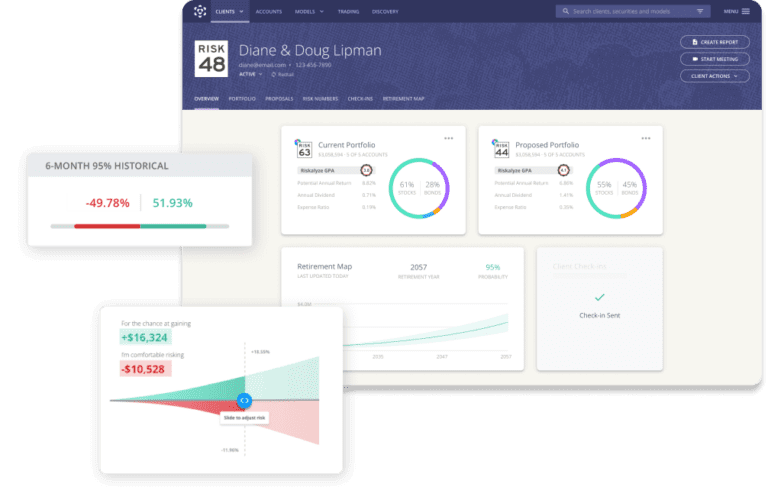
For advisors, that clarity reduces friction, and expectations can be defined early. Volatility can become easier to navigate because clients understand what is normal. Documentation is built into the workflow, supporting compliance and due diligence.
And over time, that consistency protects retention, supports growth, and reinforces the advisor’s role as a disciplined, data-driven decision maker.
How modern firms approach investment research
In many firms, investment research happens behind the scenes. Advisors move between fact sheets, third-party tools, spreadsheets, and performance reports to evaluate funds and build portfolios. The work is thorough, but it’s fragmented and time-consuming. When it’s time to present a recommendation, that analysis is compressed into static charts and summary slides.
In other words, clients see the conclusion. They don’t see the process behind it.
But research doesn’t have to stay hidden. In Nitrogen’s Research Center, portfolio analytics, modeled performance, comparisons, sector breakdowns, screening, and stress testing live in one place. Research is built, tested, and presented inside a unified platform. The analytics connect directly to the client conversation.
The difference becomes clear when the monitor turns. Allocations adjust. Strategies are compared side by side. Risk and projected outcomes update almost instantly. There’s no need for slide decks or toggling between systems. Clients see the reasoning unfold in real time.
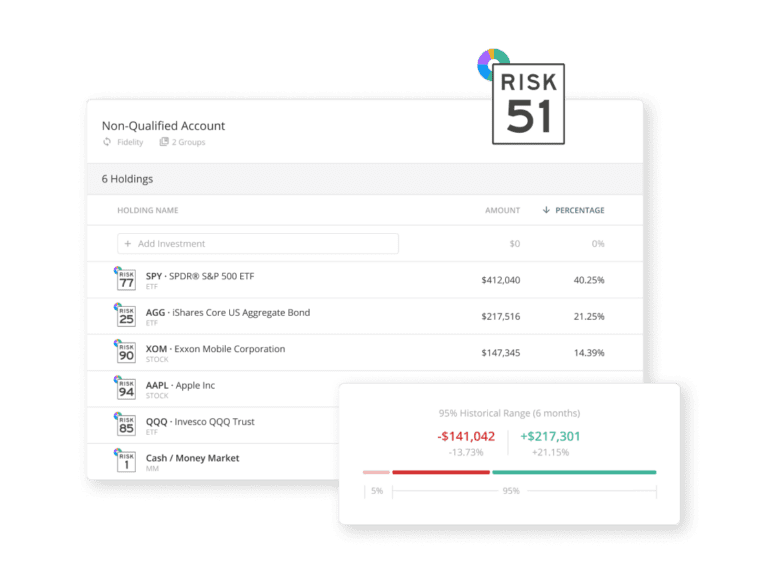
For advisors, the impact goes beyond the meeting. Preparation becomes faster. Recommendations feel more defensible and clearer rationale can help improve close rates. Research stops being a back-office task and becomes a growth driver.
How modern firms approach tax conversations
Taxes quietly erode client wealth. Yet many advisors address them only at a high level. A 1040 gets a quick review or is handed off to a CPA. When tax conversations do happen, they are dense and jargon-heavy. Clients struggle to see what actually matters.
That leaves opportunity on the table. Clients expect tax-aware guidance, but extracting insight from a complex return takes time.
With Nitrogen’s Tax Center, a 1040 becomes a starting point, not a document to decode. Advisors upload the return and generate a clear Tax Snapshot in seconds. Complex data turns into visual summaries and AI-generated insights. Roth conversions. Deduction strategies. Capital gains exposure. High cash balances. The key opportunities surface immediately.
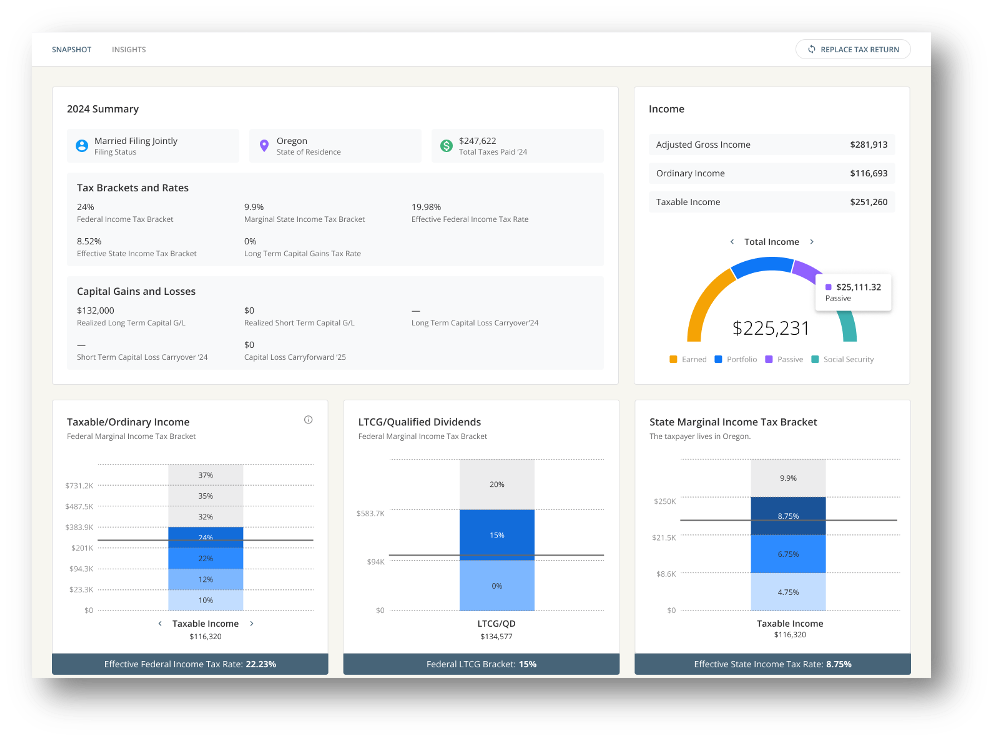
In a client meeting, this changes the dynamics. Instead of walking line by line through a return, the advisor shares a visual snapshot. The client sees their full tax picture at a glance. Questions become sharper. The conversation moves quickly from review to strategy.
The business impact is real. Tax discussions can become more proactive, and prospect meetings can start with insight instead of a pitch. Hidden accounts and held-away assets surface naturally. Over time, that differentiation strengthens trust, increases wallet share, and positions the advisor as a comprehensive, tax-aware partner.
How modern firms approach retirement income
Retirement planning often lives in spreadsheets or heavy planning tools. Hours of data entry come before a real conversation can begin. Projections are built behind the scenes and delivered as a probability score. The connection between risk tolerance, time horizon, and portfolio strategy can feel abstract.
As a result of these constraints, advisors face a choice: invest significant time building a full plan or rely on high-level assumptions.
Modern firms, however, are making income planning faster and more connected. In Nitrogen’s Income Center, advisors generate a Retirement Map using core client data and immediately show long-term probability of success. Risk tolerance, savings, retirement timing, and investment strategy are modeled together. Adjustments update in real time.
In the meeting, the difference is clear. An advisor can model retiring earlier and what increasing savings will look like. Each change updates the outcome instantly. The conversation shifts from reviewing a static projection to exploring decisions.
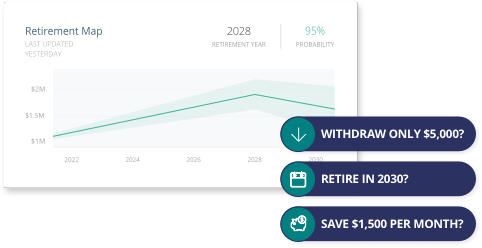
For advisors, that means fewer hours building plans that stall and more time focused on strategy. Income planning becomes easier to introduce in prospect conversations and client meetings become more productive. The firm gains a repeatable framework that supports retention, referrals, and long-term growth.
How modern firms approach client meetings
According to Kitces, advisors spend an average of 20.7 hours each week preparing, having, or supporting client meetings. That’s half the advisor’s week, and doesn’t even include meetings with prospective clients.
Notes get typed late at night. Summaries are rebuilt from memory. Compliance entries land in multiple systems. The meeting may feel productive in the moment, but the administrative work lingers.
Meeting Notetaker removes that burden from the conversation. Inside Nitrogen, an AI assistant captures, transcribes, and summarizes meetings in real time. Notes are converted into structured, editable, compliant documentation automatically. Extra logins aren’t needed, nor are any additional tools or third-party plug-ins.
During the meeting, the difference is obvious. The advisor stays focused on the client. The platform handles the note-taking. When the conversation ends, the summary is already there.
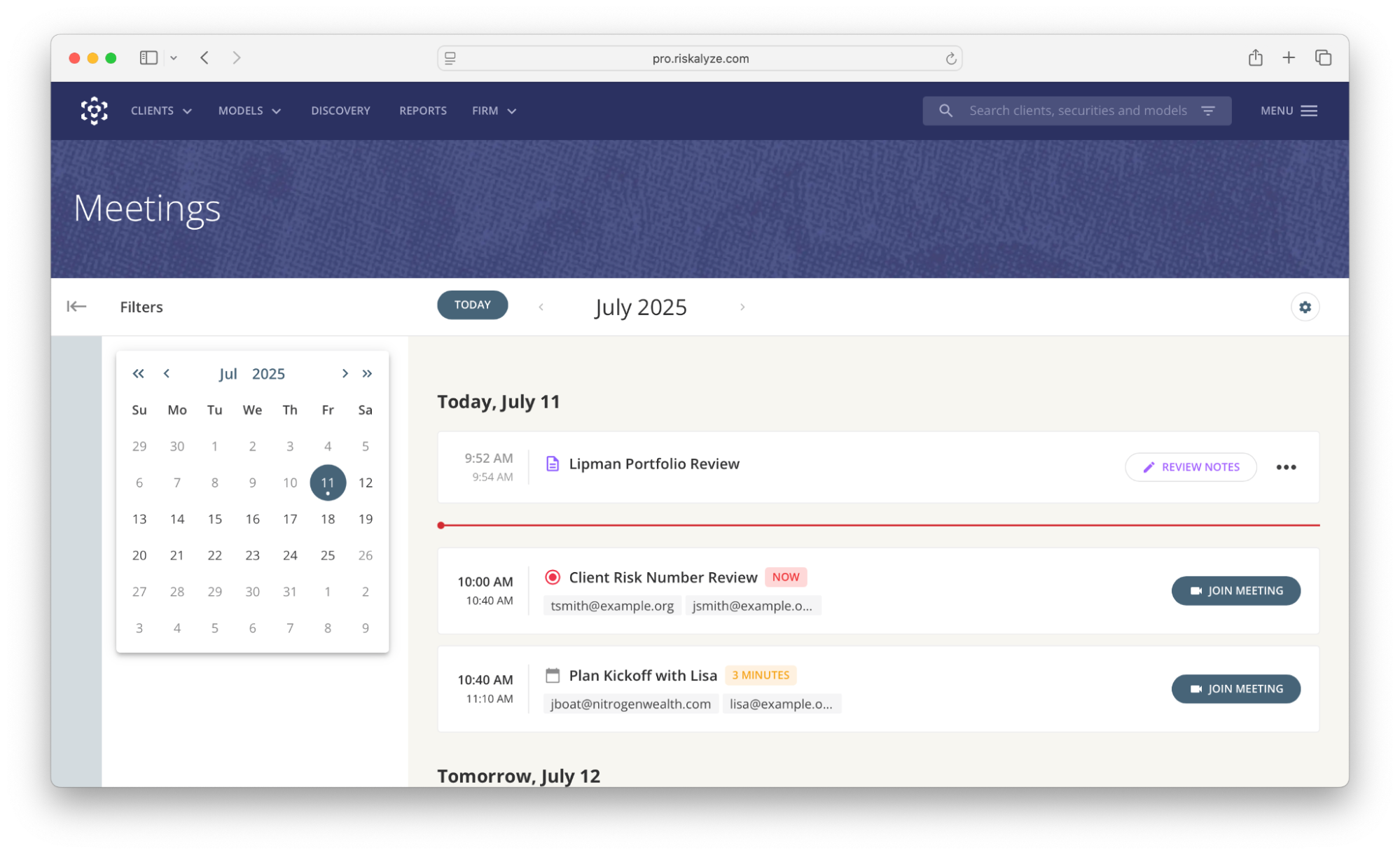
For advisors, the payoff is immediate with hours that can be reclaimed every week and administrative drag that can shrink. Documentation becomes consistent across the firm. Over time, that efficiency compounds into stronger client service, easier scalability, and a more valuable practice.
The new standard for client experience
Firms don’t grow by stacking more tools on top of each other. They grow by making advice easier to understand. When risk is clear, income planning is interactive, meetings run smoothly, and tax conversations surface real opportunities. Clients feel confident, expectations are set early and volatility can be easier to navigate.
Strategy is shown, not just explained.
That’s what Nitrogen is built for. It brings risk alignment, investment research, income planning, meeting documentation, and tax insight into one connected platform. Gone are the days of fragmented workflows and disconnected tools. Advisors are left with a client experience that is clear, digital, and built to scale.
If you want to see how it works in practice, book a demo today and explore the platform for yourself.
Frequently Asked Questions (FAQs)
How can financial advisors use technology to improve client communication?
Client-facing technology allows advisors to visually demonstrate how risk, portfolio strategy, income planning, and tax decisions connect to a client’s goals. Interactive tools help clients see trade-offs in real time instead of relying on static reports. This improves clarity, builds trust, and reduces reactive conversations during market swings.
Why are investors leaving advisors for firms with better technology?
Investors increasingly expect transparency, personalization, and data-backed insights. According to Nitrogen’s 2025 Firm Growth Survey, many clients say modern, user-friendly technology influences their trust and decision to stay with an advisor. Firms that provide clear, interactive experiences are better positioned to retain and attract clients.
How does Nitrogen’s Risk Number® work?
Nitrogen’s Risk Number® measures a client’s risk tolerance on a 1-99 scale using a scientifically grounded economic framework. Advisors can calculate both a client’s personal Risk Number and the risk embedded in their portfolio, making alignment visible and measurable. This supports expectation setting, behavioral coaching, and documentation.
How can advisors make retirement income planning more efficient?
Modern planning tools allow advisors to model retirement scenarios in real time. By adjusting savings, retirement age, or risk levels during a meeting, advisors can instantly show how those decisions affect probability of success. This makes income planning more interactive and scalable without requiring a full, time-intensive financial plan.
How can financial advisors incorporate tax planning into client meetings?
Technology can transform a client’s 1040 into a visual snapshot that highlights potential opportunities, such as Roth conversions, capital gains planning, and deduction optimization. This allows advisors to lead tax-aware conversations proactively and uncover opportunities that may otherwise go unnoticed.
What are the business benefits of using an integrated wealth management platform?
An integrated platform connects risk alignment, research, income planning, meeting documentation, and tax insight into one cohesive workflow. This can reduce administrative overhead, improve consistency across advisors, strengthen compliance documentation, and enhance the overall client experience. Over time, that operational efficiency can support retention, referrals, and firm growth.