


How Software Helps Financial Advisors Create a Better Estate Planning Process
Most advisors know estate planning belongs in the client experience. The bigger question is whether their firm has a process for turning those conversations into long-term family relationships.
That question is important because estate planning is tied directly to retention. An advisor may spend years building trust with a client, only to have little or no relationship with the people who will eventually inherit the assets. By the time wealth transfers, it may be too late to start from scratch.
That’s why estate planning cannot be treated as a one-time document review. For advisory firms, it’s becoming a critical part of relationship management and building a sustainable practice.
The challenge is making estate planning a consistent part of the client experience. Most advisors can handle estate planning questions when they come up. The harder part is creating a process that encourages deeper conversations, keeps plans current as circumstances change, and helps clients involve family members when appropriate.
The right software, however, provides advisors a better way to organize estate information and involve the right people before a transition happens.
How top advisors handle estate planning
Estate planning works best when each conversation picks up where the last one left off.
A client may start by updating a beneficiary designation. A year later, that discussion may expand into broader questions about family goals, charitable giving, or which adult children should be involved in future conversations.
Over time, those details begin to shape a more complete picture of what the client wants their legacy to accomplish. Not just who receives which assets, but who needs to understand the plan, what the client wants to protect, and how they want important decisions handled in the future.
That’s what many of the strongest estate planning processes have in common. They’re built to evolve alongside the client’s life. The advisor isn’t reopening the same conversation every year or relying on memory to connect the dots. They have a process for carrying the conversation forward.
The challenge is doing that consistently across dozens of client relationships, and that’s where software can help.
How software creates a repeatable process
Estate planning has always involved a lot of moving pieces. What has changed is the software available to support it.
A decade ago, many advisors relied on a combination of meeting notes and paper documents to keep estate planning conversations organized. Today, software can help advisors create a more connected experience for clients and their families.
Some of the most useful developments include the ability to:
- Help clients see the full picture. Estate plans can be difficult to discuss when information is spread across multiple documents and systems. Modern planning tools can bring those details together in a visual format, helping clients understand how assets connect to beneficiaries and long-term goals.
- Capture context from important conversations. Clients often share details that become relevant months or years later. Software gives advisors a place to document those discussions so future decisions are easier to understand.
- Carry conversations forward over time. Estate plans are rarely static. As circumstances change, advisors can update information and revisit previous discussions without rebuilding the entire picture from the beginning.
For firms trying to make estate planning a more consistent part of the client experience, that continuity is often the difference between a one-time planning discussion and an ongoing legacy planning process.
Extending the conversation to the next generation
Once advisors have a more structured process for estate planning conversations, another question naturally follows: Who else needs to be connected to that process?
For many families, the answer isn’t always simple. Some clients want their children involved early. Others prefer to keep details private. Some want a future trustee, executor, or beneficiary to know who to contact, but they don’t want to turn every estate planning conversation into a family meeting.
Advisors need a way to respect those preferences while still helping families avoid confusion later.
That’s especially important because the first conversation between an advisor and a beneficiary often happens during a difficult transition. If the beneficiary has never met the advisor, does not understand the advisor’s role, and does not know why the relationship exists, that moment can feel unfamiliar from the start.
Legacy planning works better when the introduction happens earlier.
That is the idea behind Nitrogen’s Legacy Key. With the client’s approval, advisors can send a formal, advisor-branded introduction to beneficiaries before a major life event occurs. The beneficiary receives the advisor’s contact information and simple guidance on what to do if they need help in the future.
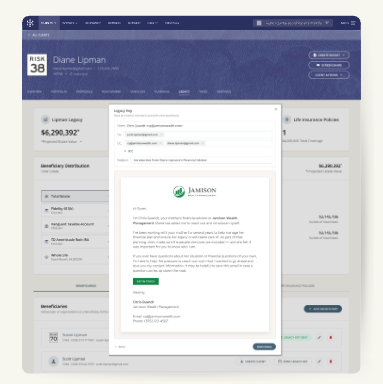
Legacy Key helps advisors formally introduce beneficiaries before a major life event occurs, creating continuity across generations.
For clients, this creates peace of mind. They know the right people have a clear point of contact if something happens.
For beneficiaries, it reduces uncertainty. They don’t have to search through old files, find a business card, or guess who was helping their parent or loved one with important financial decisions.
For advisors, Legacy Key creates a practical way to extend the relationship beyond the client household. The introduction happens while the client can still provide context and decide how much information should be shared.
That small step can make a future conversation feel less like a cold handoff and more like a continuation of the planning process already in place.
A better way to support legacy conversations
Helping families navigate tough moments is one reason more firms are looking for ways to bring structure to legacy planning conversations.
For firms looking to make estate planning a more consistent part of the client experience, software tools like Nitrogen Legacy Center offer a practical place to start.
Interested in learning more? Book a demo to see how Nitrogen can help support legacy conversations across generations.
FAQ
How does software help financial advisors with estate planning?
Software helps advisors create a more structured process around estate planning conversations. It can bring estate details into one place, make complex plans easier to visualize, document key people and relationships, and create client-facing reports that advisors can revisit over time. This helps estate planning become part of the ongoing client experience rather than a one-time discussion.
Can estate planning software replace an attorney?
No. Clients should work with qualified legal and tax professionals when creating wills, trusts, and other estate planning documents. Software helps advisors support the communication side of estate planning. It can make the plan easier to explain, organize, and revisit, but it doesn’t replace legal advice or professional estate planning guidance.
How can advisors involve beneficiaries earlier?
Advisors can start by asking clients who they want involved and what they are comfortable sharing. Some clients may want a family meeting. Others may only want beneficiaries to have basic contact information. Software can help advisors document those preferences and create a clearer path for client-approved introductions.
What is Nitrogen’s Legacy Center?
Nitrogen’s Legacy Center helps advisors make legacy conversations more visual and intentional. Legacy Map shows accounts, trusts, insurance policies, beneficiaries, projected values, and allocation percentages in a clear estate picture. Legacy Key also helps advisors send formal, advisor-branded introductions to beneficiaries so they know who to contact when the time comes.