


What is the Coverage Number™? A Guide for Financial Advisors
How confident are you that your clients have the right amount of insurance coverage?
A client might have life insurance through work, a long-term care policy purchased years ago, or a retirement savings plan they believe will cover their future needs. But having financial protection in place doesn’t necessarily mean having the right amount.
For financial advisors, determining whether clients are adequately protected often means reviewing multiple policies, calculating future needs, and explaining complicated numbers.
Nitrogen’s Coverage Number™ gives advisors a clearer starting point.
Much like the Risk Number® helps advisors and clients understand investment risk, the Coverage Number makes insurance needs easier to evaluate and discuss. It compares a client’s existing financial protection against their calculated needs, helping advisors identify potential gaps, evaluate excess coverage, and guide more informed conversations.
Here’s how it works.
What Is the Coverage Number?
The Coverage Number is a numerical score that measures how closely a client’s available financial resources align with their estimated coverage needs.

Calculated within Nitrogen’s Insurance Center, it evaluates three areas of financial protection:
- Life insurance coverage: Financial protection for dependents and outstanding obligations in the event of a client’s premature death.
- Long-term care coverage: Resources available to help cover potential long-term care expenses.
- Retirement income coverage: The ability to fund retirement spending under stressed market conditions.
Each category receives its own Coverage Number, allowing advisors to examine specific needs. Insurance Center also combines eligible coverage calculations into a single, overall Coverage Number that reflects the client’s broader financial protection.
What Does Your Coverage Number Mean?
The Coverage Number uses a scale from 0 to 200, with 100 representing alignment between available coverage and calculated need.
Nitrogen uses the following ranges to help advisors interpret the results:
- Below 80: Available resources fall below estimated coverage needs, suggesting a potential protection gap.
- 80–120: Available resources are generally aligned with estimated coverage needs.
- Above 120: Available resources exceed estimated coverage needs, which may warrant further evaluation.
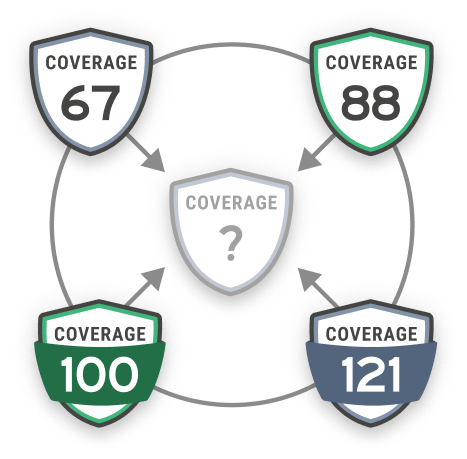
A higher score isn’t necessarily better.
For example, a Coverage Number of 121 may indicate that a client has more coverage than the methodology estimates they need. That doesn’t automatically mean they should reduce their protection.
Likewise, a score of 67 doesn’t necessarily mean the client needs to purchase another insurance policy.
The Coverage Number provides a starting point for evaluating each client’s circumstances. Advisors can review the assumptions, consider the client’s financial goals, and determine whether adjustments are appropriate.
How is the Coverage Number calculated?
At a high level, the Coverage Number compares the financial resources a client has available against their calculated coverage needs.
Coverage Number = (Coverage Has ÷ Coverage Need) × 100
Here’s what those terms mean:
- Coverage Need: The estimated financial resources required to address a particular risk, such as lost income or future long-term care expenses.
- Coverage Has: The financial protection already available to address that need, which may include existing insurance benefits or other applicable resources.
For example, suppose a client has an estimated coverage need of $1 million and $750,000 in applicable coverage.
Their Coverage Number would be 75, indicating a potential shortfall worth reviewing.
This simplified example illustrates the relationship between coverage and need. The actual calculations vary by coverage category and account for additional factors.
How Is the Overall Coverage Number Determined?
Insurance Center combines the applicable life insurance, long-term care, and retirement income calculations into one composite Coverage Number.
Rather than simply averaging the three category scores, the composite calculation uses the total coverage available and total calculated need across the applicable categories.
This gives advisors a broader view of financial protection while preserving the ability to examine each category individually.
Not every category will apply to every client. For example, long-term care and retirement income coverage are generally evaluated for clients ages 45 to 70 and 45 or older, respectively, with additional requirements for retirement income calculations.
What Types of Coverage Does the Coverage Number Measure?
Each coverage category uses a methodology designed to evaluate a different financial need.
1. Life Insurance Coverage
Life insurance coverage evaluates the financial impact a client’s premature death could have on the people who depend on them.
Insurance Center uses the established DIME framework, which considers:
- Debt: Outstanding financial obligations.
- Income: Income replacement for surviving dependents.
- Mortgage: Remaining mortgage obligations.
- Education: Future education expenses for dependents.
The calculation also considers additional dependent expenses, existing life insurance benefits, and applicable liquid assets.
For income replacement, Insurance Center evaluates the client’s annual income, an estimated replacement percentage, and the period during which dependents may need financial support.
For example, a client with young children and a substantial mortgage may have different coverage needs than someone approaching retirement with no dependents.
The resulting Life Coverage Number helps advisors determine whether existing resources appear sufficient to support the client’s financial obligations.
2. Long-Term Care Coverage
Long-term care expenses can significantly affect a client’s retirement savings, particularly when care is needed for several years.
Insurance Center estimates potential long-term care needs using state-specific cost information from the CareScout Cost of Care Survey.
The calculation considers factors including:
- Estimated annual long-term care costs in the client’s expected retirement state.
- Potential duration of care based on family history and longevity.
- The client’s preferences for using personal assets to cover expenses.
- Existing long-term care insurance benefits.
By comparing projected expenses against available resources, Insurance Center calculates a Long-Term Care Coverage Number.
This helps advisors evaluate whether a client has sufficient financial resources to address a potential care event and how those expenses could affect their broader retirement plan.
3. Retirement Income Coverage
Retirement Income Coverage evaluates whether a client’s projected financial resources can support retirement spending under stressed market conditions.
One of the biggest challenges retirees face is sequence-of-returns risk. Poor investment returns early in retirement can have a lasting impact on how long their savings will last, particularly when they’re making regular withdrawals.
Insurance Center evaluates retirement income coverage using information from the client’s Retirement Map and selected investment portfolio.
The calculation considers projected annual spending, available retirement income, portfolio withdrawals, and market stress scenarios.
It also accounts for income sources such as Social Security, pensions, and guaranteed annuity income.
The resulting Retirement Income Coverage Number reflects how consistently a client’s retirement spending can be funded throughout retirement under stressed conditions.
Advisors can use this information to evaluate retirement income strategies and illustrate how different sources of income may affect the client’s financial security.
How Can Financial Advisors Use the Coverage Number With Clients?
Consider a client who’s approaching their annual review.
They have a life insurance policy through their employer and feel reasonably confident that their family would be financially protected if something happened to them.
But they’ve recently purchased a larger home, their household expenses have increased, and they haven’t revisited their coverage in several years.
How does their existing protection compare with what their family might actually need?
Start With a Coverage Assessment
With Insurance Center, the advisor can send the client an Insurance Coverage Assessment to collect information about their financial circumstances, existing policies, and protection needs.
The assessment can be completed ahead of the meeting or together with the advisor.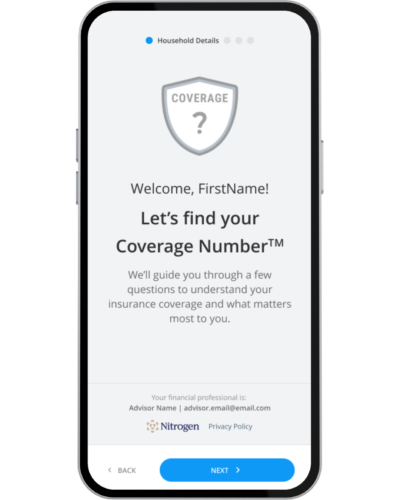
Once completed, Insurance Center calculates the client’s Coverage Number and provides a breakdown of their financial protection.
Suppose the client’s Life Coverage Number comes back at 43.
That gives the advisor a clear starting point for discussing the potential gap.
Rather than relying on complicated policy illustrations, the advisor can show the client where their existing coverage stands relative to their estimated needs.
Explore Potential Coverage Changes
From there, the advisor can review the assumptions behind the calculation and adjust them to reflect the client’s circumstances.
For example, the advisor might consider a different income replacement period, account for additional financial obligations, or evaluate specific family goals.
Insurance Center recalculates the estimated need as those assumptions change.
If additional protection is appropriate, the advisor can create a coverage proposal to illustrate how potential changes could affect the client’s Coverage Number.
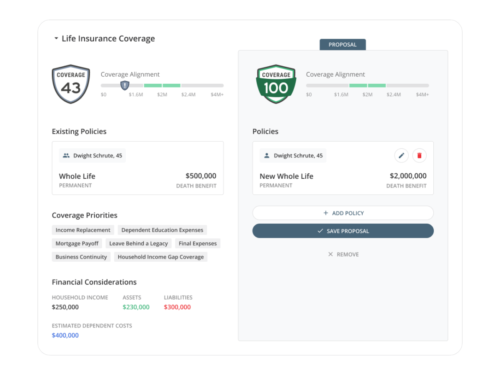
This gives clients a visual way to understand the impact of a recommendation before making a decision.
Evaluate Coverage Across the Household
Insurance needs can also differ significantly between spouses.
One spouse may have substantial life insurance coverage while the other has little or none. Looking only at the household’s combined resources could make it difficult to identify those differences.
Insurance Center allows advisors to assess spouses individually, giving each person their own Coverage Number.
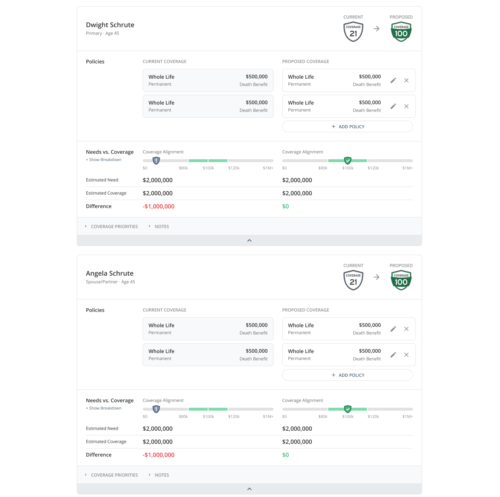
Advisors can then create proposals that address either spouse or both, helping them evaluate protection needs across the household.
Keep Coverage Aligned as Life Changes
Insurance needs rarely stay the same.
A new home, a growing family, a career change, or the transition into retirement can all affect the amount and type of financial protection a client may need.
With Insurance Center, advisors can revisit coverage assumptions, update existing policies, and track how a client’s Coverage Number changes over time.
When a client acts on a recommendation, advisors can also record the implemented coverage, helping keep the client’s current protection information up to date.
This creates opportunities to revisit insurance needs during regular client meetings and demonstrate how financial protection fits into the broader financial plan.
Make Insurance Conversations Clearer With the Coverage Number
Insurance can be one of the more complicated parts of a client’s financial picture. But understanding whether they’re adequately protected shouldn’t require them to interpret multiple policies and calculations on their own.
The Coverage Number gives advisors a consistent, visual way to evaluate financial protection, identify potential gaps, and explain how proposed changes could affect a client’s coverage.
With Insurance Center, advisors can bring life insurance, long-term care, and retirement income coverage into the same conversation, helping clients make more informed decisions about their financial future.
Ready to see how it works?
Book a demo to explore Insurance Center and see how the Coverage Number can support more effective insurance conversations with your clients.
Frequently asked questions about the Coverage Number
Is a higher Coverage Number always better?
Not necessarily. A Coverage Number above 120 indicates that available resources exceed calculated coverage needs. While additional protection may be appropriate, a higher score can also prompt a conversation about whether existing coverage still fits the client’s circumstances.
Advisors should evaluate the client’s broader financial situation before recommending changes.
How is the Coverage Number different from the Risk Number?
Nitrogen’s Risk Number® measures an investor’s risk tolerance or the risk associated with a portfolio on a scale of 1 to 99.
The Coverage Number measures how available financial protection compares with calculated coverage needs on a scale of 0 to 200.
Both give advisors a quantitative starting point for helping clients understand important financial decisions.
Can a client’s Coverage Number change over time?
Yes. Changes in income, financial obligations, existing insurance policies, and available assets can affect a client’s Coverage Number.
Advisors can revisit the calculation as circumstances change and use updated results to guide future coverage conversations.
Does a Low Coverage Number Mean a Client Needs More Insurance?
Not necessarily. A low Coverage Number suggests that available resources may fall short of calculated needs, but it doesn’t automatically mean purchasing additional insurance is the right solution.
Advisors should review the underlying assumptions, available resources, and the client’s financial circumstances before determining the appropriate next steps.