Nitrogen 101: What is Prospect Theory?

Want to know what makes Nitrogen tick? Today, we’ll discuss the behavioral finance framework that started it all—Prospect Theory.

Prospect Theory is an academic framework that won the Nobel Prize in Economics in 2002. It incorporates psychology into economic models and examines aversion to risk through a behavioral lens. Decades of academic research is empowering better decision-making today.

Historically, academic studies had taken a prescriptive approach, focusing on how decisions under uncertainty should be made. Prospect Theory instead took a descriptive approach, focusing on how people actually make decisions under uncertainty.

What made Prospect Theory different is that it discovered people treat gains differently than losses in two respects. First, individuals make choices to minimize losses, more than they gamble for possible gains. In one experiment, 80% of respondents preferred A) a certain gain of $3000 to B) an 80% chance of $4000 and 20% chance of gaining nothing. However, faced with the same two negative prospects, 92% of respondents preferred to gamble on an 80% chance of losing $4000 and 20% of losing nothing to a certain loss of $3000. In both cases, respondents chose the option with the lower expected value to avoid losses.

Nitrogen took this scientific framework out of academia and expanded it into a practical and effective tool for measuring true risk preference. Our Risk Number? technology takes into account two important factors: A) an investor’s actual financial position, and B) what constitutes a “devastating” loss or an “acceptable” gain to them. When individuals make choices based on their actual financial position, it presents real consequences for the decision maker. This is one of the ways our risk assessment has utilized and improved the theory most effectively: it’s not just a dollar amount, it’s an amount that is both specific and meaningful to the investor.

Warren Buffett investing $100,000 of his fortune on a new tech stock would be modest, considering it’s just a small portion of his overall wealth. However, a family investing their entire net worth of $100,000 in that same security is willing to risk a lot more. A $100,000 loss for someone like Warren Buffet would hardly be considered “devastating,” and that’s where risk preference plays a vital role in keeping individuals invested for the long term.

Portfolio recommendations require quantitative measurements and as many questions as are practical in order to gauge inconsistencies. Other risk questionnaires have used hypotheticals based on percentages, subjective questions such as, “What kind of car would you drive?” and other strategies that have no actual relevance to investors. At Nitrogen, we took award-winning behavioral finance principles and made them practical, giving advisors the tools, and the science, to empower fearless investing for the long term.

How Often Should You Reassess Risk?

By Mike McDaniel, Co-Founder and Chief Investment Officer


An investor’s risk tolerance is unique. With the Risk Number?, an advisor can quantify their client’s risk preferences and tailor a portfolio to match. Having just the right amount of risk means that clients are set up for long-term success, but can an investor’s Risk Number change? How often should an investor’s Risk Number get an overhaul, if at all? We wanted to share some best practices we’ve learned over the past few years of monitoring investor Risk Numbers so you know the possible signs of a risk intervention.

Major Life Events

A reassessment of an individual’s Risk Number may need to occur after a potentially impactful life event, such as divorce, death, job loss, inheritance, marriage, etc. These events may have a lasting impact on a client’s financial position, and the position of their beneficiaries, for many years to follow.

The Risk Number is generated by a number of factors, one of which is the investor’s actual financial standing. Major life events that affect an investor’s net worth, either up or down, have the potential to create a risk shift.

Example

Edward passes away unexpectedly and leaves the entirety of his estate to his brother, Harry. This one event (a death in the family) has a series of consequences: Harry’s doubled net-worth, the effect of these assets on his retirement projections, and the increased size of his estate in the event that something should happen to him, as well. Will he become more risk-seeking or more risk-averse? Harry could use this as an opportunity to decrease his risk exposure, choose to ramp up his risk exposure, or it could have no material impact on Harry’s Risk Number whatsoever. Harry could think, “I’ve got enough assets to surely see me through retirement, there’s no need to change course.” Or Harry could think, “This is a windfall I wasn’t expecting, and I could risk it all with no extreme negative impact on my retirement.”

Best Practice

Re-administer an exercise or initiate a discussion when a material financial event occurs in an investor’s life. Be sensitive to their experience and quantify their updated perspective when they’re ready.

Nearing Retirement

As the retirement horizon approaches, priorities may begin to shift. Planning for retirement is a very different animal than living it, and a reevaluation could ensure that targets are still on track.

A person’s Risk Number may not be affected by impending retirement, but their risk capacity (the amount of risk they’ll need to take to reach their goals) could require attention. A client may need to take advantage of IRS “catch-up” rules so they can make greater contributions to retirement accounts, and emotionally, it’s difficult for some clients to shift from “amassing” wealth to “spending” it.

Example

Thomas and Nancy Smith plan to retire at 60. They originally planned to downsize their home, but the home’s sentimental value is giving them second thoughts about selling. Without the proceeds from the home, is their target retirement date in jeopardy?

Best Practice

A check-in with a client near retirement is a way to make sure that their goals are still attainable at their current risk level. In the example of Thomas and Nancy Smith, an advisor can reassess their risk capacity and see if taking advantage of the IRS rules, maxing out their account contributions, or delaying retirement are valid options.

Stable vs. Unstable

Investors are either stable (rational) or unstable (emotional). Stable investors will likely have stable Risk Numbers over the course of years, whereas the Risk Number for more emotional clients may swing a bit over time, depending on several factors. Advisors need to be attuned to the psychology of their clients and be flexible enough to change course.

Example

John owns his own small business and has children in college. Recent market events have him very worried and he’s reaching out to his advisor frequently for reassurance. John’s business is experiencing an especially slow off-season, and he’s concerned about tuition costs rising, but he hasn’t experienced any significant changes in his wealth. When his business is doing well, John doesn’t call or respond as often to check-ins from his advisor.

Best Practice

Advisors use Check-ins inside of Nitrogen to identify which clients fall into the stable or unstable category. Typically, a stable investor will have consistent answers through time as collected using Check-ins or regularly administered risk assessment processes. Sporadic responses to Check-ins over time could indicate a more emotional client. That’s helpful intelligence for an advisor. Advisors would do well to confirm Risk Numbers with their emotional clients regularly (semi-annually), whereas the more stable clients may not need a reassessment but annually, or only after a major life event.

Our process is amount-driven.

Risk isn’t based on stereotypes or market sentiment. It’s rooted in an investor’s psychology, aversions, and financial position. In situations where a major life event occurs, it can impact all three.

Nitrogen’s use of meaningful dollar amounts specific to each investor expanded behavioral finance principles. Our inclusion of actual dollar amounts (rather than projections, percentages, or estimates) is an important one. Because these dollar amounts are foundational to the calculation of an investor’s Risk Number, it suggests that we can update their risk preference as life unfolds.

Do people change?

Over the past 12 years and through significant financial challenges, wild market events, and life changes, my personal Risk Number has remained unchanged (I’m a Risk Number 34). Generally speaking, we’ve not seen Risk Numbers gyrate due to market environments or “news.” That said, advisors may want to reassess Risk Numbers (especially of emotional clients) when a meaningful change in market or news conditions arise. And, I should note that the Risk Number helps confirm or combat an advisor’s assumptions concerning how they might expect a client’s Risk Number to change given the life events.

Articles you might like:

Tips for Advising Retirees: A Q&A with Bull Moose Retirement

Advising Young Investors

And the Average Risk Number is…

Why Client-Facing Technology Tells A Better Story

The world of investing is complicated. Your value as an advisor comes from taking an investor’s history, goals, risk tolerance, and ambitions, and creating an investment strategy that aligns with all of it. The ability to juggle these needs, while staying in compliance and managing the backend process, is a brilliant piece of storytelling—but are you telling that story as well as you should?

Experts agree that we’re in the midst of a Consumer Revolution. Most major tech advancements are centered around improving the user experience (UX), and fintech is no different. Self-directed robo advisors were forced to create client interfaces that were intuitive and well-designed to make up for the lack of human interaction. Without a storyteller, robos had to evolve. Over the past three years, we’ve seen an infusion of capital, robo advisors changing the way consumers expect information, and the widespread adoption of a fiduciary mindset—all three elements of the Consumer Revolution are like a perfect storm.

Today, clients expect their advisors to have all the great tools the robos have AND the winning personality to sell it. It’s not enough to say “trust me”—and we think that presents a GREAT opportunity for advisors. In the age of best interests, we need to prove our value conclusively and easily. The good news? If you invest in the right tools, proving your value is as easy as turning your screen around, pulling up an app, or logging in. The ability to relate visually is one of the most significant advances in fintech of the past ten years.

Great fintech is intuitive, and that’s where client-facing technology shines. Advisors have a wealth of knowledge, experience, and tools that make a portfolio strategy possible. Having intuitive technology that responds to the advisor’s input and communicates it visually to their client makes the investment process a partnership. Not all investors are market gurus, nor are all investors blissfully unaware of the basic tenets of financial planning. It can be a struggle for advisors to demonstrate their know-how without alienating their clients. It’s not a lack of information that’s the problem; it’s that investors are overwhelmed with information. Relating visually bridges the communication gap that has plagued the industry for decades.

We’ve been twice-voted “Best Client-Facing Technology” and know that seeing is believing. If you’re interested in any piece of software for your advisory firm, always insist on getting a personal demo. Once you see how seamless a great piece of client-facing tech can be, you’ll realize you’ve been working way too hard.

Not yet using Nitrogen? We’d love to schedule you a demo so you can see how Nitrogen revolutionizes your advice and brings a visual dimension to your client meetings.

Want more meeting tips? Check out these related articles:

What Justifies the Cost of an Advisor?
Five Reasons Clients Fire Their Advisor
Advisor Time-Saving Techniques

Risk Number Integrated into the Asset-Map Platform

Our friends at Asset-Map made an exciting announcement today about infusing Risk Numbers into investors’ Asset-Maps! Read their full release below:


Nitrogen Risk Number Integrated into the Asset-Map Platform to Deliver a Singular Visual Client and Risk Profile Experience

The integration of Nitrogen with Asset-Map Platform creates an unparalleled client and risk profiling solution for financial professionals to facilitate meaningful financial conversations by including Risk Numbers embedded on a household Asset-Map.
PHILADELPHIA, PA (PRWEB) NOVEMBER 02, 2016 – Asset-Map and Nitrogen announce the launch of the integration of the Risk Number® into the Asset-Map Platform.

Nitrogen invented the Risk Number, a quantitative way for financial professionals to pinpoint how much risk investors want, how much risk they have in their portfolio, and how much risk they’ll need in order to reach their goals.

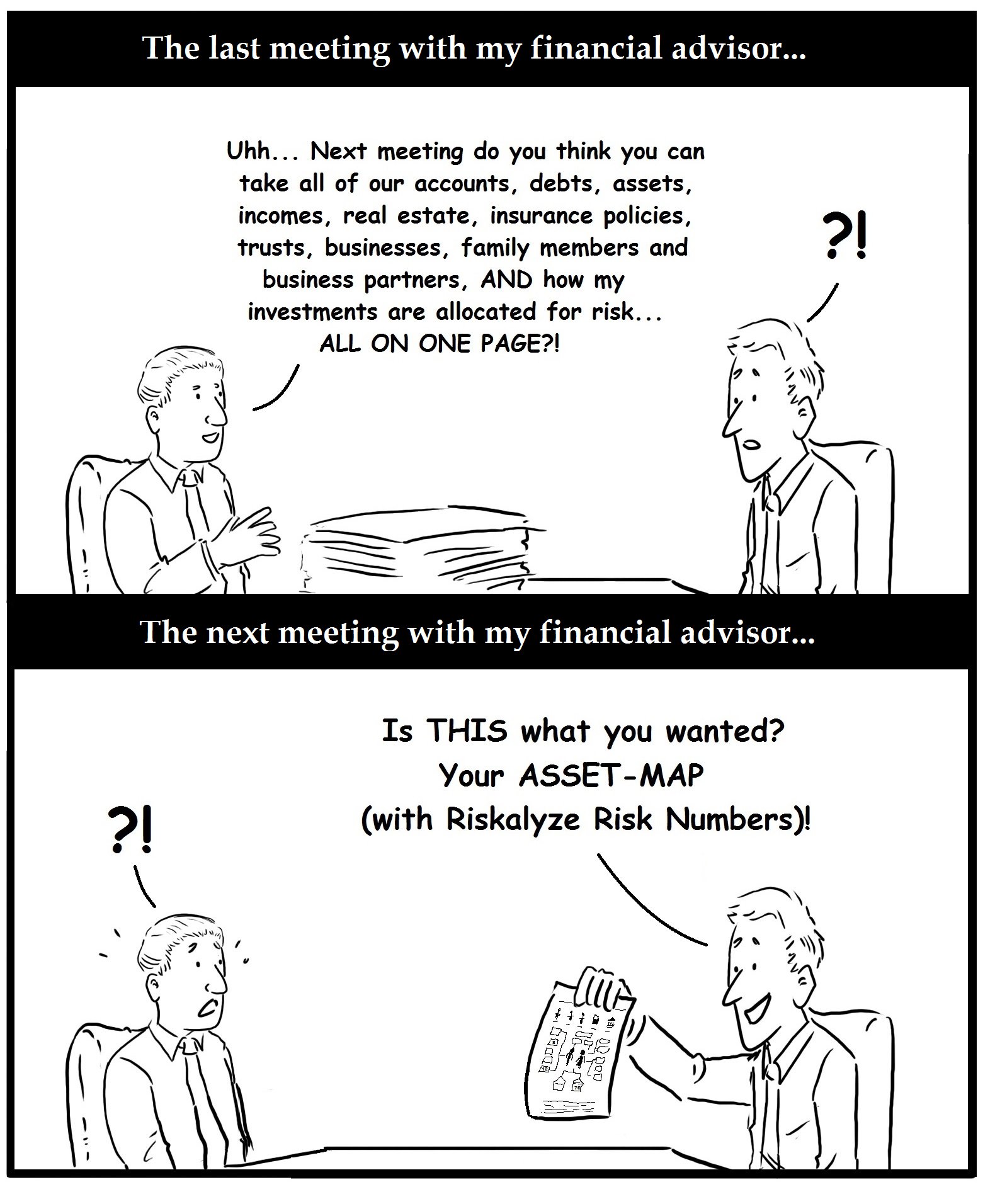
Mountain ViewAsset-Map, LLC provides the Asset-Map® Platform, the only household visualization platform that collects an entire client profile on one page to help financial professionals communicate their financial facts and conditions. The integration of Nitrogen with Asset-Map Platform creates an unparalleled client and risk profiling solution for financial professionals to facilitate meaningful financial conversations by including Risk Numbers embedded on a household Asset-Map.

The Asset-Map Platform has evolved into a practice management and collaboration platform that financial professionals choose to use alongside traditional financial planning tools because it focuses on the critical discovery process — seeking opportunities to serve clients’ best interests.

By continuously promoting the asking of good questions in the common meeting formats today (face-to-face paper reports, digital/mobile presentations and remote screen display), the platform enables collaboration among generalist and specialist practitioners in order to uncover financial structural gaps and address clients’ current financial inventories relative to the people and entities that matter most to the household.

Asset-Map is a repeatable point-of-sale and customer review experience that doesn’t feel like a typical advisor sales process. By integrating with the Risk Number, Asset-Map expands its unique customer experience that promotes confidence in current condition and risk assessment with clarity of action while promoting an elevated standard of care that clients appreciate.

This integration will also set a new standard of best interest advice and customer experience between advisors and their clients and prospects. The combination of Nitrogen and Asset-Map delivers an unmatched front-end solution to address the upcoming DOL Fiduciary Rule.

“We’re thrilled to integrate with Asset-Map,” said Aaron Klein, CEO at Nitrogen. “Giving advisors the ability to embed the Risk Number directly into an investor’s Asset-Map will give them tremendous visibility and the confidence that they’re quantifying the best interest standard.”

“The Nitrogen – Asset-Map integration creates an unparalleled conversation piece that promotes a non-threatening dialogue between clients and advisors,” says Adam Holt, CEO at Asset-Map. “It will enable financial professionals to gain new transparency and perspective in order to provide better education and guidance to their clients. This integration completes the ‘know your client’ challenge and finally gets everyone on the same page – literally. We are very excited about this opportunity to talk to the customer at their level.”

When considering potential DOL solutions, financial advisors should be confident that their process is logical and serves the clients’ interests. Having the Risk Number presented on an Asset-Map helps quantify the best interest standard, elevate the financial professional, scale across demographics, and facilitate an engaging client experience.


About Nitrogen
Nitrogen is the company that invented the Risk Number®, which powers the world’s first Risk Alignment Platform, empowers advisors to execute the digital advice business model with Autopilot, and enables compliance teams to spot issues, develop real-time visibility and navigate changing fiduciary rules with Compliance Cloud. Advisors, broker-dealers, RIAs, asset managers, custodians and clearing firms today use Nitrogen to align the world’s investments with each investor’s Risk Number. To learn more, visit https://nitrogenwealth.com.

About Asset-Map, LLC
Founded by successful financial advisors, Asset-Map® delivers practice management solutions transforming the advisor-client relationship by visually facilitating meaningful financial conversations. The Asset-Map Platform is a cloud-based and professionally branded SaaS, enhancing an advisor’s customer experience through the most common meeting formats today: using paper, computers, tablets or through remote online meetings. Advisors choose to use Asset-Map because it provides the next-generation of a continuous discovery process for opportunities to suitably serve their clients. Financial Professionals, broker-dealers, RIAs, insurance agents and agencies have mapped over $340 billion in financial instruments on the Asset-Map Platform. To learn more, visit https://www.asset-map.com.


Media Contacts:

Michael Neil
Chief Marketing Officer, Asset-Map
215-460-4523
Email

Jason Lahita
FiComm Partners (for Riskalyze)
310-593-4222
jason.lahita@ficommpartners.com

Introducing: Scenarios

We’re completely upgrading the way we approach stress testing.


Scenarios is our brand new feature that takes our current stress testing methods to the next level. And a customer preview is available to all Nitrogen users today.


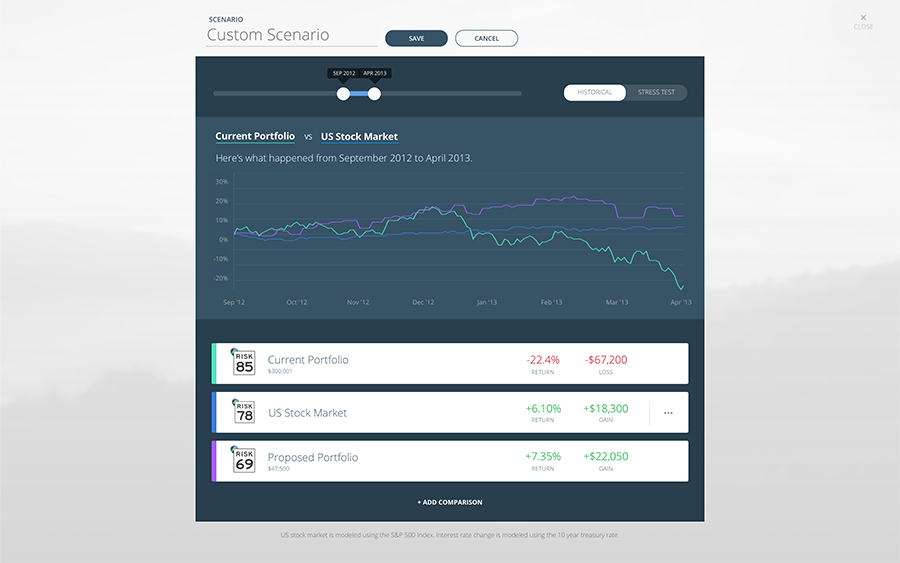
With Scenarios, you can run any of your client’s portfolios through a market timeline, and compare them to just the right benchmark to make your point. You’ve always been able to demonstrate in Nitrogen how a client’s portfolio would have performed during specific market events, but now you can string these events together to create a portfolio narrative that settles the question once and for all… “Why is the market beating my portfolio?”

Scenarios empowers you to set far better client expectations. For example, seeing how a portfolio would have performed in the 2013 Bull Market is a great stress test, but it doesn’t tell the whole story. With Scenarios, you can now show the two bear markets a portfolio had to go through before reaching the gains of 2013, and display those findings to clients beautifully in Nitrogen.


Scenarios Screenshot


You can create scenarios historically using a date range or create custom scenarios with clients in mind. Have a client looking to invest heavily in energy stocks? Create a custom scenario showing the last time energy stocks fell to demonstrate the risks associated with having a concentrated position. Is your client looking to add Apple stocks to capitalize on the iPhone X announcement? Create a scenario that demonstrates Apple’s historical performance and what your client stands to gain (or lose) using real data.

Scenarios allows you to save a variety of different contexts you’d like to highlight for your clients and compare them to your suggestions, Risk Number models, and custom market events.

What scenarios would you like to have at your fingertips to empower your clients to invest fearlessly? With Scenarios, we’ve made the solution easier than ever before.

We think you’re going to love it.


Have questions about how you can best utilize Scenarios? Check out our knowledge base article or reach out to the industry’s best support team at support@nitrogenwealth.com.


Note: Customer preview includes an upgrade to our Stress Test feature and a new Historical Performance scenario. Adding multiple portfolio comparisons and creating Custom Scenarios will be released in all accounts later this month.

The Social Advisor Guide

At Nitrogen, we’re always on the lookout to make advisors’ lives easier and better, so we’ve done some digging to create a handy social media infographic for advisors. How important is social media to your practice? It turns out, it’s really important.

25% of ultra-high-net-worth investors are regular LinkedIn users, and 85% of financial advisors use social media for their marketing efforts. And advisors that utilize social media grow their AUM by an average of 9.3 million.

Here are the top tactics to gain AUM on LinkedIn:

  • Publish long form content
  • Post to groups/pages
  • Use advanced search to prospect
  • Request recommendations
  • Write recommendations

Here are the top tactics to gain AUM on Facebook:

  • Use paid promotion to boost content views
  • Set up a business or company page
  • Request Friend connections
  • Create sponsored ads
  • Post business content

There are also certain rules that should be followed when using social media for your business including:

  • Maintaining Records (SEC Rule 17a-4(b)): Even distributed internally, all social media posts need to be preserved for a period no less than 3 years.
  • Suitability Rules (NASD Rule 2310): Make sure any recommendations on social media are relevant to the whole audience.
  • Supervision (NASD Rule 3010): Each firm is required to establish and maintain a system to supervise the social media activities of each person associated with the firm.
  • Don’t Forget About FINRA (Rule 2210) Spot checks will be performed on a more regular basis and findings from these spot checks will further define regulations on social media.

And, it doesn’t stop there. We also have strategies for you to help generate leads through social media and increase AUM.

LinkedIn:

  • Use Sales Navigator
  • Use Publishing
  • Use Slideshare

Facebook:

  • Treat your Facebook page like a website
  • Use Facebook ads

Twitter:

  • Create Events
  • Take Advantage of Twitter Cards
  • Host Contests
  • Sponsor Promoted Tweets

For more details on these strategies, follow the link below to view and download the complete guide for yourself.

Tips for Advising Retirees: A Q&A with Bull Moose Retirement

Americans are confused about retirement. If you thought challenges were limited to young investors not knowing where to start, guess again, because retirees in the thick of it are struggling too. Three out of four respondents in a New York Life study with at least $100,000 in assets had no idea how much money they could take out of savings. A separate study in the Journal of Financial Planning found that the wealthiest fifth of U.S. retirees – a group you’d think would have no problems navigating retirement – were spending 53% less than they could have.

Even retirees who have more than enough aren’t confident on what they can spend! And if the population most prepared for retirement isn’t able to figure it out, what is retirement looking like for everybody else?

It turns out that retirees and their children have a lot in common: pessimism about the economy and fear of the unknown. Not spending money in retirement, and hoarding savings due to market mistrust leads to overall bad market health (and less returns for everybody else). At Nitrogen, we want to empower advisors so that you can empower fearless investing. With so many issues to juggle, we decided to host a Q&A with a retirement specialist and knew just who to call!

bull moose

Ryan Clair is part of the father-son dynamic duo behind Bull Moose Retirement Planning Co., a firm specializing in financial strategies for those in, or near, retirement. As experts in this arena, Bull Moose advises retirees with a laser focus on confronting retirement concerns head-on. We talked to Ryan about risk, how to help clients better understand themselves, and what advisors can do now to help the retirees of tomorrow.


If retirement isn’t just a “set it and forget it” strategy, what is your recommended approach to asset accumulation and what should investors be doing for themselves?

The one thing investors forget when planning for retirement is to periodically adjust their approach based on their age and what phase of life they are in. We call it [our] Retirement Focused Approach. As folks grow older and closer to retirement time, their priorities typically should begin shifting from all-out growth to finding ways to better protect what they’ve accumulated thus far – or at least finding out what they would be comfortable risking in the event of a major stock market downturn.

A stock market downturn is a worst-case scenario, but we’ve noticed that the definition of what would constitute a “devastating loss” varies from person to person. How can advisors help retirees to better understand what their risk tolerance is?

The Risk Number? is a very effective tool in helping our clients better understand themselves. Our retirement age clients understand that they have less time to make up for a major loss in their account values, so they see a real value in being able to compare their Risk Number with the Risk Number of their current portfolio. When comparing the two numbers for the first time, many are shocked at how big of a discrepancy there is between the two.

What are the differences between advising the retirees of today versus the retirees of tomorrow?

Our advice to young investors is to begin regularly contributing to a retirement account as soon as possible – even if that means starting a forced savings plan that comes out of your bank account every month. In the past, you could rely on having a pension and working for one company for a long time. Today, things are different, and their retirement may require much more self-reliance and discipline. If your employer matches contributions to a 401(k), take advantage of it.

You’re right, private-sector pensions aren’t as common as they were a generation ago. At one point, 88% of workers could rely on them, and that number is only 33% today. If a client doesn’t have a pension, or an employer 401(k), and is starting their retirement plan later in life, what’s the first thing they should do?

It’s never too late to start, but they need to take action. Meet with a retirement planning-focused advisor right away. A meeting like this can be productive in assessing their situation and what immediate steps they should take. Their risk level may need to be adjusted, they may need to drastically increase how much they are saving, and they should be aware that they may be able to take advantage of the “catch-up” rules that allow for greater contributions to retirement accounts at a later age.


Fear of the unknown doesn’t magically disappear when you cross a different stage of life – it effects investors of all ages. Advisors skilled in the unique challenges of retirement are going to be an investor’s best asset in the new best interest economy.

Special thanks to Ryan Clair at Bull Moose Retirement Planning Co. for his expertise. His firm serves clients in or near retirement in the Toledo, Ohio area. Bull Moose was recently featured in our Best Advisor Websites blog post. Feel free to say hi!

Advising Young Investors

We’re about to witness the greatest transfer of wealth in history. Over the next 30 years, baby boomers will pass $30 trillion in assets to their Generation X and millennial children, and most of these young investors plan on firing their parents’ advisor.Anyone born between 1980 to 1997 falls into this category, and their experience plays a significant part in how they invest. What sort of financial crises have they seen in their lifetimes? A lot.


• The Dot Com bust
• The 9/11 Attacks
• The Financial Crisis of 2008


With all this volatility, it’s no wonder young investors manage their portfolios with fear and urgency, if they decide to invest in the first place. After all, losing 40% of your investments every 4-7 years (or watching your parents lose theirs) can wreak havoc on your ability to make rational financial decisions.

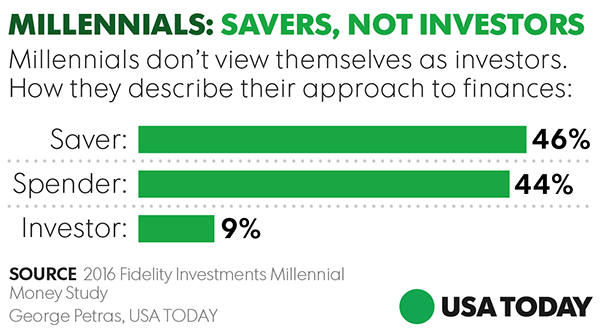
Instead of investing, millennials are saving their money to avoid taking a hard loss in the market, and a recent study by Fidelity backs up these claims.


A graph using data from the 2016 Fidelity Investments Millennial Money Study shows that Millenials describe themselves as savers, not investors.


How can advisors overcome these unique challenges – and why should they?

Here are three approaches to gain the trust of young investors:


1. Quit stereotyping young investors.

The days of stereotyping young investors into the aggressive, high-risk category are over. Sure, young investors have a head start where they can make back market losses – but is that how much risk they want to take on? Is that how much risk they need to reach their goals? The answer is maybe. A team of academics assessed Nitrogen’s research and methodology and found that 52% of 20-29-year-olds don’t fit their “aggressive” stereotype. That means if we blindly invest them aggressively, we’d be doing so outside the client’s risk tolerance more than half the time.

Investors are individuals with unique goals. How far can this investor’s portfolio fall within a fixed period of time before they’ll capitulate and make an emotionally-charged, poor decision when it comes to their investments? If you don’t know what they’re willing to risk in the short-term, how will you convince them to stay at the first sign of trouble? Let’s start treating this generation as the individuals they are.


2. Set expectations and reinforce them continually.

Advisors wear plenty of hats, but you’re likely familiar with the role of “client ledge-talker” when it comes to times of market volatility, especially with inexperienced investors. In down markets, risk-averse clients are panicking about losses, and when markets are booming, others are asking, “why is the market beating my portfolio?” It’s enough to drive great advisors insane.

Focusing on long-term goals may be the best ultimate practice, but millennials aren’t going to simply ignore every investing statement they receive until they retire. We’ve found that emotional reactions to risk are the number one killers of long-term financial plans, and that’s why advisors love using Nitrogen’s six-month, 95% probability range to powerfully set and meet expectations. It’s important to remember that long-term investors are made one short-term decision at a time.


3. Speak their language.

These days, many millennials judge a business’ credibility on their consumer-facing tech. Whether that sounds scary, or like a great opportunity, sharpening the investor-facing technology experience is a no-brainer investment when it comes to winning younger investors.

Client-facing technology isn’t optional when it comes to working with young clients. Research shows that young investors expect their human advisor to have all the tools that the robos have. Hearing their advisor say “trust me” just won’t cut it. Why tell them when you can show them?

Back-office technology frees you up to maximize your time coaching clients and accomplishing all of the above. Make sure you’ve got the right tools in your arsenal to automate manual processes and focus on what you do best.

With fintech that’s well-designed and easy to understand, you can show prospects they’re invested wrong, and prove to clients they’re invested right. Speak the language of young investors, and keep them around for the long haul.


New investors are especially susceptible to the emotional pitfalls of the investing, which makes their behavioral coach (you) their most important resource. With the right advice, experience, and tools – a young investor can be a fearless one!


DOWNLOAD PDF VERSION


IMOs Emerge as Technology Leaders in the Wealth Management Space

The financial technology market has shifted substantially in the past six months. While RIA’s and TAMP’s remain the leaders in innovating with new technology, IMO’s are now entering the fintech space, and doing so in a big way.


Some IMO’s have evolved drastically recently, coming all the way from pen-and-paper solutions to innovative, best-in-class technology for their agents and advisors.

These organizations are looking far beyond the unsettled fate of the DOL rule. They’re trying to cement their spot as a top IMO in the industry.

Some have predicted that the IMO space could begin shrinking due to regulations, but the leaders in the space are taking that challenge and turning it into an opportunity by upgrading their technology suite. At Nitrogen, we’ve been successful with IMO’s because we recognize what they’re doing, listen to their needs and help them build a world-class system. IMO’s are taking risks and innovating like never before in fintech. I think we’ll see the 20 firms that have applied to become financial institutions become the real leaders in the space going forward.


We asked Nathan Hightower, President of Amerilife, about IMO strategies in light of the trends we see in the regulatory landscape. Here’s what he said:

“If a firm is willing to sit back and wait, they are taking a huge gamble. Secondly, their fallback plan would have to be to roll under another IMO who is out there making the decision. It’s not the best tactic to take. There is nothing wrong if you’re an IMO and you don’t have the infrastructure. You just have to understand what your business strategy is. If it is to associate with a financial institution, that could cost you even more money.”


Stephen Odom, President of Impact Partners talks about the importance of picking the right partner:

“It is extremely important to be prepared and especially committed, but there is a balance with so much left be clarified. Measure twice but cut once is wise whenever possible.”


Brad Johnson, VP of Advisors Excel adds,

“IMO’s need a systematized process that takes advantage of today’s technology to:

  1. Automate taking a real world retiree’s needs and inputting them (i.e. Taking data from client fact finder) into a best-of-class annuity software defined by client needs.
  2. Crunch the numbers, analyzing the current product options based on current rates, riders, ratings, etc.
  3. Deliver the top grouping of product options for that advisor to present to that retiree as options.
  4. Document all of this and store electronically.”

We believe the best days are ahead for IMO’s. We’ve been impressed at their recent trajectory toward becoming fintech leaders, and at Nitrogen, we’re here to help. Curious how IMO’s leverage the Risk Number® to drive next-level client-agent alignment? Follow the link below.


Written by Alex at Nitrogen


Taking our Black Diamond Integration to the Next Level

We’re thrilled to announce an even more powerful Black Diamond integration we’ve released in partnership with our friends at SS&C Advent. Read their full announcement below or explore new possibilities on their Nitrogen Integration Page!


The Power of Black Diamond and Nitrogen Unveiled

Over the weekend, our developers released a new native integration (Version 2.0) between Nitrogen and Black Diamond. We’ve been working with Nitrogen since last fall when we announced our partnership and an initial data-sharing integration. Since then, we set out to create a better experience for financial advisors leveraging the power of both tools to offer advisors a more comprehensive and unified solution.

We believe the path to a better unified solution is not limited to only improving the technology integration and so as part of the partnership advisors using Black Diamond can purchase Nitrogen as an add-on to Black Diamond and receive first-level support through their Black Diamond team, which can simplify and improve the challenge of dealing with multiple vendors.


The partnership between Nitrogen and Black Diamond allows advisors to:

  • Consolidate their technology into one centralized, integrated solution

  • Enhance client dialogue by incorporating Nitrogen content into reports and presentations

  • Monitor risk within client portfolios on a daily basis as part of the overall client dashboard Propose new portfolios to clients based on risk alignment goals

  • Streamline service/support by having a single point-of-contact for both platforms


The enhanced integration (Version 2.0) gives advisors Nitrogen’s powerful risk alignment tools right inside of Black Diamond so that they can seamlessly incorporate risk into their clients’ complete wealth picture. Nitrogen content now appears directly in the Black Diamond Wealth Platform including:

  • Client and portfolio Risk Numbers

  • Proposed portfolios based on risk alignment

  • Probability charts

  • Risk/Reward heatmaps

  • Contextual Single Sign-On to Nitrogen


This integration is just part of the bigger picture for Black Diamond as SS&C Advent continues to invest in delivering advisors a complete wealth platform with financial planning, risk assessment, outside aggregation, CRM, and access to managed accounts.

If you’re interested in adding Nitrogen to your technology stack, please contact your Black Diamond representative or learn more here.

Schedule a Demo: