Financial Advisor Websites: 9 Steps to Compelling, Value-Driven Messaging

What is your website saying to your clients and prospects?

As your firm’s digital “home,” your website is a key piece of your firm’s marketing – more than two-thirds of consumers will look for a company’s website before visiting in-person. 

The key to a great financial advisor website lies in your messaging. Specifically, it’s important that your site reflects your value proposition, both visually and through copy, to engage visitors.

In this guide, we’re exploring how you can attract and retain prospects via well-positioned website messaging based on your value prop – in just nine steps.

What’s Your Value Prop? 9 Steps to Compelling, Value-driven Messaging for Financial Advisor Websites

1. Understand your audience

The first step in honing the messaging for the best RIA websites is to think through who you want to attract to your firm. For many, this involves mapping out ideal client personas. 

Client personas are fictionalized versions of the individual(s) you would most like to work with and why. From there, you can focus in on the problems that would drive your persona(s) to need your services in the first place, how you can solve those problems and what marketing tactics would work best.

Rather than using marketing that casts a wide net and speaks to no one in particular, personas allow you to talk directly to the individuals that would be a best-fit for your firm. 

And you can never go too in-depth with these imaginary clients – great client persona will include everything from demographics to lifestyle choices, and some businesses even give their personas names!

Actionable Step: Develop one to three ideal client personas

To begin, sit down and brainstorm three core questions:

  1. What do your favorite clients look like? Think about the clients you’re most excited to serve – it’s okay to have more than one, but it can’t be “everyone!” 
  2. Why do those clients need your firm? Write down the obstacles those people most often encounter in financial planning. 
  3. How can your firm reach those clients with the right services at the right moment? Consider how would each of your personas begin their search for a solution – what are they Googling? Who are they reaching out to?

Knowing the answers to these questions will help you find messaging that resonates and attracts the right kind of prospects. 

2. Find your differentiator

There are an estimated 330,000 financial advisors in the United States as of 2021 – that’s a lot of competition. 

Luckily, no two advisors are exactly alike! Finding what sets you apart from the masses can help you develop messaging for a wealth management website that keeps prospects engaged and interested. That differentiating factor could be a part of your approach to investment management, communication style, the types of clients you work with or something else entirely. 

Perhaps your background in the medical industry has given you specific insights into the lives of doctors and nurses, or your taste for adventure makes you the go-to for retirees who love to travel. 

A great example of this is Colton Etherton, also known at the Tattoo Artist Advisor, whose passion for the arts has led to a career primarily focused on solving financial problems for tattooists.

Actionable Step: Find your strengths

Start by listing out all your planning services, resources, tech tools and philosophies. Do you provide estate planning services or aid in tax preparation?

Then, make a list about yourself: your educational background, favorite places, hobbies, and more – while it may not seem obvious at first, your true differentiator could be where these two lists overlap. 

As you make your lists, circle anything that you think might be an extra value-add to your clients, a special skill or extra service. Take that brainstorm a step further and think through how those three things could specifically benefit your client personas. 

3. Distill your messaging

After accomplishing the above steps, you likely have a stack of notes, lists and imaginary clients – now what?

It’s time to weed through all that information and pinpoint your messaging. The goal here is to find words or phrases that speak to the heart of your services (i.e., your value proposition), which you can then incorporate into a website for a financial advisor.

Think about it this way: Your prospects don’t want to read a novel just to find out what you do – they want to know immediately what you’re bringing to the table. 

Actionable Step: Write, delete, repeat

Write out your value proposition in 100 words or less. It’s okay if it’s not pretty quite yet – you can always revise. The purpose of this exercise is to narrow down all that information to just the absolute necessary: Which things are you willing to hit “delete” on, and which words are absolutely essential for your prospects to know?

Then, see if you can get all of that down to one sentence or tagline – you may even find header ideas for your website!

4. Revise your homepage

Did you know that it takes just 50 milliseconds for someone to form an opinion of your website?

With less than a second to make an impression, it’s vital to have a homepage that wows without being overwhelming. Research suggests that short and engaging copy is the way to go, with one recent report stating that anywhere from 100 to 1,000 words on a homepage is a good range, but 400 to 600 is optimal. 

You should also pay attention to the size and placement of the text on your homepage. Make use of various sized headers, bolded text and easy-to-read fonts to guide the viewer’s attention down the page.  

Actionable Step: Host a brainstorm session

Gather the core members of your team to look at your homepage together and gather feedback. Are you getting that value proposition right away? Is there too much or not enough content? 

If there’s more than 1,000 words on the homepage, it may be a good idea to think through what could be cut. 

5. Remember your “why” – and add it to your site

Your journey – and your firm’s background – can help create an emotional connection and build trust with site visitors. It humanizes your firm, giving it a face and a narrative that people can relate to while also providing an opportunity to reinforce your value prop. 

Of course, that doesn’t mean you have to tell every detail of your life – content throughout your website should always be crafted with user functionality in mind, so make it scannable and add headers where it makes sense. 

For example, Nitrogen’s “About” tab gives you a brief overview of our mission, with a CTA to learn more about our core values. As you scroll down, you’re invited to learn more about each member of our team, including a brief biography, their favorite Nitrogen value and a fun fact. The content here gives prospects a look at each individual, as well as how and why they’re supporting our core value proposition of empowering others to invest fearlessly. 

Actionable Step: Look at your “About” page

If you haven’t already, create or revisit your “About” page and add some context to your practice: Share your journey, your mission and the passion that fuels your work. Much of this can (and should) align with your value prop. 

Whether it’s a personal experience, a vision for a better financial future, or a commitment to ethical investing, let your “why” shine through.

6. Use visuals that support your message

Humans are visual creatures, so the financial planning website design and photos you use matter just as much as the copy and taglines you’ve chosen. 

Consider what aspect of your services or philosophy you want to emphasize. If your value proposition centers on providing unparalleled customer service, incorporate images that showcase interactions between your team and clients. If technology is a key focus, use visuals that highlight your cutting-edge tools and platforms. Alternatively, if your message revolves around local roots, feature images of your team in the community or iconic landmarks.

With that in mind, there are a number of stock photo websites you can use to browse for photos (such as Pexels and Unsplash). You can also work with a local photographer or even hire a graphic designer to help you customize your website’s look.

Actionable Step: Revamp your visuals

Take stock of your site’s current imagery and make changes as necessary. Feeling a little out of your wheelhouse? Consider reaching out to a website designer for input or inspiration. 

7. Build credibility 

You know your value proposition, and you’ve built the right messaging, but how do you get website visitors to really believe you?

Awards, testimonials and case studies show site visitors that you have a trustworthy reputation and invite them to learn more about your services – it builds “social proof,” or credibility based on feedback from others. Some of the top financial advisor blogs on the web today publish articles aimed directly at filling the credibility gap.

In the financial services industry especially, that credibility and trust are essential, and demonstrating that you have a track record of success and satisfied clients goes a long way in building confidence with potential clients.

As you choose which pieces of social proof to include on your site, keep your overarching goal in mind – which speak directly to your value proposition?

It’s also important to keep compliance in mind considering the recent SEC Marketing Rule updates

Actionable step: Make room on your homepage for those award icons. 

If you get the okay from compliance, it’s a good idea to place some client testimonial quotes on your homepage (especially any that touch on your value prop). You can also consider linking to a page dedicated to case studies for further social proof. 

8. Offer educational content that reinforces your expertise

Don’t just talk the talk – show off your value with educational insights and resources for your prospective clients. 

Grace Bryan, Corporate Marketing Manager here at Nitrogen, puts it into perspective:

“Content marketing encompasses so many different kinds of thought leadership content from digital content, promotional content, white papers, ebooks, podcasts, videos, etc. It really serves to build trust with your audience.”

As you develop your financial advisor content library, consider what questions your clients and prospects ask most often. For instance, if your firm specializes in retirement planning, you could create content that addresses the unique challenges and opportunities retirees face. Provide practical tips, industry insights and actionable strategies to position yourself as a trusted source.

Actionable Step: Create consistent content

Start by developing a content calendar that outlines the topics, formats, and publishing schedule for your team. Align these resources with your areas of expertise and your value proposition to drive impact. 

9. Monitor, measure and make changes as needed

When you make changes to your site, it’s important to measure their effectiveness. 

Aside from gathering feedback from clients, you can also use analytics tools to track how many visitors are on your site, how long they stay on each page, etc. From there, you’ll have a better idea of what messaging is resonating most. 

Google Analytics is one of the most popular tools available, and they even offer free, self-paced resources and classes to help you get started. 

As you dive into analytics, pay particular attention to metrics related to your value proposition. Are visitors spending more time on pages that highlight your unique strengths? Are they engaging with your educational content? Use these insights to make data-driven decisions about refining your messaging and optimizing your website for maximum impact.

Actionable step: Set up Google Analytics 

Set up Google Analytics to monitor and measure the impact of your messaging changes, but keep in mind that it could take several months before you see new marketing tactics really move the needle.  If you’re trying something new, set a reminder to check in on the data in a month or two. 

Bonus tip: Leverage the Nitrogen Advisor Marketing Kit

Nitrogen’s wealth management platform includes the tools you need to craft compelling marketing and messaging for your site. With our Advisor Marketing Kit, you can easily create: 

  • Personalized, client-facing videos
  • Presentation templates 
  • Brochures and press releases
  • Print items with free delivery
  • Online advertising campaign
  • And more

All of these tools are branded and positioned to reinforce your firm’s value and create a more engaging digital experience for prospects and clients. 

Remember, effective communication of your value proposition is not a one-time task but an ongoing process. With these nine steps in mind, you will be well on your way to creating one of the best financial advisor websites on the internet today.

Get Started with Nitrogen

Looking for ways to attract, engage and win over prospects? We can help. Click here to connect with a member of the Nitrogen team today. Read more about how to grow your financial advisory business and enhance your marketing through our complimentary High Growth Playbook

Boost Your Advisory Marketing with Wealth Management Webinars

There are several ways to market your wealth management firm and boost current client engagement, but one of the most effective methods is video. In particular, advisors hosting wealth management webinars may find improved conversions.

This form of marketing has a lot to offer a financial professional. For example, up to 15% of webinar attendees will sign on a client. Even if a prospective client doesn’t book a call immediately, 73% of attendees are likely to be qualified leads. But a webinar doesn’t just help you attract and sign on new clients.

It can also be a stellar retention tool. A webinar offers the chance for clients to learn more about investment planning, discover your thoughts on a recent market update, and further trust your expertise. Furthermore, it gives your clients something to send to friends and family as an unofficial referral.

In this article, we’ll cover the best practices for setting up a webinar and what you can talk about without breaching compliance regulations.

The Basics of Financial Advisory Webinars

Setting up a webinar for investment or financial planning can be fairly straightforward. All you need to get started are:

  • Webinar or video conferencing tools
  • A website or landing page software
  • A phone or webcam

It’s likely that you already have all of these tools. Many advisors are using software like Zoom to handle calls with remote clients and attract new clients with their websites.

Webinars are also easy to integrate into your ongoing marketing efforts.

How Long Should My Webinar Be?

The general census is to tailor your webinar’s length and style to your audience. However, there are some overarching trends and best practices, according to current data, which offer an excellent starting point. One Loghic Connect study found that:

  • The average watch time for webinars is 52 minutes
  • Thursday is the best day to host a webinar
  • 92% of attendees want a Q&A session after the main content

And while 40% of registered attendees will show up, 25% only want to watch the recording. Therefore, it’s important to consider the post-webinar wrap-up.

Following up after a webinar often includes sending out an email with the recording. You may also want to post the recorded webinar on social media and on your website.

Should I Pre-record the Webinar?

In most cases, you’ll want to focus on hosting a live webinar. One survey found that 75% of attendees prefer live webinars. However, you can record the session and post it on your website, social media, or blog after the event.

Types of Wealth Management Webinar Topics

There are several topics you can choose from when it comes to airing a financial advisory webinar. When choosing a topic, it’s important to consider your ideal client. If your client base is primarily retirees, you may want to focus more on maximizing savings or estate planning. Meanwhile, as a young, 30-something professional, you may choose to focus on the fundamentals of investing or market news.

Investing

Investment and portfolio building is often one of the more confusing aspects of wealth management. There are so many different sub-topics to choose from that you can actually pull multiple webinar ideas from this single service.

You could discuss things like:

  • Risk tolerance
  • Investing in different life stages
  • Best practices
  • Portfolio analysis
  • Working with an advisor

Retirement

Another key topic could be retirement. Retirees have a unique set of needs, and many would appreciate discussions and Q&A with an established advisor. These webinars could cover topics such as Social Security, tax optimization, and shifting to a conservative portfolio.

However, it’s important to note that not all retirees are tech-savvy. It may be worth recording a live seminar and posting it to your website or social media channels.

Market News

Covering market news can help you answer relevant, pressing questions for prospective clients quickly. However, keeping up with market analysis webinars can be challenging. It’s often best to put parameters on what you will cover. For example, you may choose only to cover regular, predictable events–such as the release of the CPI. Or you may want to commit to discussing one timely event per month.

Educational 

Educational content is often one of the easiest ways to get found. Potential and current clients are likely scouring the net on their own time to answer simple questions. What is an ETF? A custodian? A financial advisor?

These evergreen topics enable you to capture a wider audience.

Trusts and wills

Trusts, wills, and legacy planning aren’t simply topics. Many investors may be unaware of what a trust is, how it differs from a will, or why they may need one. They may also be uncertain about how legacy planning fits their financial goals. Co-hosting a webinar with an experienced lawyer can also build trust and attract more potential clients.

Insurance

A wealth advisor with access to institutional annuities or life insurance can educate viewers about how these products differ from others on the market. In addition, many financial planners for retirees must also consider Medicare and health insurance options, so co-hosting with a professional who handles these topics can boost your viewership.

General Q&As

The best way to connect with clients and prospects is to set time aside to answer their questions. A simple Q&A session, either as a standalone webinar on a specific topic or attached to a session, can boost registration and engagement. Almost 1 in 4 clients prefer hosts to take questions from the audience.

Compliance Considerations

Registered investment advisors must abide by strict compliance measures. When hosting a webinar, it’s important to remember:

  • Don’t discuss client portfolios
  • Don’t release clients’ personal information
  • Don’t give financial or legal advice
  • Don’t keep dated recordings of your webinar videos and related communications, such as emails, reminders, or a webinar chat log.

That said, it’s possible to give accurate and specific information about financial products and services without falling into non-compliance.

Discover How to Boost Client Engagement

Wealth management webinars are but one tool in a financial advisor’s tool belt. Check out our in-depth guides to learn more about client engagement and marketing strategies.

What’s New in the New Portfolios Experience

The portfolio screen is the hub of the work you do in Nitrogen. Whether you’re reviewing a client’s portfolio, preparing for an upcoming prospect meeting, or building a new proposal — this is where you start. We’ve been making huge strides in our development of the all-new portfolios experience.

Most of the features we build and release, we build from scratch and then we iterate over time. But our new portfolios experience is about taking all the innovation we’ve poured into the most complex part of our platform over the course of a decade, and bringing it all into the modern era.

That brings us to today—because we’ve reached some major milestones not just in performance and functionality, but in how intuitive the whole design is.

Take it from our Chief Product Officer, Justin Boatman.

As you can see, we’ve released a ton of powerful updates over the last year, but I’d like to highlight a few features that will change the way you use portfolios.

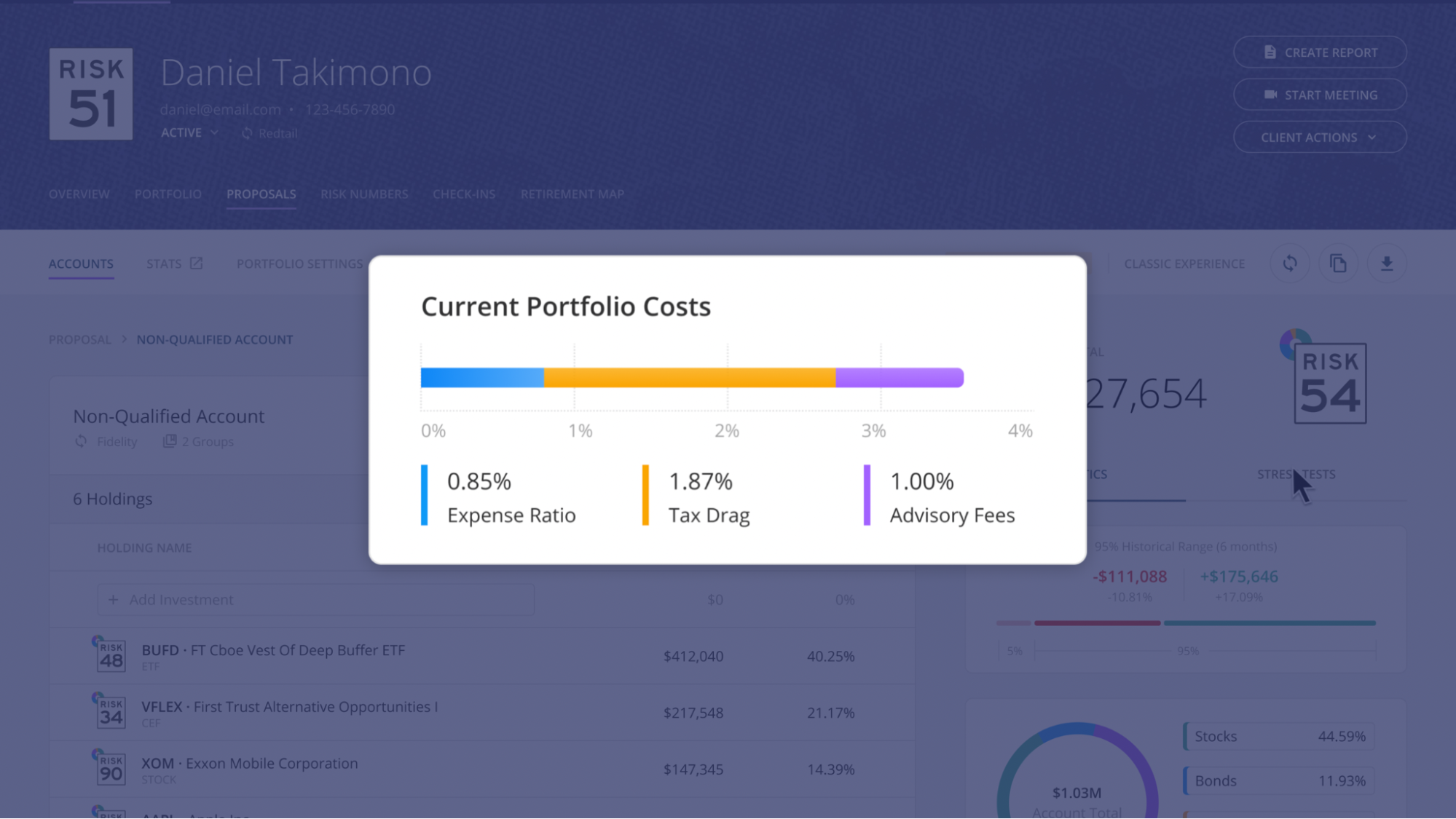
Tax Drag

Last year at Fearless, we announced Tax Drag, which we first applied to securities. This year, we’ve applied Tax Drag calculations at the account and portfolio level as well.

You know of Tax Drag as the reduction of a portfolio’s annualized return due to taxes, or you might say it’s tax liability triggered by distributions and capital gains. Putting it at the heart of portfolios lets you tell that story about non-qualified accounts to clients, so you can win and keep business.

image-of-nitrogen-product-current-portfolio-costs

Stress Tests

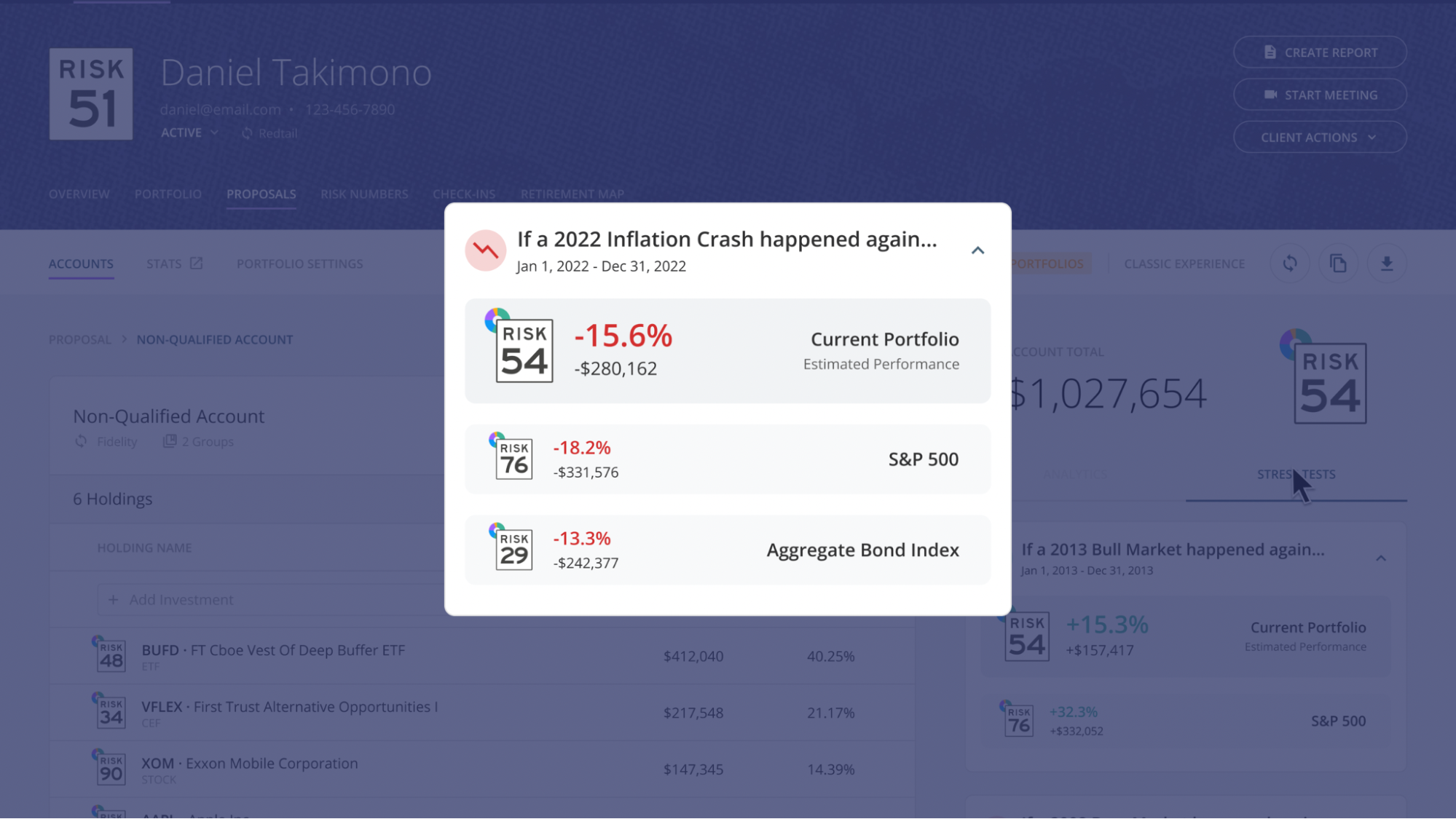
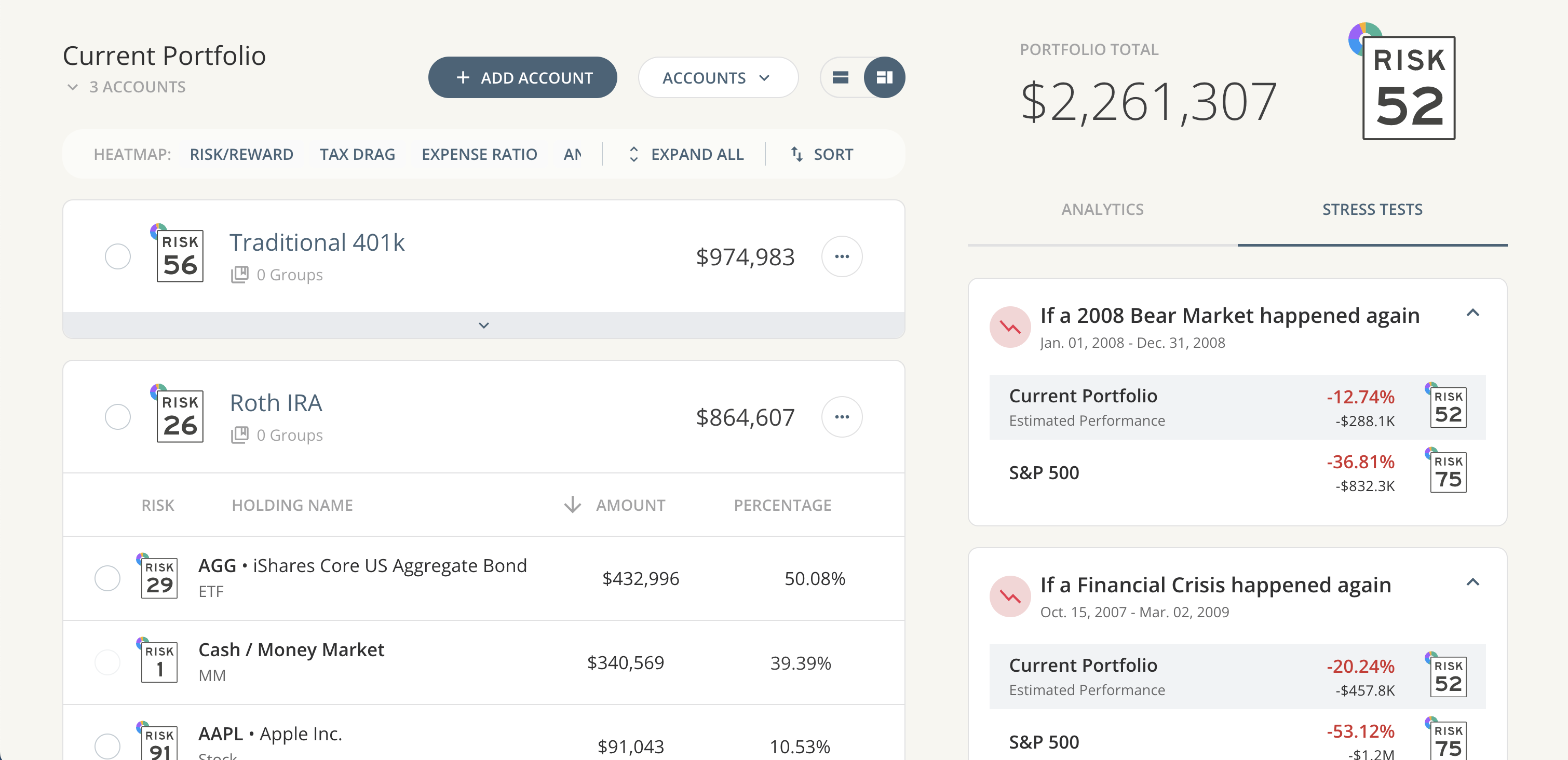
We’ve completely redesigned Stress Tests this year. When a client asks why the market is beating their portfolio, you know exactly how to answer. We’ve made the Risk Number even more prominent—it’s front and center. 

We’ve also added a new Stress Test to the mix. While you’ve always been able to model what happens to bonds in a high-interest rate environment, or to equities when times get tough, now you’ve got a multi-comparator stress test to illustrate the effects of the 2022 Inflation Crash on both stocks and bonds.

nitrogen-product-image-of-stress-tests

Heatmaps

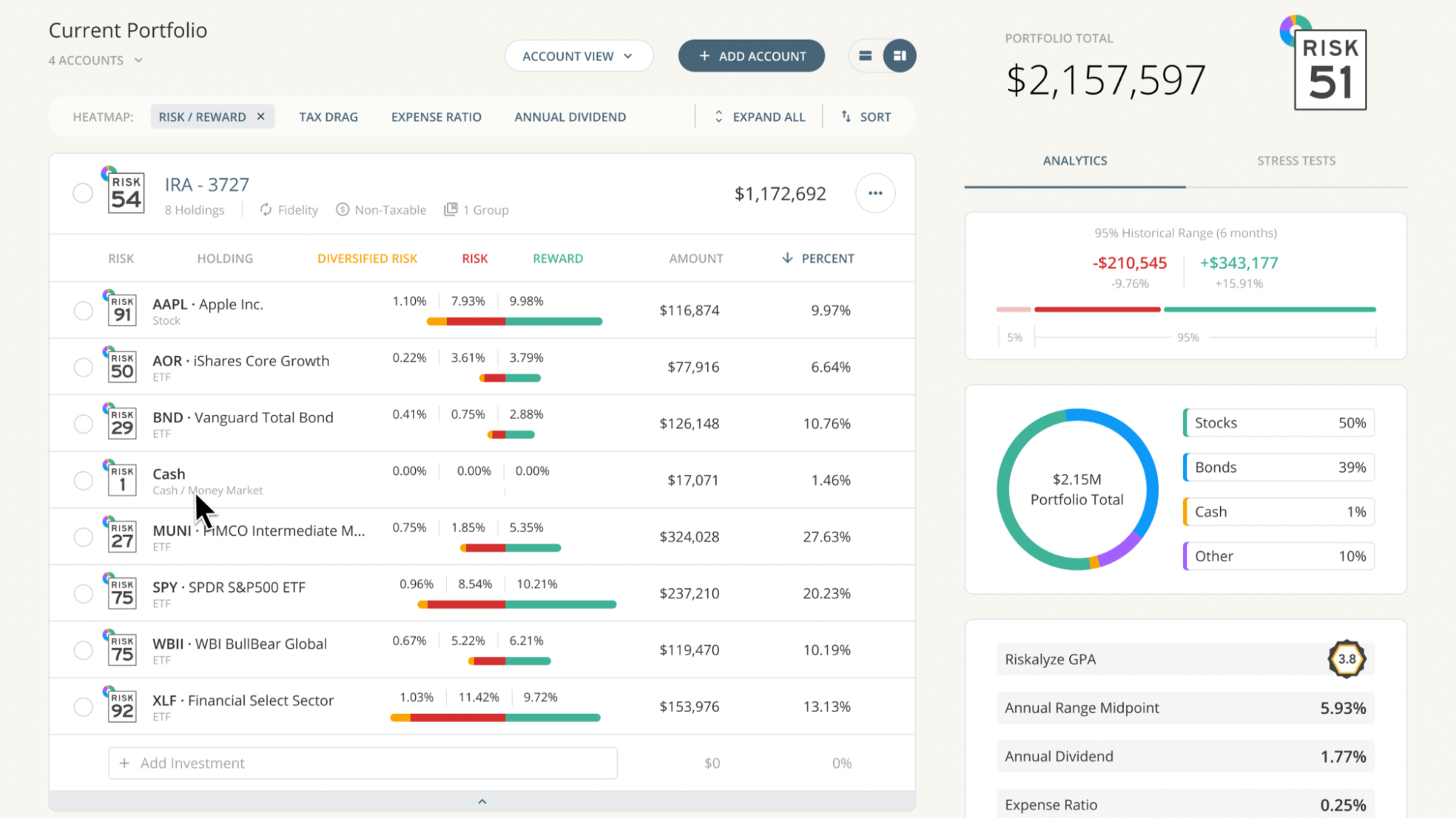
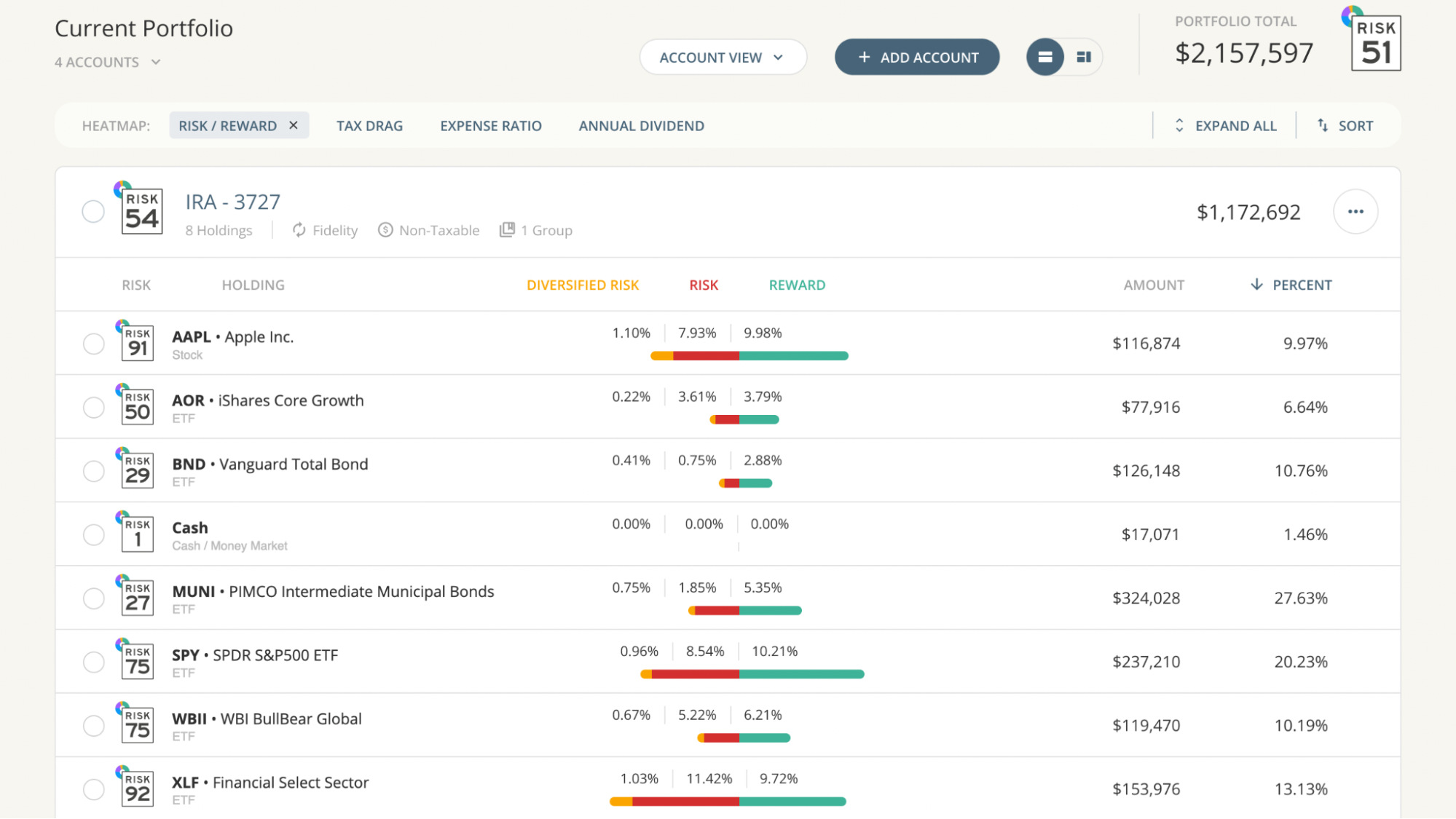
With Heatmaps, you can pinpoint which individual holdings have the greatest relative impact on the portfolio. The Risk/Reward Heatmap shows the weighted potential upside reward and downside risk of each security, so you can visually show clients how you want to rebalance holdings or propose anticorrelated assets to diversify away risk.

It’s the most powerful way to illustrate the effects of diversification to clients in a way they can see and understand.

nitrogen-product-image-heatmaps

It can also lead to additional conversations around held-away assets. When you can pull in outside accounts with Asset Sync, you can get a truer understanding of how much risk or diversification a client actually has in their whole portfolio. 

Annuities

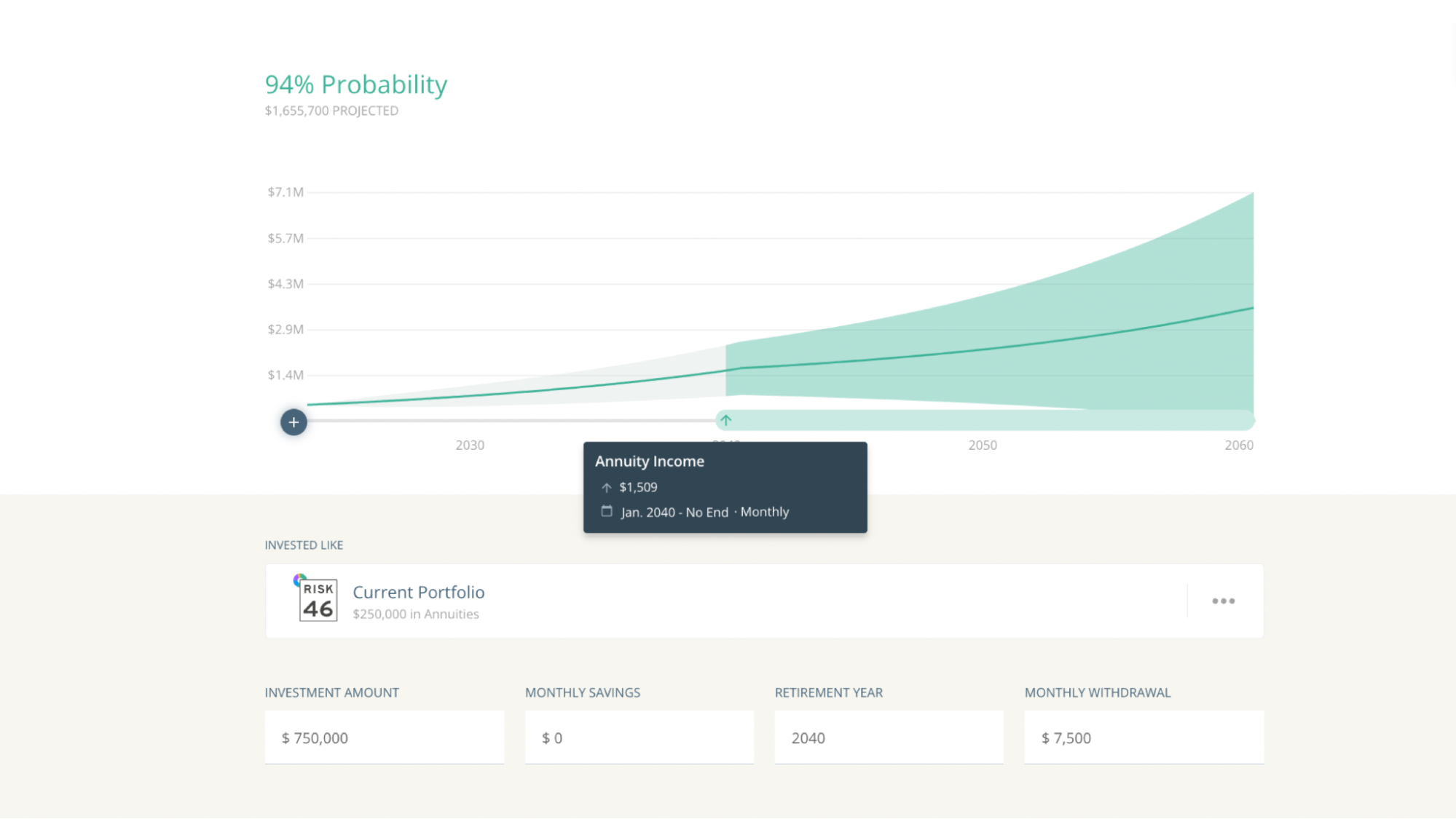
Annuities are also available in the new experience. And now, when you apply an income rider, it’ll show up as a timeline event with income in a client’s Retirement Map.

nitrogen-product-image-annuities

Navigating Portfolios

We’ve made working accounts just as intuitive as it should be. If you haven’t tried the new portfolios experience lately, now’s the time to play around with it. You’re going to find a lot of delightful little ways you can interact with accounts you may not have known about.

You can add holdings from your Discovery favorites, assign Account Groups, sort by Risk Number, name, and value, expand and collapse accounts, and even drill into accounts and models. And you can do it all in a new view as well. With Fullscreen Holdings View, you can expand your screen enabling you to put the focus right where you want it.

nitrogen-product-image-portfolios

So, that’s what’s new in the All-New Portfolios Experience. We think you are going to love all of the updates and delightful touches that the team has been working on.

Next Up

The team is hard at work making sure there will be no reason you’ll need to go back and use the old, slower experience. Soon, custom securities will get new settings, you’ll be able to create a portfolio by importing a file or using model templates, you’ll be able to launch Scenarios, access the client actions menu, and adjust advisory fees at the account level. And that’s it! Give it a shot — we’d love your feedback.


Not seeing the new experience in your account? Head to Settings > Early Access, and toggle on “All New Portfolios.” Need a hand? The industry’s best Customer Care team would be glad to help at care@nitrogenwealth.com.

If you’d like to get a demo of the All-New Portfolios Experience and all of the other powerful features in the platform, sign up for a demo here. We’d love to show you around.


Why clients leave a financial advisor (and what you can do about it)

Financial advisors and advisory firms looking to scale can’t rely solely on client acquisition. While attracting new clients does contribute to your firm’s success, the real growth is in retaining them. 

High client churn stunts growth and creates irregular cash flow. It is also expensive in comparison to client acquisition—with it costing five times more to replace a lost client than to keep them.

And client retention is a significant concern. According to an E*TRADE Advisor Services report of registered investment advisors (RIAs), 20% of clients leave within their first year, and 25% leave in the second. After that, the rate drops until year five, when the turnover rate is 15%. 

To better understand how advisors can boost retention, let’s look at the main reasons why clients leave their financial advisors. 

The top 5 reasons clients leave their advisor

The same report highlights several reasons why investors, particularly millionaire investors, fire their advisors. In order of the top 5 motivations, clients leave because the advisor:

  1. Does not return phone calls in a timely manner 
  2. Is not proactive about contacting a client
  3. Does not provide good ideas or advice
  4. Does not return emails in a timely manner
  5. Is under-performing compared to the stock market

Runner-up reasons include the advisor not understanding the client’s risk tolerance and losses over a 2- or 5-year period. 

And many of these results were replicated in Nitrogen’s 2023 Firm Growth Survey. Timely client communication and regular meetings ranked high as effective relationship-building tactics at hyper-growth firms. This suggests that paying attention to client concerns about communication and being proactive does lead to improved retention. 

We can break these down further to better understand related causes on the advisor side and how to fix them.

Does not return phone calls in a timely manner 

If a client is contacting their advisor, they likely have a question, concern, or need to reschedule a meeting. Failing to follow up can leave clients feeling frustrated and neglected.

But advisors can’t spend their entire day calling back clients. Advisors today barely spend 20% of their time meeting with clients. Their schedule is dominated by administrative, marketing, and investment-management tasks. 

However, it is possible to decrease your response time, such as leveraging customer service software to log calls or creating a system or strategy for addressing calls and other client communications. 

You’ll also want to measure your response time to map your baseline and set a goal.

Is not proactive about contacting a client

Another client communication-based challenge is contacting the client before they get around to calling or emailing you. This lack of connection taps into the same feelings of neglect as not returning calls. It can make a client feel more like a number than a person. 

The problem here stems from a few issues: Not having enough time, inability to prioritize which clients need the most support, and a lack of communication processes.

Using wealth management software that can prioritize your clients based on their risk tolerance, such as Nitrogen’s Risk Number, and sending regular check-in surveys to assess their sentiment are easy ways to automate the process. Tools that streamline the process for you enable you to spend less time on manual reviews and more time calling clients. 

Does not provide good ideas or financial advice

This can be a bit trickier. Both the market and the client’s life can be unpredictable, and it’s possible to make a mistake. Clients unaware of their actual risk tolerance or goals can also hinder their advisor or financial planner from developing a solid plan. After all, advisors require accurate client information to give sound advice. 

Another challenge can be in the presentation of ideas and advice. Not all people absorb information in the same way, so having a number of visual aids can help you to explain complex concepts. 

Proposals with visual analytics are one way to better support your advice. Another way to ensure that you have the most accurate information possible to give your best opinion is to centralize your data. Integrations with your CRM or growth platform enable you to keep track of all a client’s data, as well as research and investment information. 

Does not return emails in a timely manner

Email is becoming just as important as phone calls, especially for the younger generation of investors. You may have more leeway in terms of response time, but clients are expecting faster and faster replies. 

The good news is that this can be somewhat easier to improve than phone response time. Automated messages that confirm you’ve received their email can help clients feel heard—even if you can’t read it yet. Having a live chat option on your website can also reduce the burden on you or your team to answer questions, especially common inquiries. 

Is under-performing compared to the stock market

It’s impossible to predict the market, and there will always be times when a portfolio underperforms.

Often, solving this issue is about communication more than short-term performance. Being proactive about addressing a client’s potential concerns, gauging their risk tolerance, and providing easy-to-understand explanations of their portfolio’s long-term performance can all help remedy client anxiety. 

Boost client retention

Financial advisors working on growing their firm don’t need to necessarily focus on explaining high fees or marketing to new clients. Client retention itself both maintains and grows an advisory firm through steady cash flow and referrals, respectively. 

Excellent client communication is a significant part of turning current clients into a power base to drive growth. But it isn’t the only factor.

Watch our on-demand webinar on developing a superior client experience to drive referrals for more tips to grow your financial firm.

ETFs & Mutual Funds: How Tax Drag Highlights Stark Differences

By: Mark Bivens, Product Manager at Nitrogen 

Earlier this year, our team rolled out Tax Drag, an entirely new way to win new business and prove your portfolios, models, and proposals are built in the most tax-efficient manner.

Tax Drag is defined as the reduction of a portfolio’s annualized return due to taxes. It’s the tax liability triggered by distributions and capital gains in a non-qualified account. 

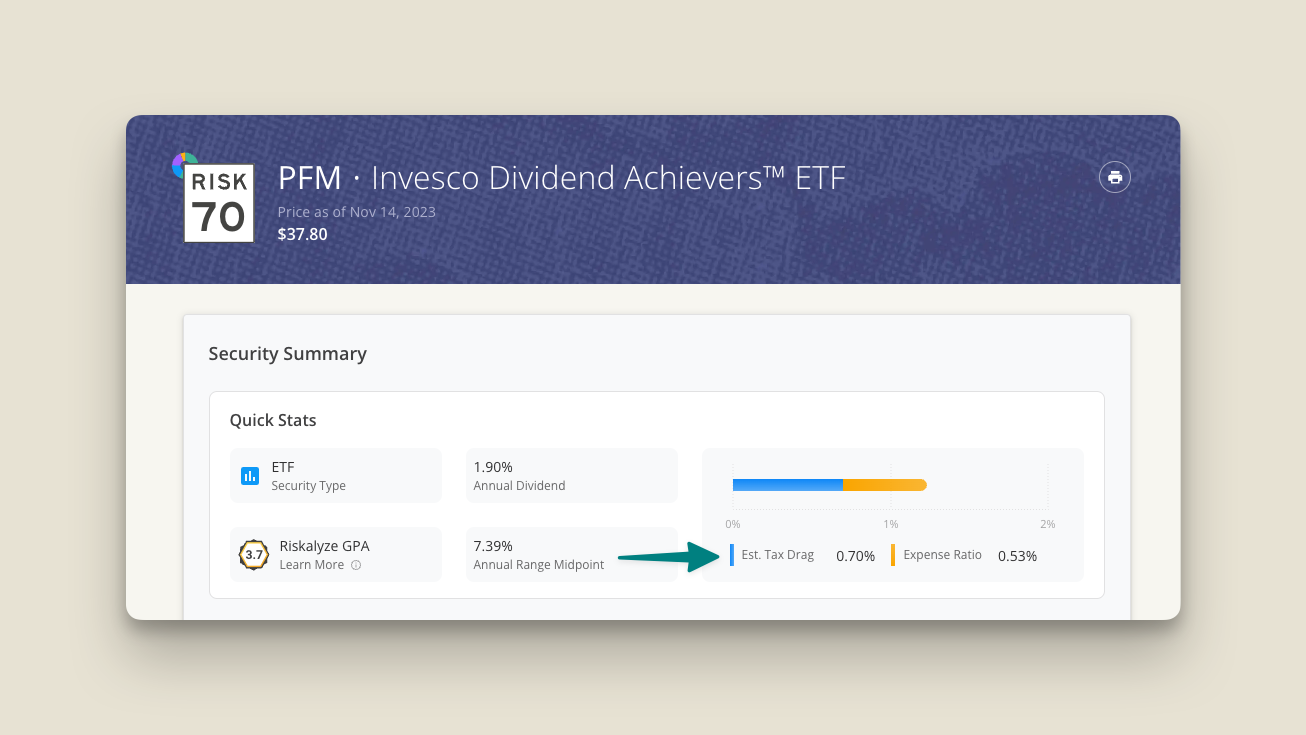
With the addition of Tax Drag to the portfolio screen, Individual Security Analysis, and Detailed Portfolio Stats, advisors now have an easy-to-understand metric to explain the taxable implications of owning a specific security to clients.

in-product-image-from-Nitrogen-platform

Now, advisors can easily show the tax implications—and erosion of gains—through a security’s distributions and dividends.

We wanted to learn more about how Tax Drag is affecting client portfolios, so we challenged our Risk & Analytics Team to look into the data from 2023.

After crunching the numbers, our team found a stark difference between mutual funds and ETFs. With the recent market turbulence, ETF fund managers have generally been able to maintain lower tax drag across their funds by a wide margin compared to their mutual fund counterparts.  

Take a look at the data:

Average Tax Drag as of Nov 1, 2023
Top 10 Growth ETFs.39%
Top 10 Growth Mutual Funds6.69%

September top 10 funds lists from Yahoo finance and Morningstar for top growth funds.  Mutual funds – BCSIX, CIPMX, CIPSX, FDGRX, LSGRX, MPEGX, MSEQX, NWSAX, POAGX, POGRX.  ETFs – IWP, IVW, SPYG, IWF, VUG, SCHG, ARKK, MGK, QQQ, QQQM*.  *No coverage

The data is clear—we’re seeing a large reduction in tax liability for clients holding ETFs rather than their equivalent mutual funds. 

This stark difference in Tax Drag is due to the ETF’s ability to absorb capital gains distributions through in-kind distribution. When an authorized participant wants to create or redeem shares, the ETF issuer can deliver them through actual shares of the underlying investments in the ETF. This passes the capital gains distribution to the authorized participant and shields the end investor from the taxable burden.

On the other hand, when an authorized participant wants to create or redeem shares in a mutual fund, the issuer must sell those shares prior to delivering cash, directly passing the taxable implication to the investor who holds the shares of the mutual fund. This takes away most of the compounding effect of holding the investment. 

In a volatile market, like we’ve seen this year, many mutual fund issuers will take profits from their larger positions to hedge against further downside. While this protects fund managers, investors lose due to the additional market volatility and larger than usual tax bills due to capital gains distributions.

Unfortunately, the investor doesn’t even have to participate in the gains of holding the shares! If you are purchasing shares of a mutual fund today, and the issuer redeems shares or takes a capital gain distribution tomorrow, the client is on the hook for that distribution of gains that may have culminated long before their ownership in the fund.  

While there are tax advantages to choosing ETFs over mutual funds, they are not always the right choice for every client. There may be reasons when clients need active management through mutual funds.

Regardless of which type of holdings you put into your client portfolios and proposals, the Nitrogen Growth Platform can help you articulate how clients should be investing. 

If you’d like to get a demo of Tax Drag and all of the other powerful features in the platform, sign up for a demo here. We’d love to show you around.

Thanks as always for empowering the world to invest fearlessly.

Talking to Clients: Key Touchpoints and Effective Strategies for RIAs

Talking to clients has become a challenge for the modern RIA or financial advisor, and much of the difficulty comes from a lack of time.

According to the 2023 J.D. Powers U.S. Financial Advisor Satisfaction Study, 28% of advisors said they don’t have enough time to speak with clients. Yet, these clients need updates and advice on the market, their portfolio, and short-term financial planning, among other things. Failing to talk with clients regularly can lead to high client turnover.

Two of the primary reasons clients fire their advisors is due to the quality of the advisors’ advice and the quality of their relationship. Both of these may be linked to poor or not enough communication.

The good news is that a sound communication strategy can help RIAs make more time to talk to clients and cover important topics effectively. It all starts with client expectations.

What communication clients expect

With the advent of omnichannel communication options — such as using phones, text, and emails — client communication has become more complicated across industries. As financial advisory firms’ growth hinges on client relationships, they must develop effective strategies to reach clients with their preferred method.

Before diving into the types of conversations every advisor should be prepared for when talking with clients (and best practices), let’s take a look at how people communicate today.

While 72% of clients prefer their advisors to send general updates and educational materials via email, 51% of clients prefer to resolve potential challenges over the phone. Live chat and in-person conversations are also popular when dealing with client service.

The challenge with most firms is that phone calls and in-person discussions can be time-consuming and difficult to scale. They also aren’t required for every single topic. But determining a communication strategy and prioritizing when to check in with clients also takes time to develop.

The best way to start is to consider what kind of conversations you are likely to have with your clients and how you can best respond. 

Types of Key Client Touch Points 

Onboarding 

Client onboarding should always be a face-to-face or video-call conversation, which may take more than one session. During this conversion, you will want to welcome them to the firm, set expectations, gain access to their accounts, and review your risk assessment or contracts.

Financial Planning

Another key conversation to have face-to-face is for financial planning sessions. While you can send emails with plan proposals or portfolio progress to clients, you will want to be able to set expectations and determine goals and milestones in person. Furthermore, you may want to check-in at regular intervals to check on how your client feels about the markets, their portfolio, and their financial plan.  

Difficult Discussions

There are a number of events that can be challenging to address for advisors. Deaths, divorces, family estrangement, job loss, and mental health all require financial advice but are extremely personal conversations. 

It may not always be possible to have an immediate in-person conversation, as your client may be busy dealing with the matter at hand, especially if it’s a personal matter. Maintaining a healthy and respectful tone, regardless of the communication method, is key. It may also be useful to follow up, not necessarily to request a meeting, but to show support for your client. The stronger your relationship is with a client, the more likely they will come to you rather early. 

Market Shifts

With difficult portfolio information, it’s important to be clear and transparent with your clients. Most likely, your client will see a statement and call your office or leave an email. A phone or video call is likely the best option here, but you can also be proactive.

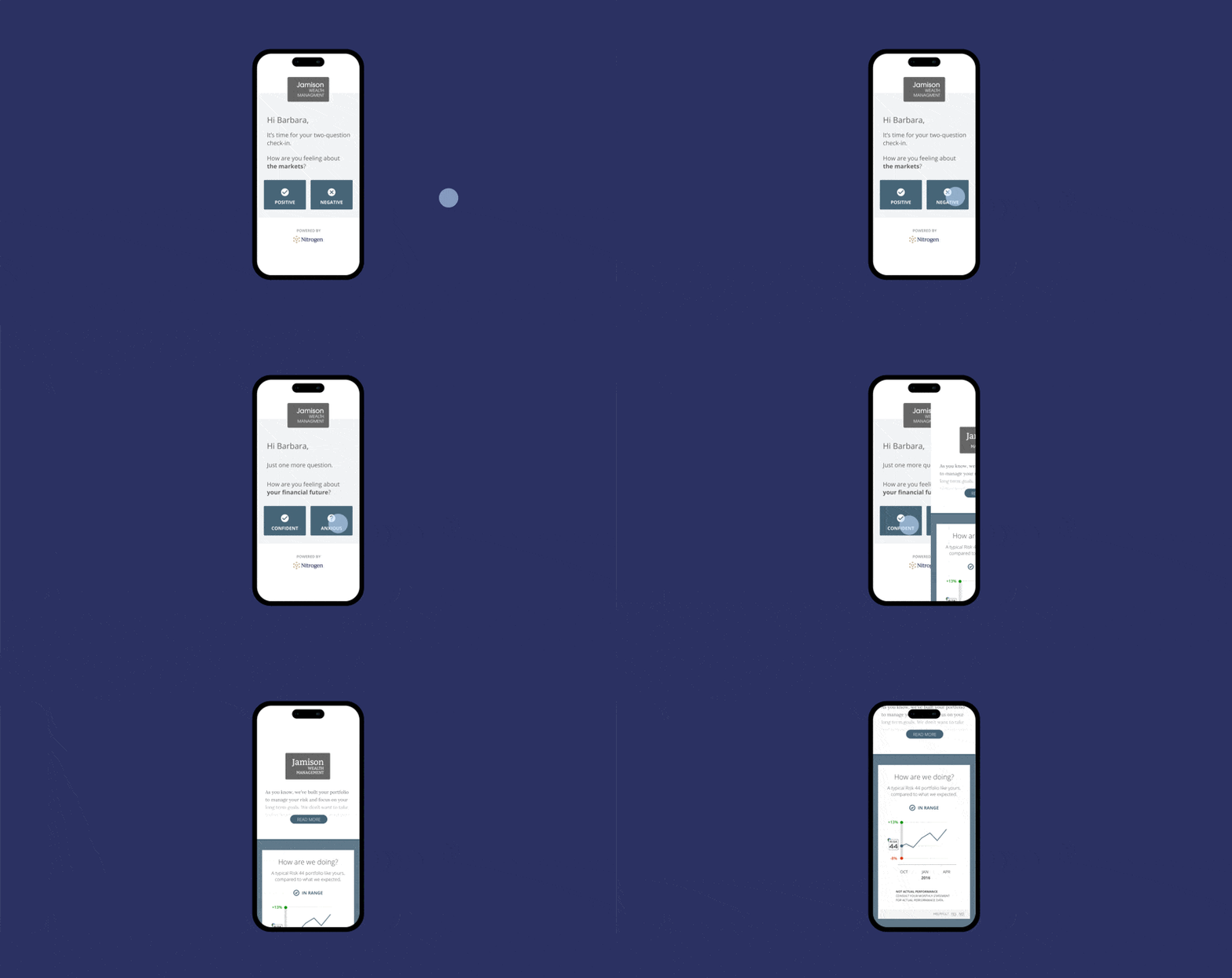
For example, Nitrogen’s Check-ins automatically sends two-question surveys to help flag which clients you should check in on first. Awareness of the market changes and your client’s tolerance can help you proactively contact them, thus strengthening their trust and optimizing your time. 

Personal Life

Not every conversation needs to be serious or work-related. Holiday emails and even direct mail, such as for sending birthday or anniversary cards, are a great way to maintain communication and position the relationship as authentic and friendly. 

Reminders and follow-ups

Finally, you’ll need to send reminders and follow-ups for meetings and events. These can be easily automated as email or text messages. But if it appears that your client is not responding or opening your communication, you may want to follow up with a manual phone call.

Tips for better communication

Respond in a timely manner

Immediate client responses can be challenging for advisors due to the amount of daily tasks required to successfully run a firm and manage portfolios. However, most clients assume that you will respond quickly to their emails, texts, and phone calls. The faster you respond, the better.

How soon is ideal? For 90% of clients, an immediate response is expected—the majority defining an immediate response as under 10 minutes. This time isn’t always possible for most advisors. The key is to respond quickly, even if it is only to confirm that you’ve received their message. 

Set expectations early

Mismatched expectations of performance and services are the foundation of client dissatisfaction. Be clear upfront about what you provide, your fees, meeting frequency, and your process. 

While you can’t guarantee performance, you can use analytics and custom models based on the client’s portfolio and risk tolerance. Clarity, brevity, and visual aids can ensure that your new client understands your role.

Record conversations as much as possible

Emails and text messages are fairly easy to keep track of. But it can also be helpful to record and store all video calls, in-person conversations, and phone calls. Not only will this help you to keep track of client information, concerns, and discussions, but it can be useful for maintaining compliance.

Use positive language

Even during market downturns and volatility, you can use positive language to mitigate stress and highlight solutions. This is different from downplaying or minimizing challenging portfolio discussions. Rather, this approach uses positive words and phrases to emphasize the solutions and an action plan.

Adjust your tone for your client

Another way to improve communication is to speak to clients in their own language. One client may be extremely formal, while another is incredibly casual and laid back. Being able to match a client’s tone can help you be better understood and build trust. 

Consider small talk

Some clients may hate small talk, but engaging in some questions about your client’s personal life can kick-start meetings and show you pay attention to them. Agreeing or discussing minor topics in the beginning may also lead to a more open conversation when you get to the financials.

Designate responsibilities

After a client call or meeting, it can be helpful to send a summary to your client, highlighting who is responsible for what. Perhaps you owe them a revised financial plan, but you need a few documents first. Sending this list will incite client engagement.

Optimizing your communication and engagement

Once you nail your client communication strategy, it’s important to optimize the process. Saving time through automation or using prioritization tools can help you and your advisory team more efficiently talk with clients.

Furthermore, client communication and the related tools are a part of a larger engagement initiative. To learn more about how communication fits into retention goals, learn more about our top client engagement strategies.


9 Proven Ideas for Client Appreciation Events

On average,  20% of clients leave an advisor within their first year. The reason? The vast majority of clients leave due to poor communication, whether that’s not returning phone calls or not being proactive when contacting clients.

There are a few ways advisors can combat this challenge, including operational adjustments such as automation and risk assessment tools to prioritize communication. But there’s one effective method that is often overlooked: client appreciation events.

A client appreciation event offers a fun, proactive way to communicate with clients while demonstrating your commitment to their overall well-being. This approach emphasizes that your client isn’t just a number to your firm, thus boosting client retention. 

Registered financial advisors and brokers can leverage several types of events to engage their clients and thus boost retention and loyalty. Let’s take a look at these top 9 client appreciation event ideas—and go over some essential best practices.

9 Proven Ideas for Client Appreciation Events

1. Exclusive Educational Workshops

Your existing client base is likely to have similar interests when it comes to investing in education. Retirees want to understand how to optimize their savings and estate planning. Younger clients may want to know more about high-growth investments and need advice related to career movements. 

Providing exclusive workshops lets you provide clients with in-depth knowledge relevant to their interests. There is no need to pitch services, as with public events, leading to more nuanced conversations and stronger relationships. 

You can also bring in guest speakers to address topics adjacent to wealth management. For example, you could bring in a lawyer to discuss trusts or an accountant to answer questions about tax mitigation. 

2. Tasting events

A winery or brewery visit is a popular client event option, as you can socialize with clients without focusing on finances. However, these aren’t your only options for tasting events. If any of your clients don’t drink, or if you want an alcohol-free event, you may be able to find local non-alcoholic drink tastings. There are also food options, such as chocolate, fudge, or candy tastings. 

3. Brunches, Lunches, and Dinners

Having a one-on-one or group meal is a utilitarian and considerate client appreciation event, especially for clients with busy schedules. Inviting clients and their spouses or other family members makes it easier for you to build stronger relationships not only with your clients but with those important in their lives. Furthermore, you can offer to extend the invitation to any plus one. In this way, clients may bring close friends or another individual who could be a prospective client. However, it’s important not to talk about investing in finances. This meal is about appreciating your client, not highlighting your performance. 

4. Sporting events

Hosting or attending a sporting event also offers the opportunity to bond with clients. The event you choose can be based on client preferences, and there’s a wide range of options. Golf, baseball, football, hiking, fishing, and skiing are just a few examples. However, unlike meals, workshops, or tasting events, these may require more thought and preparation. This is especially true for engaging in sports like golf or fishing, as opposed to attending a game. 

5. Milestone celebrations

Birthdays, marriages, and graduations are key life events that you can use to show appreciation to your clients. The easiest way to engage in this kind of event is through surprise meals. But you can also throw a party with a client’s friends and family, particularly for big events like marriage anniversaries, promotions, or retirement. These don’t have to be big or drawn-out affairs, but they are a great way to stay involved in your client’s life. 

6. Holiday parties

Another great group event is throwing a holiday party. And there are many options to choose from: Christmas, Easter, the Fourth of July, and Thanksgiving are just a few. The flexibility and availability of holidays make this easier to plan.

7. Craft workshops

Similar to taking clients to a sporting event, hosting or attending an arts and crafts workshop taps into a client’s hobbies. You can build a stronger relationship with a client while at an easel or pottery wheel, among other options. The key here is to hone into client preferences.

8. Charity events

Most individuals have causes they care about, whether they are local challenges or international issues. You can host a charity event for clients to attend. The charity can be one you are passionate about or one that a client is involved in. 

 There are also many variations of this kind of event: Pancake breakfasts, silent auctions, fun runs, galas, and murder mystery parties are just a few ideas.

9. Local festivals

If most or all of your clients are local, you can invite them to a local festival on a one-on-one or group basis. Most cities offer art, music, and food festivals, giving you are range of options based on client preferences. Furthermore, some clients may participate in these festivals, such as maintaining an art booth or competing in a BBQ competition. Meeting them at these events can demonstrate how you support them in their personal life outside of the serious stuff. 

Best Practices for Client Events

Appreciation events are an excellent way to connect with and retain current clients. But it’s important to adhere to a few best practices to ensure you’re building long-term relationships. For example, you’ll want to:

  • Not talk shop — unless a client brings it up.
  • Tailor events, especially one-on-one meetings, to a client’s preferences.
  • Always invite a client’s friends and family.
  • Spend a little time with everyone at group events.
  • Send reminders before the event and follow-ups after.

More ways to build client engagement

Client appreciation events offer a fun and interactive way to build stronger client relationships, drive client retention, and potentially generate referrals. But there are other ways to boost engagement. Check out our list of client engagement strategies for more actionable insights.

Top 15 Must-Have Holiday Gifts for Financial Advisors in 2023

From High-Tech to Timeless: Gift Ideas for Every Type of Financial Advisor

Financial advisors are unsung heroes in many of our lives, and as the year draws to a close, what better way to express our appreciation than with a thoughtful gift? Whether the wealth manager is a friend or a family member, selecting a meaningful gift for the financial professional in our life can be a daunting task. That’s why we’ve curated a top 15 list of gifts that strike the perfect balance between utility, luxury, and sophistication.

  1. Montblanc Meisterstück Classique Fountain Pen: An elegant and professional tool that’s not just for writing but a status symbol in the business world.

  1. Noise-Cancelling Headphones: Brands like Apple, Bose, or Sony offer premium noise-canceling features, aiding concentration in noisy environments.

  1. Industry News Subscription: Outlets like financialplanning.com and wealthmanagement.com provide specialized reporting, commentary, and analysis, along with access to exclusive events. This gift is ideal for professionals who need in-depth financial information and want to stay up-to-date on market trends.

  1. High-Quality Leather Briefcase: Tumi, Saddleback, and other premium brands offer durability and style for this essential accessory, whether for travel or trips to the office.

  1. A Sophisticated Whiskey or Wine Set: Includes a decanter and glasses, often customizable with initials or logos.

  1. Desk Organizer Set: A premium wood or leather set that includes a charging dock, stationery holder, and other essentials.

  1. Personal Finance or Investment Books: Signed editions or classics can provide both knowledge and a touch of elegance to an advisor’s office. For signed books, we recommend Premiere Collectibles. For top rated books, we’ve loved reading The Laws of Wealth by Dr. Daniel Crosby and Same as Ever by Morgan Housel. We’re also big fans of Ryan Russell’s My Annoying, Irritating, Always-in-the-way Shadow for kids.

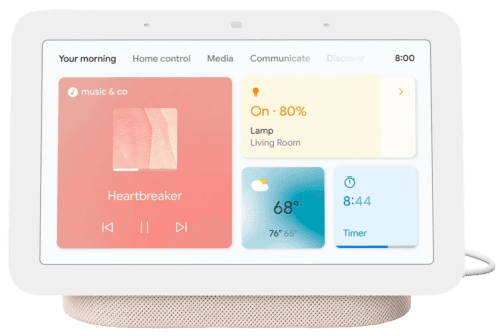
  1. Smart Display: Amazon Echo Show or Google Nest Hub for quick voice-controlled access to news, data, or video conferencing.

  1. Professional Networking Event Tickets: Consider gifting tickets to a high-profile industry conference, like the Fearless Investing Summit. Conferences and events offer the chance for skill development and networking for advisors.

  1. High-end Mechanical Watch: A Rolex or an Omega serves as both a fashion statement and a lasting investment.

  1. Digital Picture Frame: For a more personal touch; can be pre-loaded with cherished memories or inspiring quotes.

  1. Premium Coffee Maker: Brands like Nespresso or Keurig make quick, delicious coffee, a must-have for those long hours.

  1. Ember Mug: Keeping with the coffee theme, an Ember Mug is a favorite of Nitros and keeps your hot beverage at the perfect temperature for hours. No more taking a call only to come back to cold coffee!

  1. Gourmet Gift Basket: High-quality snacks or a variety of teas/coffees can be both a thoughtful and practical gift.

  1. Luxury Resort Day Pass: Services like ResortPass.com allow you to purchase single-day use of a local resort’s spa, pool, or other luxury amenities. This can provide a break from work, as well as a networking opportunity, without having to stay at the hotel.

Choosing the right gift can be as much an art as it is a science. Whether you opt for something timeless like a Montblanc fountain pen or something tech-forward like premium noise-canceling headphones, the key is to match the gift with the unique personality and needs of the individual. This list offers a wide array of options that are both personal and professional, ensuring you can find something that hits the mark. 

NOTE: The list above is for family and friends of a financial advisor. If you are a client or a prospective client of a financial advisor, the wealth management industry has rules specific to the acceptance of gifts from clients to uphold a transparent and ethical advisor-client relationship and mitigate potential conflicts of interest?. 

These regulations and guidelines are in place to promote transparency, honesty, and to prevent any unethical behavior or conflicts of interest that may arise from gift exchanges between financial advisors and clients. It’s also notable that different wealth management firms may have their own internal policies regarding gift-giving, which could be more restrictive compared to the regulatory guidelines. Please have a conversation with your financial advisor ahead of any gift purchase.

A Decade of Platform Enhancements

Since we introduced the Nitrogen Growth Platform in 2013, advisors and firms have generated more than 50 million Risk Numbers. And that number continues to grow at a staggering rate!

Advisors around the nation have adopted the Risk Number as their source of truth to grow their AUM, engage with clients and prospects, protect their businesses, and empower fearless investing.

Understanding the Risk Number is simple, which makes it an invaluable resource for advisors and clients. Clients can easily get frustrated and confused when given standard deviations, Sharpe ratios, and scatter plots. It’s not that clients have too little information — the problem is that clients are overwhelmed. That’s why the Risk Number was born.

The Risk Number boils that complexity down into understandable terms.

Because, when advisors can orient conversations around how much risk investors can handle and have the tools to articulate that investment strategy, that turns prospects into engaged clients, and those engaged clients into referral champions.

When we first launched our product, it was just the Risk Number questionnaire and basic portfolio alignment. But over the past decade, we embarked on a decade of building the ultimate growth platform for advisors.

Nitrogen has been at the forefront of this evolution, rolling out enhancements and features that not only keep advisors ahead of the curve but also revolutionize the way they engage with clients. Let’s take a look at how the platform has evolved over the years.


2014: Help Clients Understand How to Control Risk or Beat the Market

In 2014, we built three powerful visualization tools that help clients understand how much risk they are taking.

Stress Tests allows advisors to run portfolios through historical events like the 2008 Financial Crisis, 2013 Bull Market, or 2022 inflation crash. This helps clients understand what it means to control risk or beat the market.

stress-test-product-image

Now, your firm can create preset market scenarios to illustrate hypotheticals with your clients. These examples are not only powerful for illustrating how you’ve built a portfolio, they’re also a game-changer when it comes to reinforcing how you set a client’s expectations.

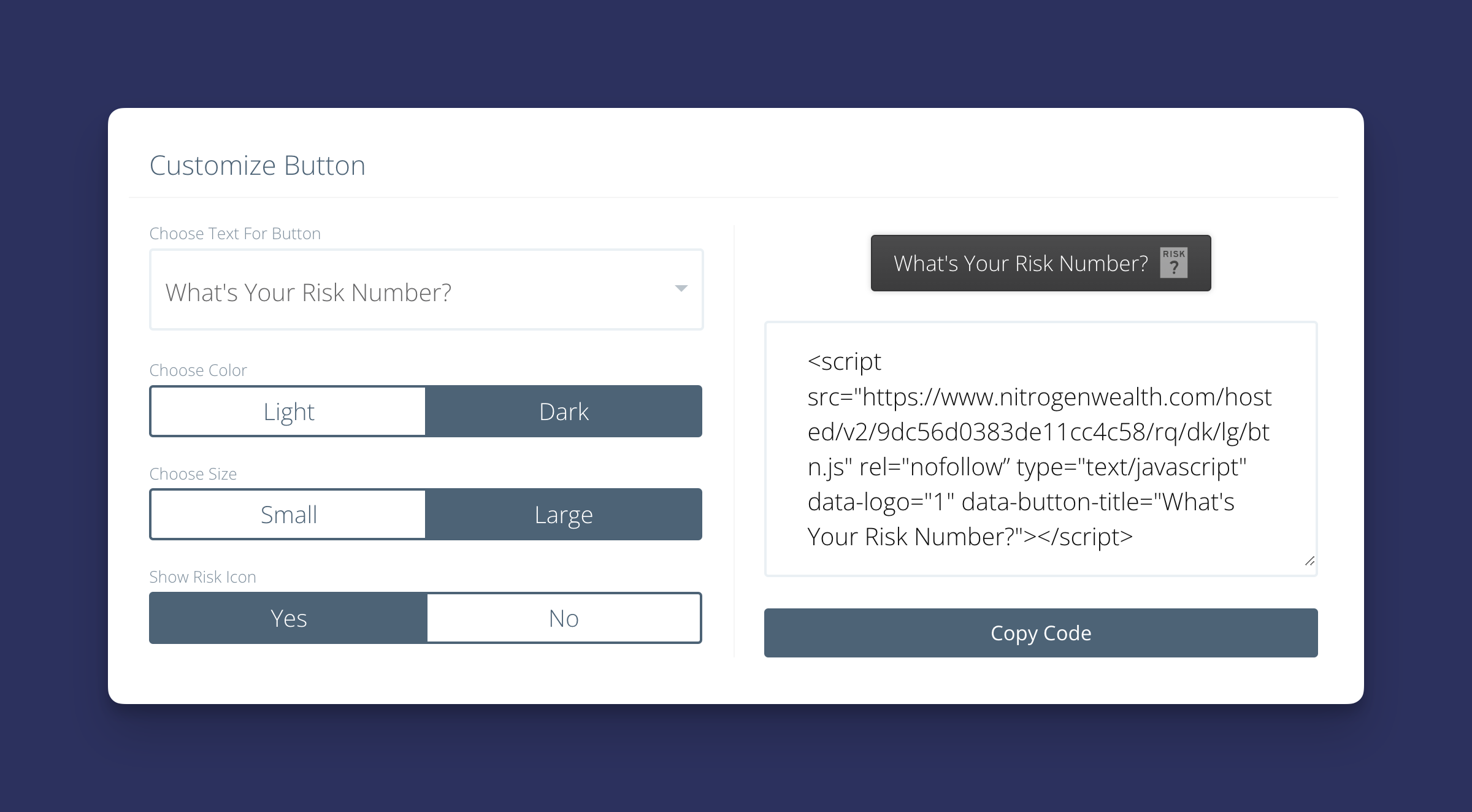
The Lead Generation Questionnaire gives you the power to drop a simple link onto your website or email signature to turn it into an interactive risk analysis tool and a lead-capturing machine. Now you can leverage the four most powerful words in financial advice — “What’s Your Risk Number? to turn leads into prospects, prospects into meetings, and meetings into engaged clients.

lead-generation-questionnaire-product-image

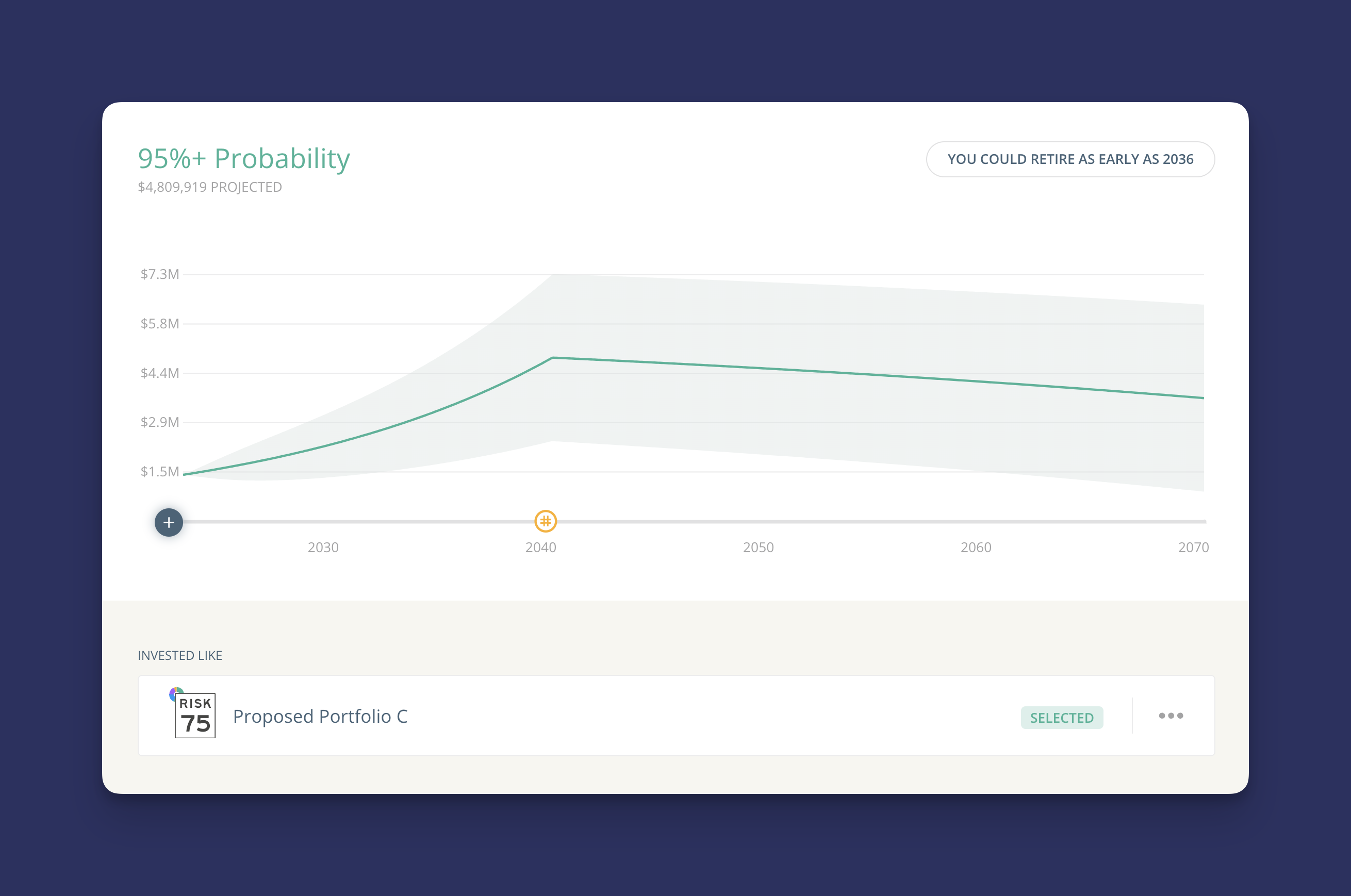
Retirement Maps helps you illustrate how much risk your clients need to reach their goals. Now you can calculate their probability and build a map to success. It’s never been easier to Illustrate the bigger picture and even uncover outside assets.

retirement-maps-product-image


2016: An Automated Behavioral Coaching Tool

In 2016, we launched Check-ins — an automated coaching tool to build a strong foundation to support your message between client reviews.

With powerful, behavioral coaching, you can take the pulse of your clients on a regular basis. That way, you’re set to receive an early warning sign if a client’s psychology needs a little care. Now, you get data points on how your clients are feeling about the markets and their financial future, allowing you to take action at the first sign of trouble.

check-ins-gif


2018: Unleash Your Inner Math Geek with Powerful Analytics

The beauty of the Risk Number is how it empowers investors to stay the course during the short term so they don’t lose sight of the long term. But what happens when your analytical clients need more detailed analysis or reporting?

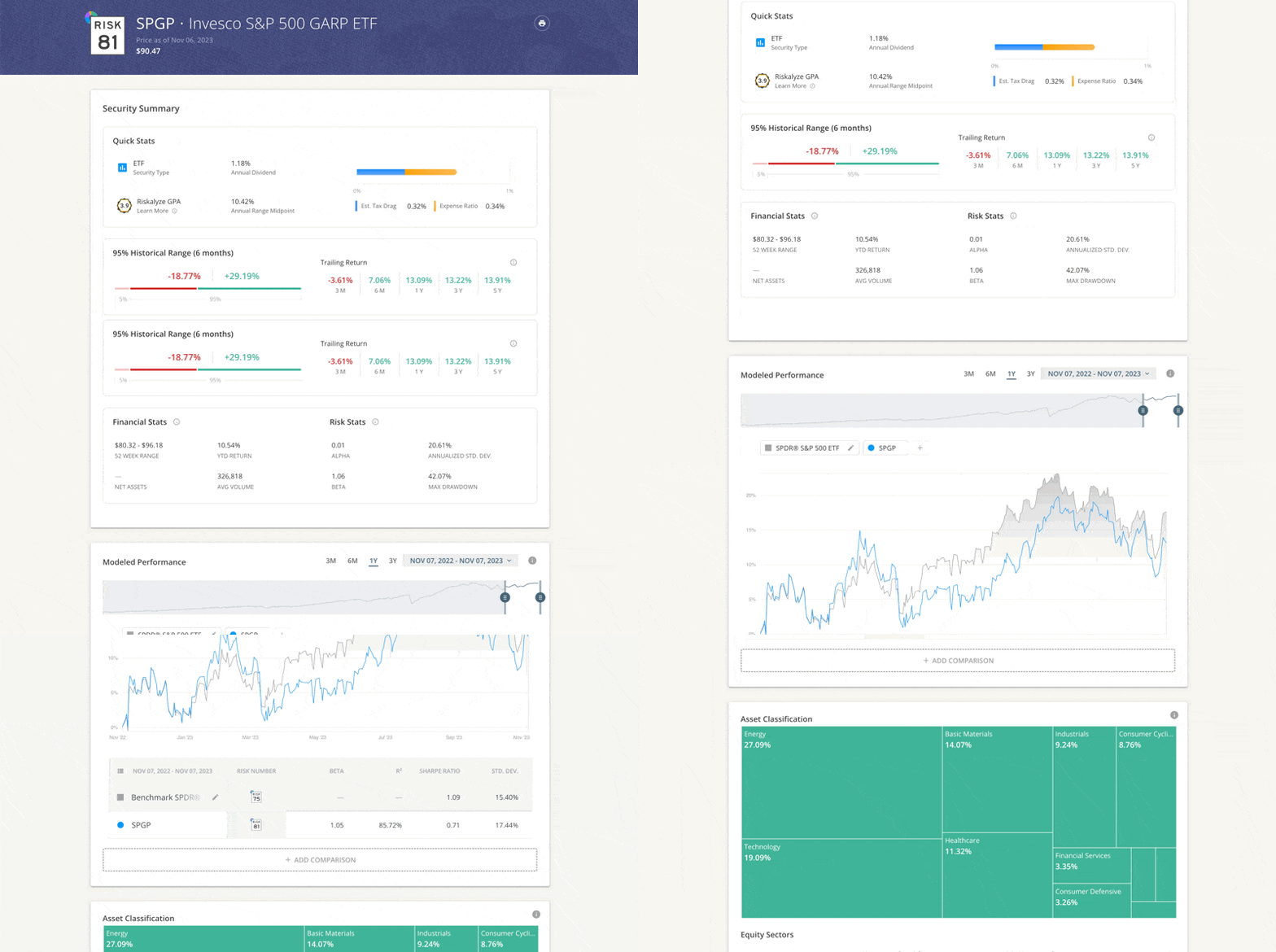
Detailed Portfolio Stats and Individual Security Analysis is data analytics taken to the next level. With a variety of tools ranging from modeled performance, sector breakdowns, risk/reward scatter plots, and data correlation, it’s the most effective way to analyze a portfolio through the lens of risk.

Whether you need detailed analytics for individual stocks, ETFs, mutual funds, portfolios, models, or proposals, we’ve got you covered.

ISA-product-gif


2019: A Suite of Marketing Tools and Templates

In 2019, we launched the Advisor Marketing Kit, an interactive portal of design templates and resources available in Nitrogen Elite, Ignite, and Ultimate. Complete with personalized client-facing videos, templates for presentations, brochures and press releases, social media images, and more, it’s your one-stop shop to infuse the Risk Number into your firm’s marketing. 

These materials are designed to showcase your brand, not ours! Take a look at our client-facing video. ?

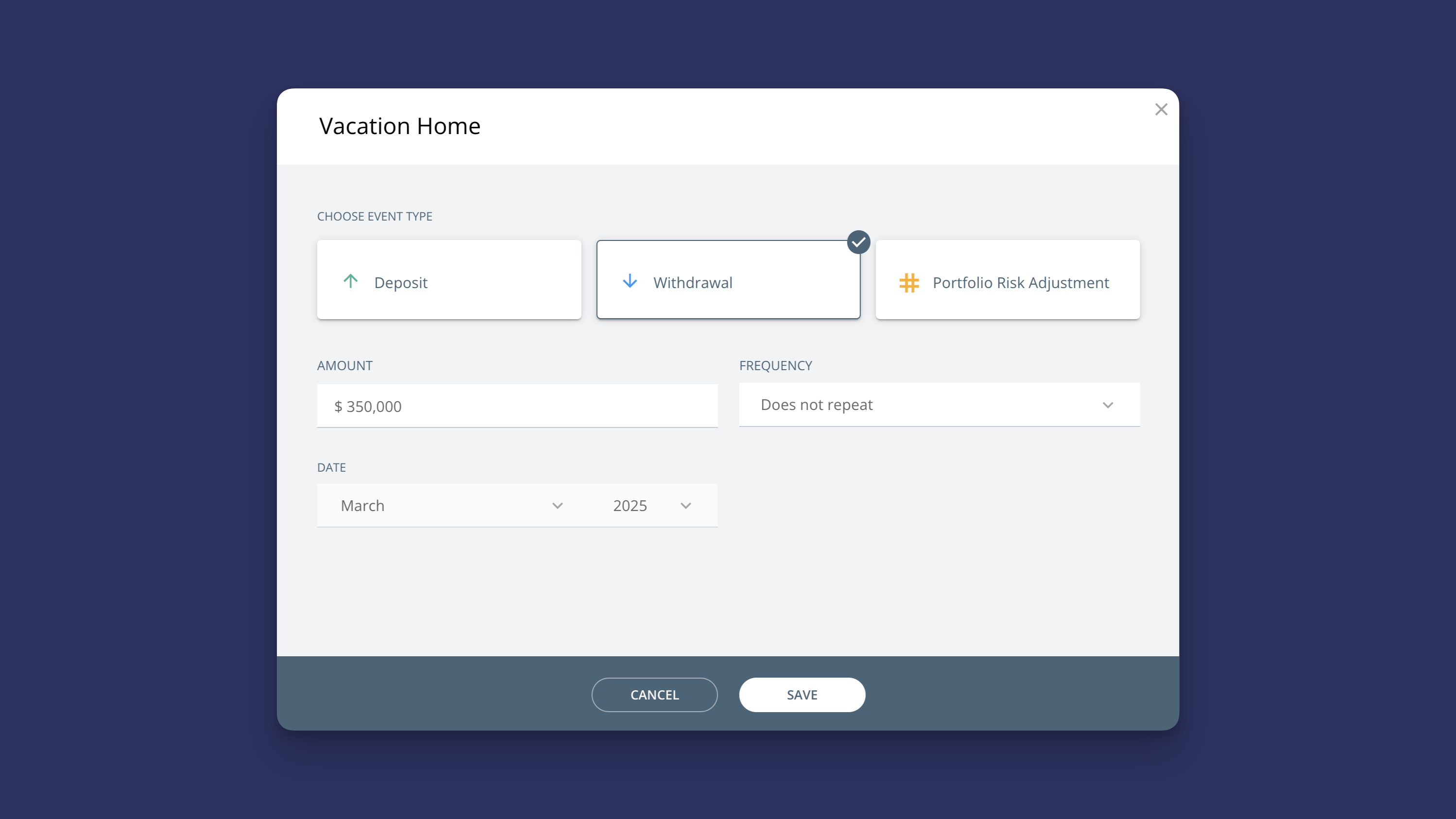
And with Timeline, you can unlock the power of events in Retirement Maps. Now you can illustrate how changing your client’s Risk Number, income, or expenses over time will affect their overall risk capacity.

Can your client afford a vacation home? Drop it on the timeline.

Want to see the effects of Social Security? Add it with a click.

Timeline is dynamic and interactive, helping facilitate conversations around what is most important.

timeline-product-image


2021: Unlock Powerful Investment Research

With the addition of Discovery, advisors can quickly dive into their investment research based on the most important search criteria including the Risk Number, GPA, expense ratios, and more. It’s as simple as clicking and dragging the filters that are most relevant to your search.

And with Individual Security Analysis, you can take your research one step further. You can dive deep into the modeled performance, asset classification, risk metrics, and so much more. You can even favorite funds right from the Discovery screener to add them to client portfolios.


2022: Advisors and Compliance Can Agree on How to Engage Clients

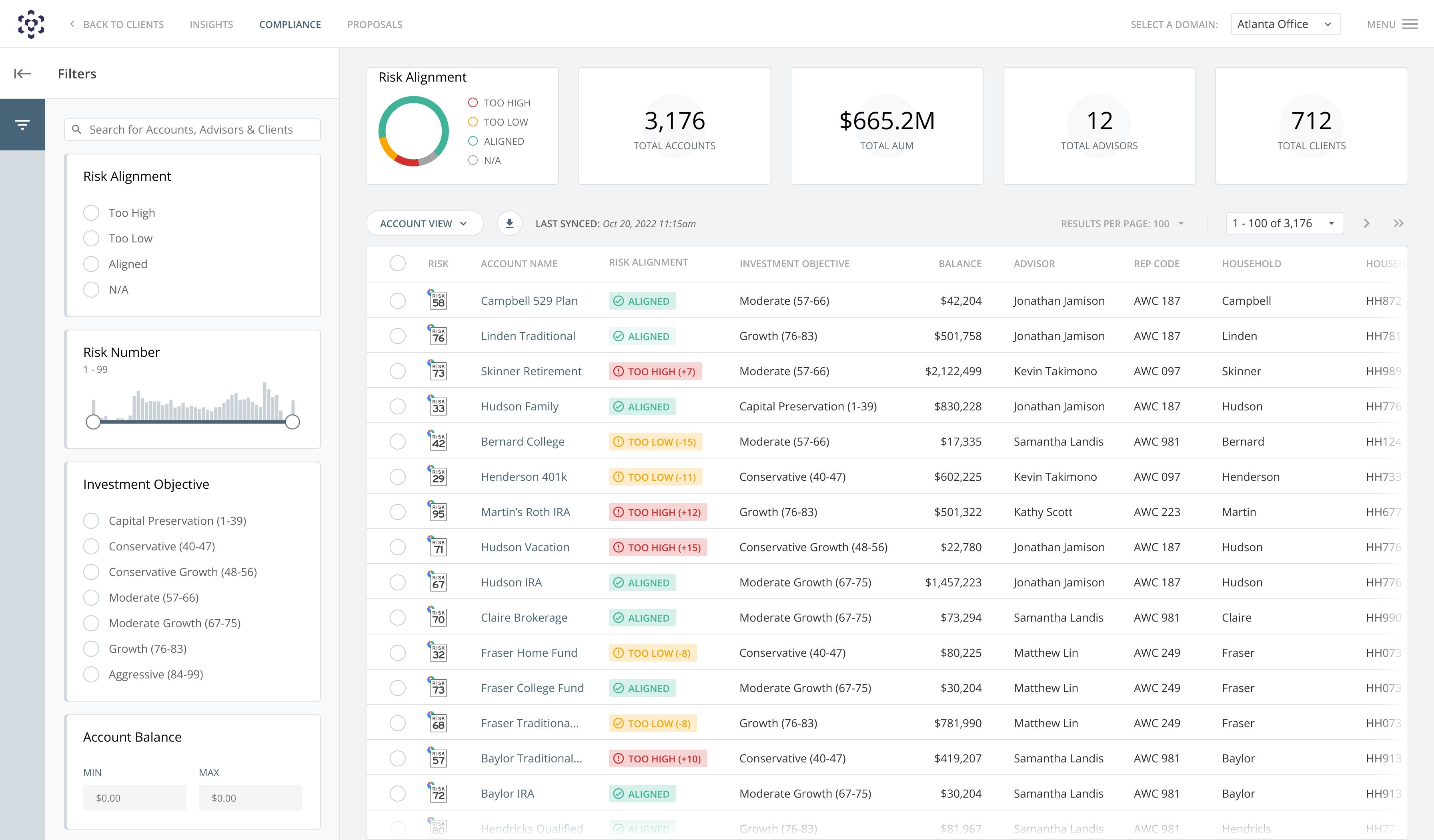
Whether you’re a Chief Compliance Officer or compliance is one of your many hats at your firm, Nitrogen Compliance has the tools you need to fly through thousands of accounts, find issues before they become problems, and leverage the analytics necessary to get clients back on track.

With the launch of Nitrogen Compliance in 2022, we built a dashboard that gives you visibility into your entire book of business. What’s unique here, is that we calculate the risk on every single holding in every account using the proven risk methodology that has powered the Nitrogen platform since 2013.

Now, you have instant access to your firmwide risk alignment and can easily isolate accounts with risk above or below their target.

compliance-dashboard-product-image


2023: You can’t grow what you can’t measure

How can you tell which advisors are performing at their best? Or how does your firm’s Risk Number and GPA stack up to others? Insights was built to answer all of those questions. Because you can’t grow what you can’t measure.

Insights is the Executive Dashboard that measures your firm’s growth and risk analytics across your entire book of business. Now, you can quickly see which advisors are outperforming and share their expertise with the rest of your team for exponential growth.

We also launched Nitrogen AI — an all-new AI content assistant that can generate high-quality marketing content with just three clicks. Powered by some of the most popular AI engines, we’ve fed it with our advisor-specific content to give you a head start the next time you need to write for social media, your blog, or anywhere else!


We’re just getting started! 

The innovation for you and your firm doesn’t end here. At the 2023 Fearless Investing Summit, we announced two major product enhancements that are coming in 2024: Reports Builder and Lead Management.

Reports Builder will become your go-to interface where assembling reports isn’t just intuitive, it’s powerful and flexible. Reports builder will have an extensive collection of pre-built templates and elements that can be used to customize each client report. And if you are on Nitrogen Ignite or Nitrogen Ultimate, you can configure your primary and secondary brand colors to flow through all of the report elements to make each report feel like it was custom-built for your business. You can learn more about Reports Builder here. 

Lead Management is also coming in 2024. Lead Management is going to help you automate more of what you do today in driving prospects toward a meeting and a successful proposal. It leverages cutting-edge AI-powered predictive analytics to surface the next best lead to follow up with, and gives you tools for getting that lead into a meeting to become your valued client.

All of this syncs seamlessly to the CRM of your choice, and it’s not just about making your workflows easier — it’s about setting a new industry standard for what client acquisition looks like for the wealth management firm of the future.


As we reflect on the past decade, the Risk Number was just the starting point. Now, we have a full-fledged Growth Platform that supports, engages, and grows with every facet of your business. With powerful tools that have redefined client engagement, risk assessments, and the compliance needs for advisors across the nation, Nitrogen has not only kept pace with the evolving landscape but has consistently stayed several steps ahead. 

So here’s to the next chapter in this remarkable journey — where we not only keep up with change but drive it, ensuring our advisors are always at the forefront of innovation and can continue to empower the world to invest fearlessly.

Want to check out Nitrogen for the first time? Request a demo here and a specialist would love to show you around.

Nitrogen Appoints SaaS Veteran Zitting as CEO, Doubling Down on Plans to Help Wealth Management Firms Grow

Aaron Klein passes the CEO baton after 12 years leading the firm; will continue as board member and strategic advisor.

AUBURN, CALIFORNIA – November 14, 2023Nitrogen, the company that is revolutionizing how financial advisors and wealth management firms grow, today announced the appointment of Dan Zitting as Chief Executive Officer. Zitting is a seasoned executive, known for his former role as CEO of Galvanize and his extensive experience spanning growth, risk and compliance functions. The appointment completes Nitrogen’s next-generation leadership team and sets the stage for further platform expansion and continued scale. Aaron Klein will transition out of operational leadership before year end, continuing to serve on the Nitrogen board of directors, as a champion of Fearless Investing at the 2024 Fearless Investing Summit and as a strategic advisor to Nitrogen’s leadership team.

“It is an honor to join a team that has truly defined how the wealth management industry engages with clients on their risk tolerance and financial behavior,” said Dan Zitting, Chief Executive Officer at Nitrogen. “Over the course of my career, I have measured my own success by the value my teams have provided to customers. The opportunity to serve advisors who deliver professional advice to Americans preparing for significant milestones in their lives is incredibly special to me. Standing amidst the greatest generational wealth transfer in history, there has never been a more important moment for our Fearless Investing vision. I am excited to accelerate the expansion of our platform, adding new ways for advisors to differentiate their services, engage the next generation, drive up client satisfaction and to grow their own firms.”

Zitting began his career as a certified public accountant and is a three-time company founder. Among the companies he founded is Workpapers.com, which was subsequently acquired by Galvanize. Over the course of his career with Galvanize, he grew the company to more than 500 employees, 50 worldwide channel partners and $100 million in annual recurring revenue (ARR). He ended his career with Galvanize as CEO after a $1 billion acquisition by Diligent. There, he went on to become Chief Product and Strategy Officer, integrating the technology, people and customer bases of four additional acquired companies.

“I am enormously grateful — to my teammates, our partners at Hg, our outstanding board and most importantly, the advisors and firms we love to serve — for my last 12 years as CEO,” said Aaron Klein, Co-Founder and former Chief Executive Officer at Nitrogen. “After a decade plus of pouring my heart and soul into this company at nearly every waking moment, it’s time for me to take some time, pour my energy into my family and help contribute to Nitrogen’s vision and strategy from a different role. It has been the honor of my career to lead this firm, and Dan is going to be an amazing new leader for this organization, driving Nitrogen’s next decade of success.”

In addition to being the firm’s largest individual shareholder, Klein will continue to serve on Nitrogen’s board of directors, and as a strategic advisor to the Nitrogen leadership team. Zitting joins Chief Product Officer Justin Boatman (January 2016), Chief Financial Officer Will Cureton (August 2022), Chief Revenue Officer Stephen Brandes (April 2023), Chief Technology Officer Josh Gray (July 2022), Chief Marketing Officer Craig Clark (May 2022) and Senior Vice President of Operations Micaela Barraza (April 2013).

“We’re so grateful to Aaron for the amazing culture of innovation he has built, and for his role in cultivating an iconic firm in the wealth tech space,” said Laurie Schultz, Board Chair at Nitrogen. “Great businesses set themselves up for success beyond their first CEO, and I’m confident that Dan is well equipped to build on the foundation we’ve established during our firm’s first decade.”

For more information about this transition, please visit nitrogenwealth.com/excitingnews.

# # #

About Nitrogen

Nitrogen has been revolutionizing how financial advisors and wealth management firms grow since the launch of Riskalyze in 2011. Today, Nitrogen is the growth platform for wealth management firms, helping advisors turn leads into meetings, meetings into valued clients, and clients into referral champions. The company invented the Risk Number®, built on top of a Nobel Prize-winning academic framework, and is the champion of the Fearless Investing Movement — tens of thousands of financial advisors committed to our mission of empowering the world to invest fearlessly. To learn more, visit NitrogenWealth.com.