How to Measure Client Retention in Your Wealth Management Firm

Poor client retention is one of the top reasons financial advisors struggle to maintain and scale their operations. It’s also a factor in high advisor churn.

A report by Cerulli Associates found that over 72% of trainees failed to become advisors, and 40% of brokers will leave the industry over the next ten years.

There are several methods advisory firms can use to reverse this trend and keep talent. One way is to train advisors in client satisfaction and retention.

It costs up to five times more to acquire new clients than to keep current ones. Yet, 20% of clients leave their advisor within the first year of signing. And 25% leave after year two. For new advisors, poor client retention affects both their income and confidence. 

Teaching new advisors how to measure client retention offers firms an easy way to boost morale, troubleshoot problem areas, and give advisors a way to become proactive about the client experience. 

The basics of measuring client retention 

In a previous article, we covered how and why firms should measure client satisfaction and retention. We also detailed three of the main key performance indicators (KPI) advisors can start tracking immediately:

  • Client retention rate
  • Client retention cost
  • Client satisfaction score 

However, there are advanced metrics you can use to gain more insight into the existing client experience. While advisors understand the importance of numbers, taking qualitative feedback is a helpful supplement to fully measure client loyalty and potential churn. There are also metrics for measuring the health of a specific client, as opposed to focusing on the client book average. 

We have compiled 5 additional client retention KPIs advisory firms can start tracking as soon as they sign a client.

5 ways to measure client retention 

1. Recurring revenue

Another helpful KPI for financial advisory firms is calculating recurring revenue. This metric is useful when compared to earlier periods, as you can determine whether your firm is growing, stable, or declining. 

For most industries, this is done every month. However, since most fee-based firms bill annually, it’s possible to tweak this formula.

To review your recurring revenue, you would use the following equation:

Recurring revenue = Number of clients over the year or month * average revenue per user (ARPU)

In practice, it would look like this:

Recurring revenue = 50 clients over the year * $10,000

Recurring revenue = $50,000

As many advisory software and tools now charge a monthly subscription, it may also be helpful to first divide the annual APRU by 12 for a monthly estimate. This way, you can use the numbers to review monthly cash flow. 

2. Client lifetime value

Client lifetime value (CLTV or LTV) represents how much revenue a firm earns from a single client until they leave. Understanding the average lifetime value of your clients can help you better understand when clients may be likely to leave. 

For example, you may find that the average client churn is at the 5-year mark. You can then use this data to refine your client engagement strategy for boosting retention. 

Calculating a client’s base LTV requires the following formula:

LTV = (Average revenue per margin x Gross Margin) / Churn

To break this down further:

  • Average revenue per user: The average revenue per client over a specific period.
  • Gross margin: This is the result of subtracting revenue costs from net sales. In the case of financial firms, net sales could be replaced with gross revenue, as they do not offer allowances, returns, or discounts. 
  • Churn rate: The number of clients that left your practice during the same period.. 

3. Net promoter score

Net promoter scores (NPS) are used to measure client retention. You’ve likely seen the NPS scale before. This simple metric is calculated with a single question, usually attached to a follow-up email. The question is:

On a scale of one to ten, how likely are you to refer your advisor/recommend this financial product to a friend?

You can then aggregate all answers for specific questions to gauge your client base’s general feelings about their advisor or portfolio. Depending on the score, you can follow up with a more in-depth survey. 

4. Client health score

A client health score is essentially a self-designed metric that looks at the satisfaction of individual clients.

This KPI requires an organization-specific formula. Here are the steps to set your scoring system up:

  1. List actions that both an engaged and dissatisfied client does. You may include frequency (i.e. emailing once a month)
  2. Attribute a number of points for each action. Typically, positive interactions add points to a total score, and negative ones subtract from the total.
  3. Then, calculate the total score based on what interactions a specific client partakes in.

After completing steps one and two, you have a scorecard you can use for any client.

5. Qualitative survey

One of the best, but often more time-consuming, ways to determine client satisfaction is through asking them directly. Periodically sending surveys, such as once a year, to assess how clients feel about the firm is a great way to glean insights to improve the firm.

To collect better data, it’s important to:

  • Write clear, precise questions
  • Keep it short
  • Use multiple-choice or true/false questions

A simple, easy-to-complete survey improves completion rates. Even looking at how many clients complete or open the survey can indicate their level of engagement.

Qualitative surveys differ from check-ins, which assess client sentiment about the market and their portfolio.

Building a stronger advisory firm

Advisor churn is directly related to client churn. Luckily, it’s possible to track both. And teaching new advisors how to review client retention data can help firms keep more advisors.

Key performance indicators like recurring revenue, client lifetime value, net promoter scores, client health scores, and surveys offer insight into existing client loyalty and trust. 

That said, KPIs and client retention are only two aspects of a success. Discover new strategies for growth in our 30-minute, on-demand webinar on building a successful advisory firm

How Nitrogen Boosts Retention for RIA Firms

Financial advisors need to tap into the potential of innovative tools and strategies to thrive in this highly competitive landscape. Enter the growth platform—a game-changing solution key to unlocking new opportunities and propelling advisors toward greater success.

By leveraging growth platforms, advisors can streamline their operations, optimize client experiences, and engage with their target market more meaningfully. Financial advisors can elevate their practice with the right solution and drive sustainable growth.

This article will explore how effective growth platforms in financial advisory services work and what parts of the client acquisition and retention processes they affect. 


What is a growth platform?

A growth platform encompasses a comprehensive range of technologies, software, and methodologies designed to enhance the efficiency and effectiveness of financial advisors. How each solution approaches growth may be different. At Nitrogen, for example, our tried-and-tested method emphasizes improving the client journey without increasing the workload for advisors.


Growth platforms vs lead generation tools

Lead generation tools are essential for any advisory firm. However, these platforms have a narrow focus, and tend to only support the attracting or nurturing prospects. A growth platform takes this a step further.

For example, a sound growth platform will not only identify and store lead information but also facilitate meetings, automate successful proposals, and help generate referrals. Furthermore, many features should apply to client retention, not just acquisition. 


The client journey: From prospect to referrals

Successfully signing a client (and keeping them) hinges on understanding the client’s journey. At each stage, client needs and expectations differ. At the same time, it’s important to ensure every stage is tailored to the prospect or client. 

A growth platform can help you maintain personalization at every step of the client journey. Here’s how: 


Prospects: The search for value.

Most marketing advice recommends that advisors develop a “lead magnet,” an item of value prospects are ready to trade their email addresses for. And one of the most powerful tools for advisors is a personalized assessment.

The most common automated assessment is a type of calculator. However, there are a few issues with this approach. First, most calculator apps don’t take in enough information to give an accurate picture of a prospect’s financial situation. Furthermore, these assessments often don’t provide the guidance necessary to understand the data. It’s also possible that the data isn’t saved in your CRM system alongside the prospect’s email, so you start from scratch at every discovery meeting.

A growth platform should allow you to save a prospect’s pre-meeting assessment. For example, advisors can add a Risk Number assessment to their website. This feature is a customized visual representation of a prospect’s risk alignment. As the Risk Number is easy to understand and personalized for each lead, it effectively generates leads and fits into any marketing strategy. 

Effective meetings

Effective meetings are vital for both client acquisition and retention. An advisory’s CRM plays the role of easily booking discovery or review meetings and storing client information. However, there is much more to a successful meeting than what a CRM provides.

A growth platform should connect your CRM with other client data—such as their risk assessment or portfolio information. This integration allows advisors to generate relevant and specific reports, scenario analyses, and questionnaires. As a result, advisors can improve the prospect or client experience by simplifying complex financial data. All of which leads to retention.

RIAs must also consider compliance requirements such as recording client conversations and presenting. A growth platform should be able to log or store this data or integrate it with a document manager.

Emphasis on retention

Growth platforms should offer a streamlined sales process and improve the prospect experience. However, it also acts as a significant client retention tool. 

By leveraging customer data and insights, advisors can understand clients’ unique needs, preferences, and goals. This enables them to tailor their communication, offer relevant advice, and provide customized solutions that resonate with clients. Personalized engagement strengthens client relationships, builds trust, and increases the likelihood of successful deal closures.


Communication prioritization features (such as Nitrogen’s check-in feature) also offer advisors a proactive approach to client management. For example, short surveys can help advisors determine a client’s current market sentiment and schedule a follow-up meeting or call. As a result, clients feel taken care of. 

A growth platform should facilitate seamless collaboration among financial advisors and other stakeholders. It provides a centralized platform for sharing information, tracking progress, and coordinating efforts. This fosters teamwork, enables effective communication, and ensures everyone is aligned in providing the best possible client experience. 

The power of referrals 

Referrals are critical to the success of any firm. One 2021 study on clients finding and working with financial advisors discovered that 1 in 4 prospects with over $5 million in assets found their financial advisor through referrals from family and colleagues. For prospects with $1 million to $5 million in assets, nearly half of all respondents used referrals. 

In other words, a steady stream of referrals is essential for rapidly scaling your firm. But what does it take to get a referral?

With a growth platform, financial advisors can tailor their services and communications to meet their clients’ specific needs and preferences, increasing the likelihood of receiving referrals. RIAs and advisors can effectively manage client relationships, keeping track of every touchpoint and interaction along the client journey. This comprehensive view allows advisors to identify potential referral opportunities and engage with clients at the right time, strengthening their relationships and increasing the likelihood of receiving referrals.

Start to scale your firm

In conclusion, a growth platform offers RIAs and advisory firms the opportunity to take their marketing to the next level. This solution personalized the client journey, centralizes client data, and offers innovative features to attract and retain clients. 

To see how to scale your firm with a growth platform, check out how New Jersey firm PIP Wealth streamlined its client journey.

What Software Will Financial Advisors Use in 2024?

Financial advisors often juggle a mix of legacy and startup software solutions for everything from wealth management research to marketing and client communication. 

Yet, technology evolves rapidly, creating two challenges for financial advisory firms. Many companies want to use advanced solutions to stay ahead of the competition without the risk of investing in outdated software. They must also consider how each element of their tech stack will work together.

It’s common for a financial advisory or advisory firm to consider what software will bypass these challenges. While each firm requires a unique tech stack, there are trends wealth management advisors can focus on when selecting software for 2024. 

Upcoming 2024 Software Trends

Financial advisors today can leverage a powerful combination of technologies. According to Nitrogen’s 2023 Growth Survey, hyper-growth firms value efficiency when creating their tech stack. As a result, advisory firms are shifting towards specific features to build a seamless workflow for tasks such as automating client emails or better tracking a client’s risk tolerance level. 

Leveraging artificial intelligence

Artificial intelligence (AI) enables advisors to accelerate and scale workflows more efficiently. One of the main benefits of AI-based software is that advisors can boost productivity while freeing up time to work with clients. 

AI isn’t exactly new but continues to evolve. And companies are reporting significant gains as more businesses have applied AI solutions over the past decade. For example, one recent study found that 81% of employees believe AI has improved productivity. 

AI can be used in various scenarios, such as marketing, research, and billing. For example, this technology is now used to generate contracts, proposals, scenario analysis, and similar time-consuming tasks. 

Moving to the cloud 

For many advisors, using cloud-based software is ideal, as they will be able to access portfolio data from anywhere. It is essential to ensure that the selected cloud platform stores data completely. 

Cloud computing offers numerous benefits to businesses and individuals alike. Here are some of the key advantages.

Cloud computing allows for easy scalability, where resources can be rapidly added or removed based on demand. At the same time,  businesses no longer need to invest in expensive hardware, software, or maintenance costs. Instead, they can pay for the services they consume on a subscription basis, resulting in lower upfront costs and predictable monthly expenses.

Cloud-based software enables access to data and applications from anywhere with an internet connection. This accessibility promotes remote work, collaboration, and flexibility for advisors working with clients regionally or nationally. 

Cloud service providers employ robust security measures to protect data from unauthorized access, loss, or theft. They also offer backups and recovery solutions in case of a disaster or hardware failure. 

Most, if not all, financial advisor software will likely move to the cloud. 

Connecting software with integrations

In the past, advisors have used various software that did not share information. As a result, there was significant redundancy. Software that integrates with other solutions proves more adaptable and flexible. Yet, one of the biggest challenges for advisors is poor integration infrastructure for individual software. 

Research by Cerulli & Associates discovered that 94% of practice management professionals believed a lack of integrations hinders productivity. Furthermore, the 2022 InvestmentNews Research Adviser Technology Study found that 57% of advisors felt that a lack of integration was the most significant painting point relating to technology.

Integration capabilities will likely become the top criteria for selecting effective financial advisor software in 2024 and beyond. 

6 Types of Software Financial Advisors Will Use in 2024 (with examples)

The modern wealth management firm can build a tech stack with multiple high-powered software solutions. Below are 6 main types of software every financial advisor should have and some examples of premier solutions. 

1. A centralized growth & engagement platform

One of the biggest game changers in financial advisory software in 2024 is the growth and engagement platform. This software combines client engagement functions with essential portfolio data to improve acquisition and retention. As a result, growth and engagement platforms enable advisory firms to scale their client book efficiently. 

Each platform is built differently. For example, Nitrogen’s Growth and Engagement Platform provides several features to boost client communication and better prioritize communication. The check-in survey allows advisors to determine how clients feel about the market and use that data to prioritize follow-ups. Visual portfolio models and digital proposals give advisors more ways to explain investing strategies to clients. Analytics, Compliance, and Retirement Maps provide a personalized, repeatable process that delights every client, builds trust, increases retention, and covers all KYC regulations behind the scenes.

2. A high-powered CRM

Client relationship management (CRM) software has long been a mainstay for many financial advisory firms. A CRM makes it easier than ever for financial advisory firms to organize their client communications. Advisory firms have many options, as there are both general CRM solutions and those tailored for financial advisors. 

Some popular examples include:

  • Salesforce: As one of the most well-known CRMs, Salesforce offers a number of key features for advisors. Advisors can use it to track client communication and AI-powered insights and integrations.
  • Wealthbox: This CRM assists financial advisors with a number of tasks, including mail tracking, task lists, calendars, workflow automation, file storage, and report generation.
  • AdvisorEngine: AdvisorEngine has CRM features, as well as tools for billing, rebalancing, digital onboarding, client portals, and analytics. 
  • SmartOffice: This software is aimed not only at RIAs but also broker-dealers and BGAs. It offers CRM capabilities, contract management, investment tracking, calendar management, and more.  

3. Complaint document managers

Sending and storing sensitive data compliantly is another critical part of an advisor’s tech stack.

Often, Google Drive just won’t do. Instead, many firms employ thorough and secure solutions. Some even come equipped with document libraries, thus helping advisors not only send or store documents but also create them on the fly. 

Some examples of advisor-centric document managers include Laser App.. This solution is solely a document manager and library, with 33,000 ready-to-use form templates and over 70 integrations. 

4. Streamlined financial planning solutions

Financial planning and portfolio management processes can be incredibly time-consuming. Even digitizing the process may not accelerate the actual workflow. However, several options provide advisors with the ability to streamline the financial planning process and improve accuracy. 

There are many examples of different techs:

  • LifeYield: RIAs can use this platform for better tax management to optimize retirement income projections, improve tax harvesting processes, and more. 
  • FP Alpha: This AI-powered software enables RIAs and advisors to summarize critical data and glean insights from financial documents, such as tax returns, insurance policies, and wills. 
  • Income Labs: With multiple features, Income Labs provides tools for retirement planning, tax sourcing, investment lifecycle management, and more.
  • eMoney: This platform has several features for financial planning, including account aggregation, client portals, interactive decision analysis, and personalized investment plans. 

5. Automated marketing software

There are several platforms that help an investment advisor with marketing initiatives:

  • Snappy Kraken: This tool creates a seamless marketing system, including customized websites with original content and marketing automation. This combination can help financial advisors build better relationships with prospects and current clients.
  • White Glove: Built for advisors, White Glove aims to help firms attract and engage with potential clients with a comprehensive marketing approach.
  • FMG: This software is a marketing toolkit that drives organic growth and automates marketing campaigns effortlessly.

6. Digitized admin and compliance software

The practice management team can also benefit from an automated workflow. Software like Altruist enables RIAs to digitally open accounts, bill clients, generate reports, and perform other essential tasks. 

Beyond that admin, there are also solutions that target specific wealth management processes, such as retirement planning, compliance, and tax planning. 

Other financial planning software aiming to streamline the planning process are:

  • RIA in a Box: This software is an RIA compliance solution that streamlines compliance-centric tasks, such as RIA registration, communications archiving, cybersecurity, and more.
  • CircleBlack: As a turnkey solution, CircleBlack offers advisors a single platform for performance reporting, trading, billing, and similar tasks.

Power your advisory firm

Today’s financial planning software offers financial advisory firms and wealth management practices the ability to streamline and improve nearly all their processes. The proliferation of integrations further helps advisors centralize data and speed up, if not automate, time-consuming tasks. As a result, these firms can focus on better client service and growing the organization. 

As a growth platform, the Nitrogen solution is built to work with the best advisory and client management software. Check out our complete list of integrations to learn more about the top tools our clients are using.

The Top Advisor Websites of 2024

How long does an advisor website really last?

According to one recent article from Forbes, the half-life of a website is about two years. If you’ve already spent thousands of dollars (or even tens of thousands) designing and building your firm’s website, that number might be a shock. 

Luckily, a website revamp doesn’t mean you have to start from scratch – but it does mean you should take a look at what other firm websites are doing, check in with your clients about their user experience on your site and review any relevant site analytics. 


As part of our annual series, we continue to evaluate the evolving landscape of advisor websites. For a look back at our previous selections, you can explore our top picks from 2023 and 2022, or visit our article Financial Advisor Websites: 9 Steps to Compelling, Value-Driven Messaging.

To help you get started, we’ve rounded up the best advisor websites on the web in 2024, what they’re getting right and how you can implement these same strategies on your own website. 

1. Baobab Wealth Management | baobabwealth.com 

Why It Works: It might seem counterintuitive, but sometimes giving away your insights for free can be a great way to attract leads and show off your value. Baobab Wealth Management does just that right on their homepage, offering a downloadable Retirement Handbook and the first chapter of CEO James Miller’s “Divorce the IRS” book at no cost.

The site further engages users with an innovative feature – a countdown timer indicating the next tax increase, emphasizing the importance of timely financial decision-making and underscoring Baobab’s commitment to keeping clients well-informed and prepared.



2. Capital Design Private Wealth | capitaldesignpw.com

Why It Works: FinTech marketing expert Samantha Russell recently posted, “If you want to be good at marketing, just constantly repeat ‘it’s about THEM, not about ME.’”

Capital Design has embedded that idea into their website’s copy, starting with the tagline “Designing Wealth to Answer Your Why.” In fact, they use the word “you” over three times more often on their homepage than the word “we!” This, combined with the clear website copy sets a tone of proactive and positive financial planning. 



3. Cetera | cetera.com

Why It Works: Cetera has a wide range of ideal clients, including advisors, tax professionals, financial advice-seeking individuals, wirehouses and more. So how do they make their website work for all of these groups?

The Cetera website embraces a “choose your own adventure” style homepage, in which site visitors are easily directed to the parts of the website built specifically for their needs. If you have a wide range of client personas, this is a great way to address all of them!


4. Stash Wealth | stashwealth.com

Why It Works: Stash Wealth’s website is a masterclass in targeting strategy, specifically tailoring graphics, content, and language to engage ‘HENRYS’ (High Earners Not Rich Yet), demonstrating a keen understanding of their ideal and specific client base. From the homepage’s title of “Not Your Father’s Financial Advisor” to each page complimenting their mission, it all collectively builds trust and resonates deeply with millennials.

If your firm targets a specific type of client, consider employing Stash Wealth’s strategy of targeted communication and social proof through client testimonials.



5. IFP Securities | ifpartners.com

Why It Works: Did you know that referrals have the best conversion rate in the financial services industry? That’s why marketing tactics like testimonials (now allowed by the SEC) are so valuable. 

IFP’s carousel of advisor testimonials lends their organization more credibility, especially since the quotes are next to pictures of the real advisors that submitted them. If you’re hoping to increase your prospects via your firm’s website, testimonials might be the way to go. 



6. Global Wealth Advisors | gwadvisors.net

Why It Works: Even though a human touch is always best in customer service, there’s a time and place for chatbots, too. In fact, 87% of people rate a typical chatbot interaction as neutral or even positive. 

Global Wealth Advisors has a handy chatbot in the left-hand corner of their site, just visible enough to be noticed, but without interrupting the site experience. When a chatbot is integrated into your site appropriately (like GWA has done) it can help clients find answers more quickly, keep visitors on your site longer and help you collect information on prospects!
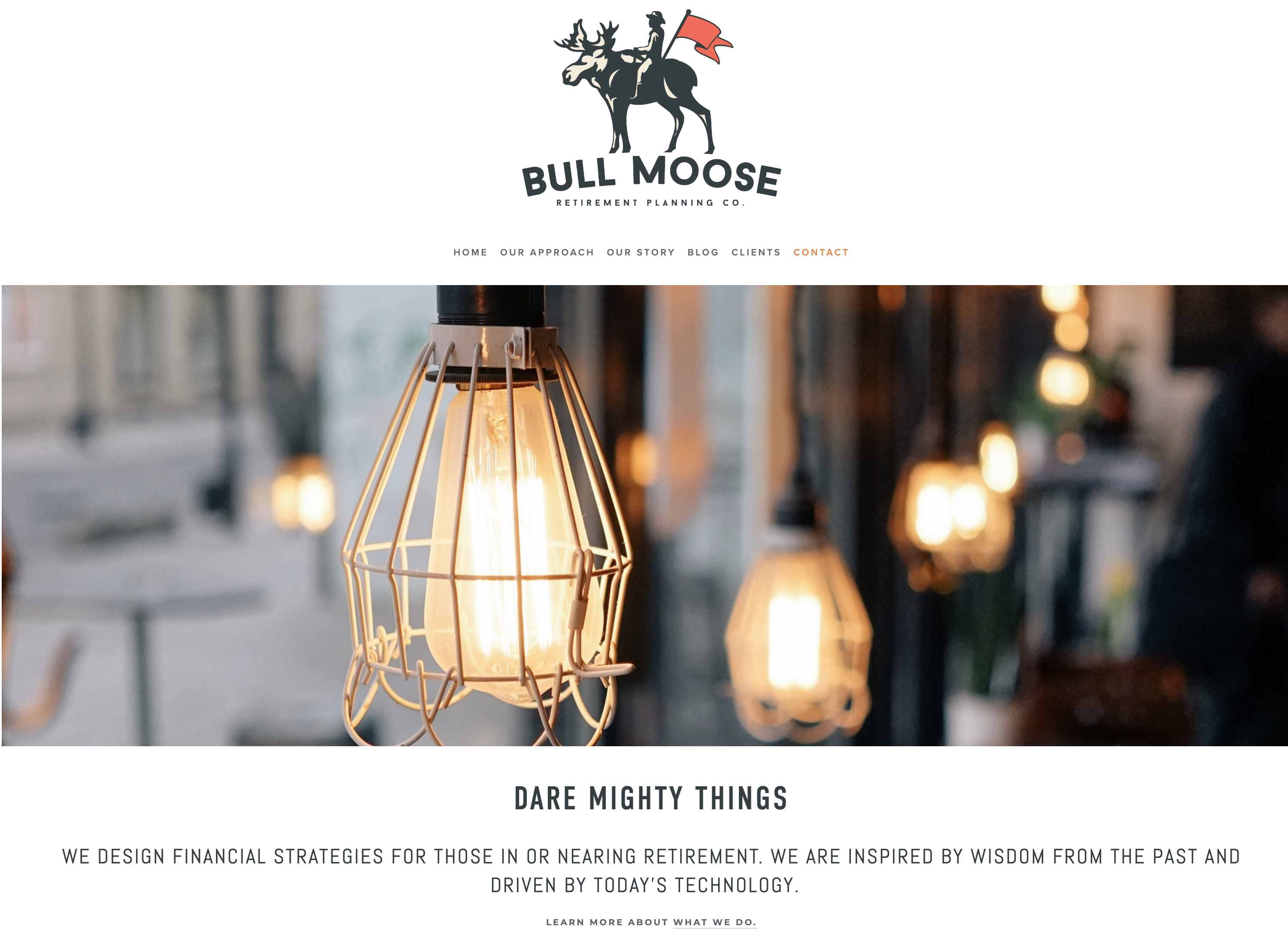


7. Bull Moose Retirement Planning Co. | bullmoosewealth.com

Why It Works: Bull Moose Retirement introduces themselves with a classic, American aesthetic. The website uses clean design and high-resolution pictures to show quality – which can be a handy tool in demonstrating competency. “After all, if their site is good, I bet their other services are just as good…” Their message also describes their specialty: financial strategies for those in or nearing retirement. No-fuss, no muss (like Teddy Roosevelt himself).


8. Matthew James Tax & Wealth Management | matthewjames.com 

Why It Works: The biggest standout on Matthew James’ site is a little button right next to their “Schedule a Call” CTA – one that simply says “Start My Plan.”

When visitors are interested in learning more about Matthew James, but aren’t quite ready to make a call, they can take a three-minute quiz and receive a complimentary Retirement Financial Plan, sent directly to their inbox. They also have access to the Nitrogen Risk Number® questionnaire right from the MJ homepage. 

Putting interactive quizzes like these on your site can help you collect prospect information, boost engagement and even increase your conversion rate


9. Town Capital | towncapitalllc.com

Why It Works: You’ll notice many top financial advisor websites on this list succeed by deeply engaging a specific target client rather than attempting to appeal broadly. Specializing in a particular niche allows advisors to emerge as leading authorities in their field, leveraging unique growth opportunities where their expertise meets financial advisory needs.

Town Capital exemplifies this approach, targeting nuclear power plant professionals. This focus is immediately evident upon visiting their website, where every element, from the tagline to the copy and imagery, reinforces their unique position in the market. For advisors serving distinct industries, Town Capital’s strategy of integrating their niche into every aspect of their website offers a compelling model to emulate.


10. Bush Wealth Management | bushwealthmanagement.com

Why It Works: Visitors to Bush Wealth Management’s website are immediately greeted with a stunning hero video, which sets a dynamic and engaging tone right from the homepage. It complements the site, which is both visually appealing and effortlessly navigable.

The prominent display of their accolade as a ‘Top 100 Advisor’ by AdvisorHub not only elevates their prestige but also serves as a powerful testament to their expertise and trustworthiness for potential clients.



11. PIP Wealth | piplp.com

Why It Works: “Do you know your Risk Number®?”

When you visit the PIP Wealth website, that question is likely the first thing you notice – it’s in bold, large letters across the top of the screen, even above their menu bar. 

Putting a question front and center on your site is an effective way to pique curiosity, boost engagement and promote self-reflection. That strategy also fits in well with PIP Wealth’s homepage copy, which focuses on personalization and individuality. 
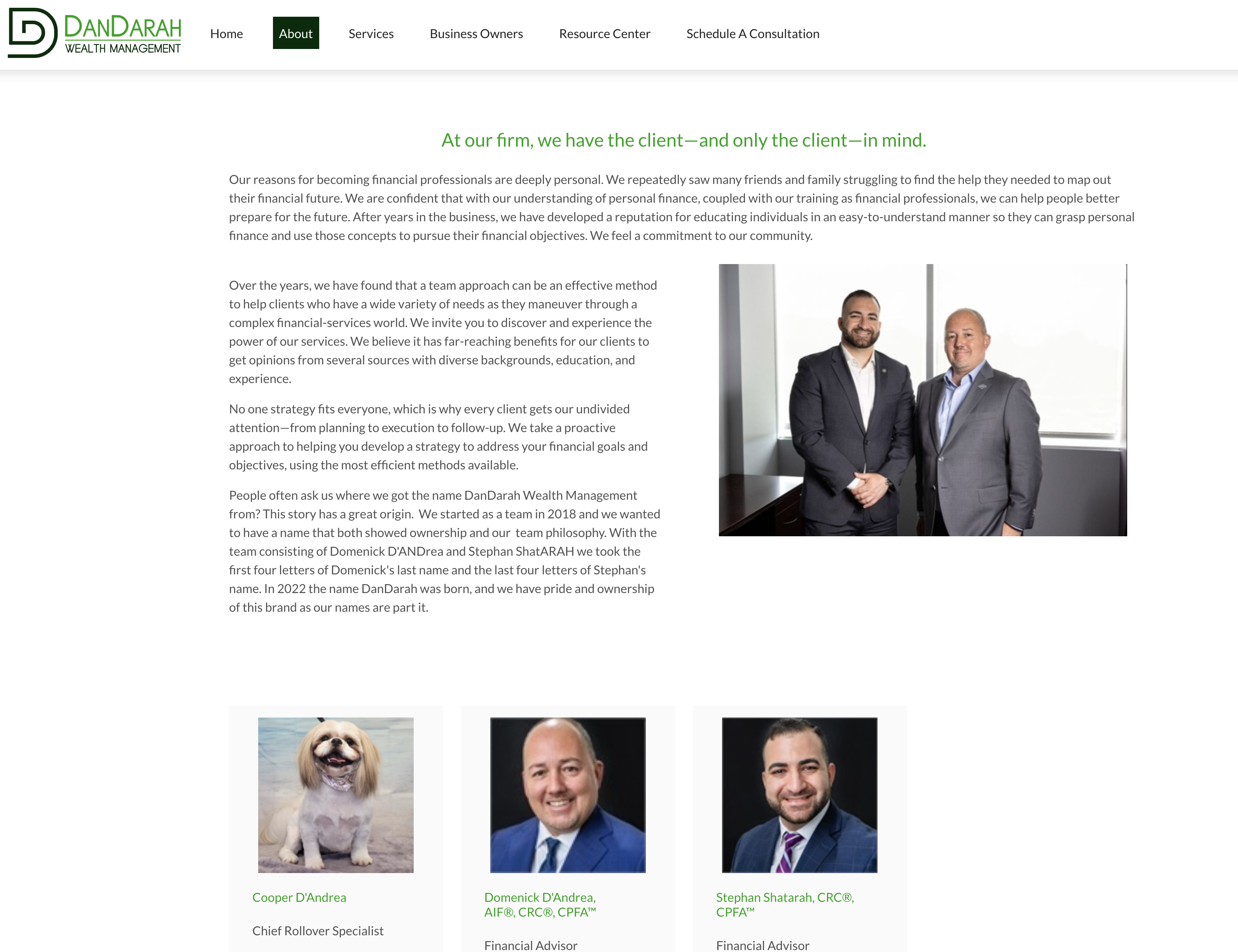


12. DanDarah Wealth Management | dandarah.ceterainvestors.com

Why It Works: Can you guess which of DanDarah’s staff loves belly rubs, taking daytime naps and guarding their office from rabbits?

That would be Cooper D’Andrea, DanDarah’s own Chief Rollover Specialist!

While the majority of your staff is likely human, it might be worth your while to “throw a bone” to any four-legged team members. By putting a pup on their staff page, DanDarah is showing personality and offering an opportunity for connection. After all, over 65 million households in America own at least one dog!
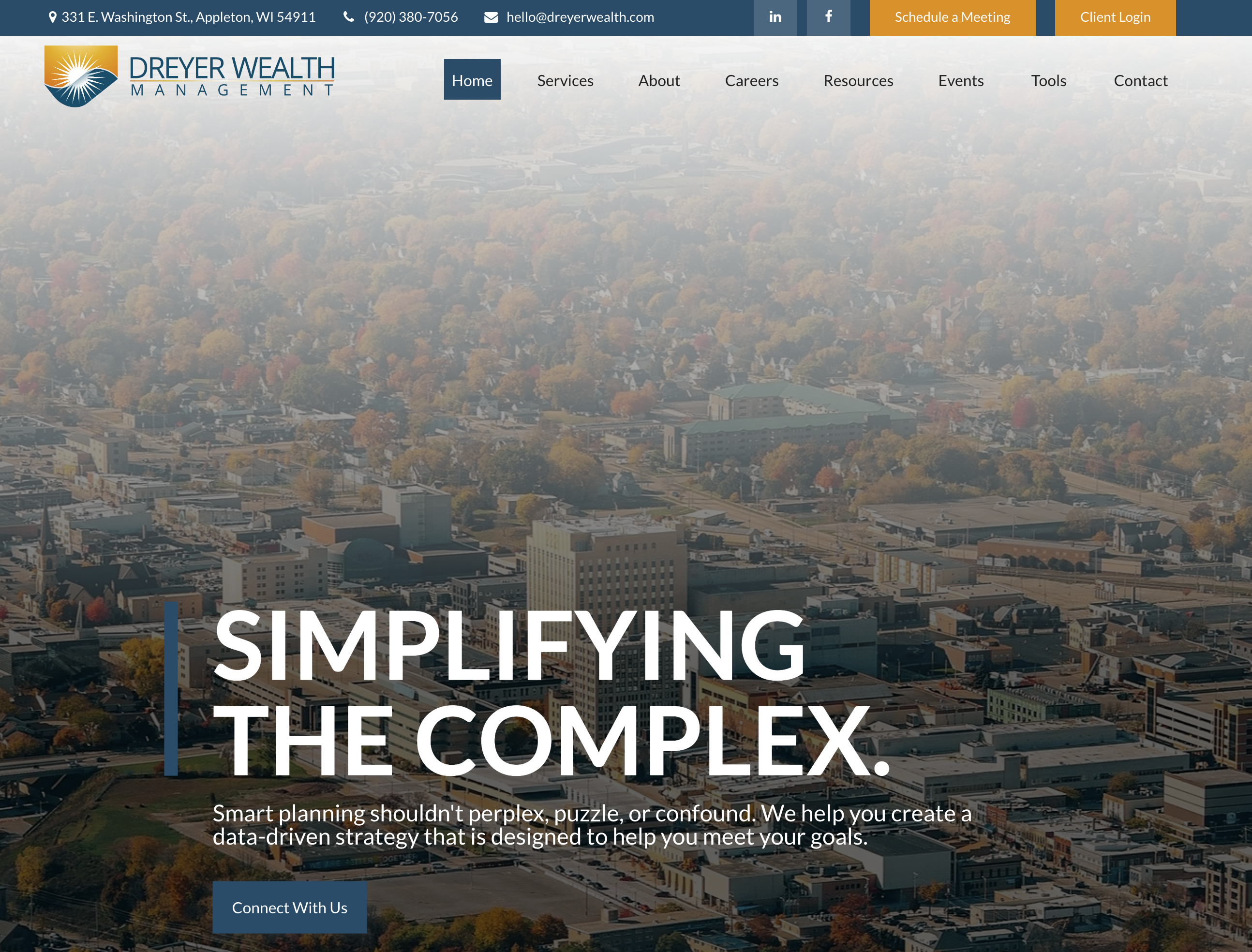


13. Dreyer Wealth Management | dreyerwealth.com

Why It Works: If there’s one thing every advisor website should absolutely have, it would be a clean, intuitive interface. If a prospect can’t find a way to contact you, you might be losing out on potential business. Similarly, a confusing page structure could annoy visitors and leave them with a bad impression. 

The Dreyer site exemplifies a strong user experience with clear CTAs, contrasting colors and short, bold copy. All of their contact information is visible along a top bar, and their menu is organized in a simple, straightforward way. 


14. Good Financial Cents | goodfinancialcents.com

Why It Works: Good Financial Cents stands out for its use of clear, relatable language that resonates with the average investor, exemplified by straightforward menu options like ‘make money’ and an engaging homepage statement: ‘I teach people insanely actionable wealth building strategies to increase income and work toward financial freedom.’ This approach demystifies financial concepts, making the site exceptionally accessible and appealing to those seeking practical advice on wealth building and financial independence.


15. CUSO Financial | cusonet.com

Why It Works: None of your marketing materials –  be it your website, advertisements or social media – would be possible without the power of proper disclosures. 

But fitting disclosures into your website can feel like a complicated puzzle. Are they prominent and visible enough? Will they distract site visitors? 

CUSO Financial is taking a new approach to that problem by placing a section just for disclosures along the top menu bar of their site. Regardless of what page you’re on, you can easily click and see whatever disclosure you need. In the age of ever-increasing compliance, this straightforward and transparent approach is refreshing, which prospects and clients might appreciate. 
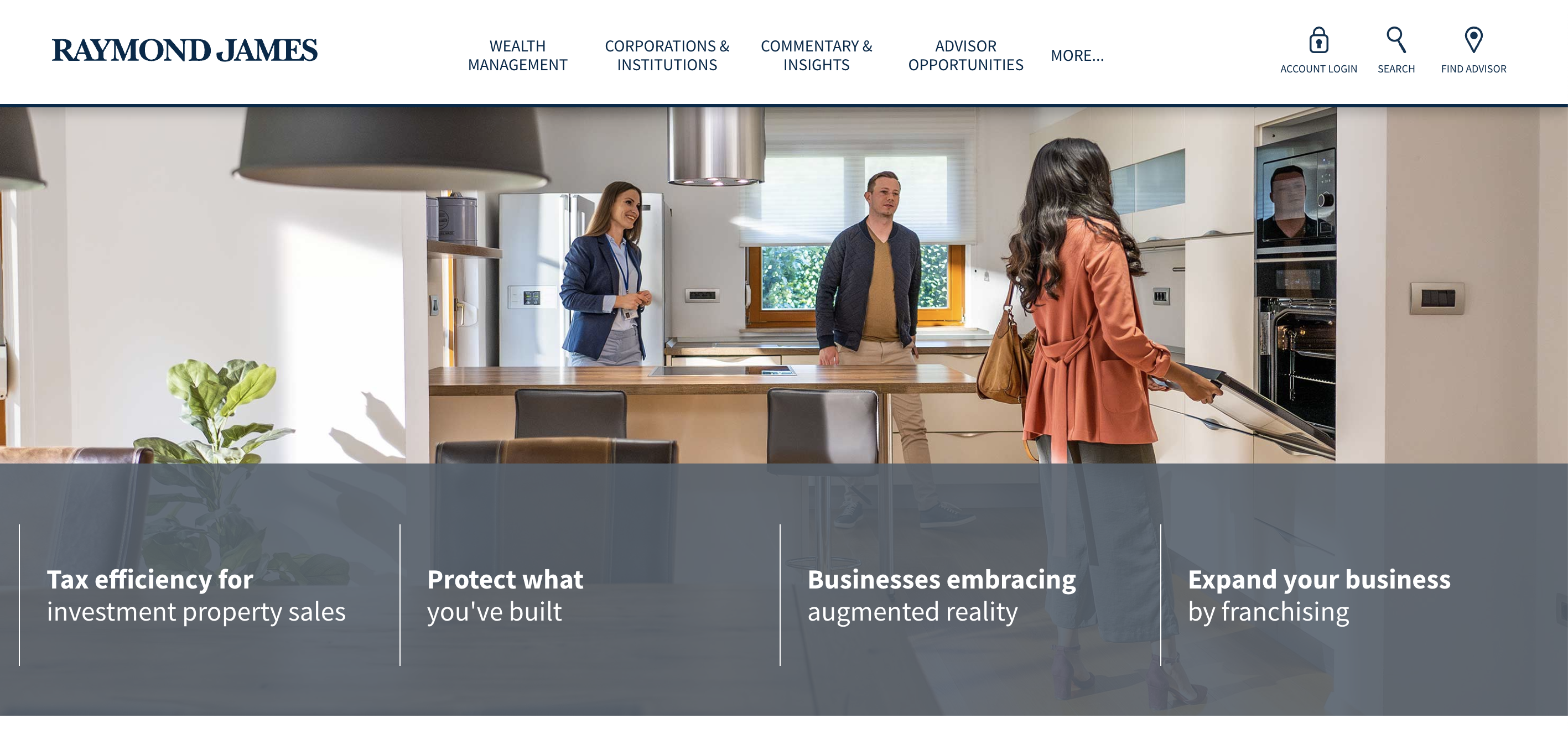


16. Raymond James | raymondjames.com

Why It Works: Raymond James’ website mixes old-school sophistication with sleek, tech-inspired images, bringing a professional and established feel to their firm. 

Their site reminds us that while bright colors and hyper-niched brands are increasingly common, there’s also room for traditional, muted hues and a focus on business. In fact, this clutter-free approach can give your firm a more established, authoritative feel, which may increase trust with prospects. 



17. Millennium Planning Group | mpgplan.com

Why It Works: One of the first words you’ll see on Millennium Planning Group’s website is “humancentric.” Nearly every single picture on the site features smiling faces of families spending time with each other, and their About page states how important it is for their advisors to really get to know clients. Yet, the majority of MPG’s client interactions are totally virtual and they operate on a 100% paperless basis. 

Many tech-first firms would have chosen sleek, software-heavy images and copy – but the MPG website is a stellar example of how firms can break the status quo in their digital messaging to meet evolving needs. 


18. Dynamic Wealth Advisors | dynamicwealthadvisors.com

Why It Works: You don’t have to develop your own quiz to put interactive elements on your advisor website. Dynamic Wealth Advisors accomplishes that engagement with colorful cards that flip when hovered over, each addressing a different financial planning topic. 

They’ve also embedded a Google Maps section where site visitors can enter their own address to find a nearby DWA location – which serves to keep prospects on their site longer and is a simple way to add a little extra value to the overall experience. 


19. Investably LLC | investably.com 

Why It Works: Sometimes prospects and clients need a little perspective to truly understand the value of a financial planner. Investably gets to the heart of that with a bold YOLO-esque tagline: “You only get one life. Make it a great one.”

Rather than focusing on whatever issues prospects need solved, Investably presents the end result of working with their firm, which they describe as “a sustainable life of abundance and happy moments.”

Combined with free resources and a bright, clean aesthetic, the website is effective at answering all questions before they’re even asked – while also keeping visitors’ eyes on the prize.


20. Moors & Cabot | moorscabot.com

Why It Works: Moors & Cabot has been in business over a staggering 130 years, but they still describe themselves as a sort of startup. 

That’s because they’ve built their firm on a long history of future-forward thinking and innovation. When prospects visit their site, they can watch a short video on the firm’s historical roots, and then explore the software solutions Moors & Cabot use to solve clients’ financial challenges. 

Their site exemplifies how firms can evolve their processes and services while still retaining the core of their brand – and even turn that evolution into an effective brand story. 


21. AIM Advisors | aimadvisorsnc.com

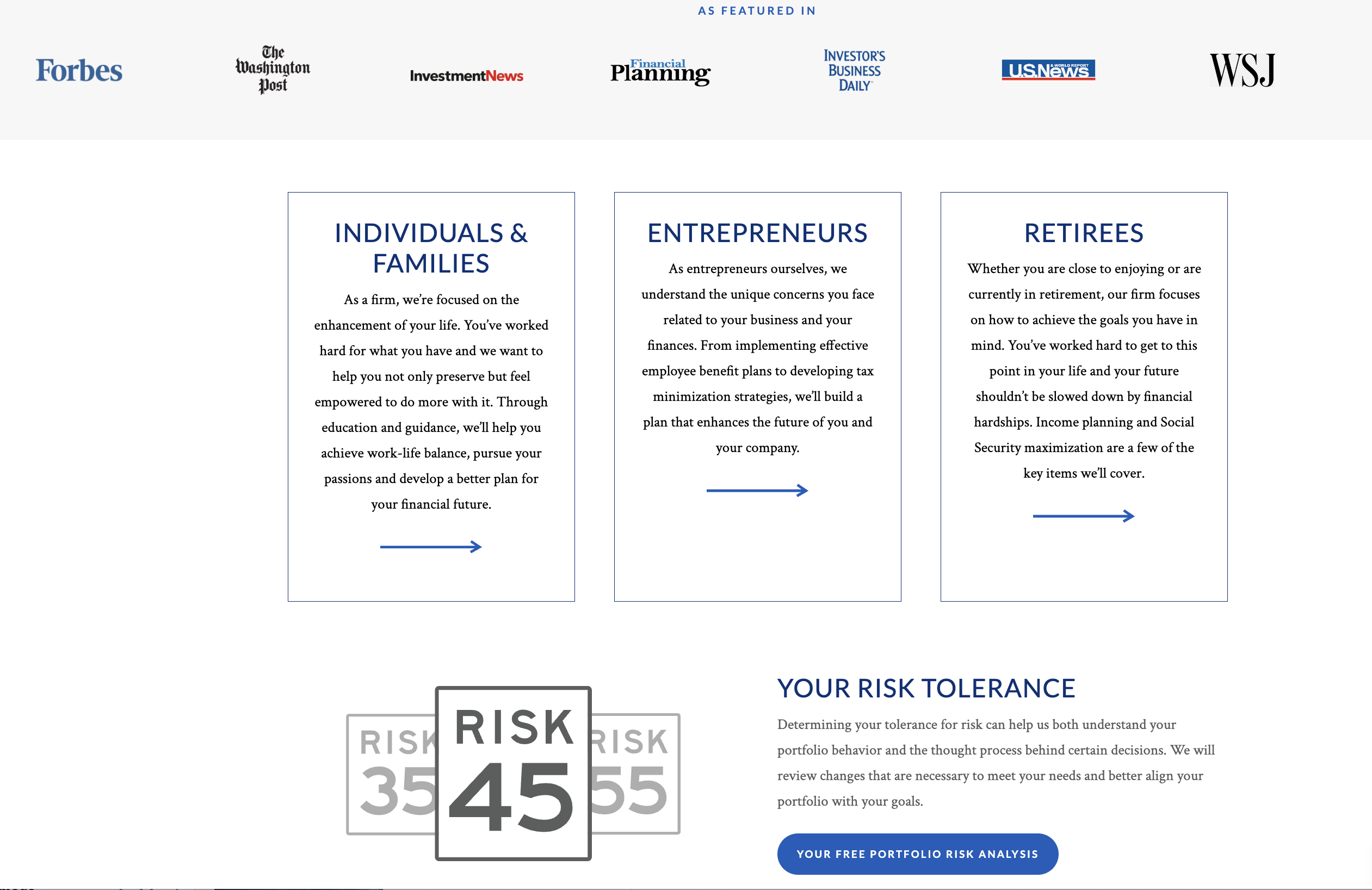
Why It Works: AIM Advisors stands out as a premier financial advisory firm, earning its distinction through strategic showcasing of notable features in leading publications such as the Washington Post, WSJ, and CNBC, which enhances their credibility and market presence.

Their website effectively caters to diverse groups including individuals and families, entrepreneurs, and retirees, further enriched by offering a complimentary Risk Tolerance Questionnaire, inviting potential clients to engage directly and understand their portfolio risk, an innovative approach blending client education with interactive engagement.


Get Started with Nitrogen

Ready to make your advisor website a lead generation machine? Click here to request a free demo of Nitrogen and learn more about how to transform conversations with the Risk Number.

8 Factors to Consider When Selecting a Wealth Management Platform for Growth

The tools your firm uses are more than just one-off solutions – they shape the way your advisors and clients think about finances, interact with one another and make important decisions. In many ways, choosing the right software for your team is similar to finding a trusted partner. 

And since implementing and training that software can be time-consuming and costly for your team, it’s critical that you research and choose solutions that fit your firm’s needs in  2024. Wealth management platforms provide a wide range of solutions at each level of your organization – but as your firm looks to achieve growth in the coming years, how can you feel confident in choosing software that’s a best-fit for your practice?

In this guide, we’re exploring what a true growth-focused wealth management technology looks like, as well as eight key factors you should consider as you choose a wealth management solution for your firm in the new year. 

What is a Growth-focused Wealth Management Platform?

A wealth management platform is a software solution built for RIAs and advisory firms, providing tools to help these teams manage client assets, enhance lead generation, streamline compliance and improve the overall client experience. 

Growth-focused wealth management platforms take these key goals and kick them into overdrive, building integrations, processes and solutions for firms looking to achieve sustained growth and success. They go beyond basic asset management to provide a comprehensive suite of tools and features that support the expansion and advancement of your team. It’s about building truly scalable efficiency. 

Related: Uncovering the Secrets of Hyper-Growth Firms

At Nitrogen, we sum that up in one simple phrase: We empower the world to invest fearlessly. From your advisory team to support staff, compliance and clients alike – a wealth management platform built for growth should give you the tools you need to achieve more with confidence.

8 Factors to Consider When Selecting a Wealth Management Platform for Growth

Let’s explore the eight key benefits you should look for when choosing wealth management software for your RIA, including tech integrations, lead gen, analytics capabilities and more. 

1. Technology integrations

Choosing a piece of software isn’t as simple as finding a great vendor – you also need to ensure that the new technology can work well with your existing systems. While siloed systems leave room for both user and data error, true integrations provide firms with efficiency, security and scalability.

InvestmentNews Research’s 2022 Adviser Technology Study found that the average advisory firm uses five different tech partners, while a third of the respondents indicated they were looking to expand that number by adding even more tech solutions to their stack.  

Even more telling, that same study found that 57% of advisors pinpointed a lack of integrations as their biggest tech pain point. Simply put: A standalone solution could bring more headache than it’s worth. 

As you begin your search for wealth management platforms, it’s essential to know whether the solutions you’re considering have the integration capabilities your firm needs. For example, the Nitrogen platform is built on six core APIs (with more in the works) that allow you to easily integrate with:

  • Popular CRMs (such as Redtail and Salesforce)
  • Portfolio management systems 
  • Trading platforms
  • Your firm’s own data lake or warehouse
  • 40+ other technology providers

Click here for a comprehensive list of Nitrogen’s integration partners

2. Lead generation

Lead generation is any strategy, tool or resource your firm uses to generate interest in your services, while also giving you more information about potential prospects (like their demographics or email addresses). Case studies, webinars, newsletters and even in-person events could fall into the lead gen category. 

And while it’s no secret that many firms are switching up their lead gen strategies – opting for social media, in-person events and newsletters over cold-calling or more traditional ads – are advisors effectively tracking, nurturing and following up on those leads?

Historical data points to no, with one 2016 study showing that “just 38% of firms formally tracked leads.”

The answer to that problem may lie in advisor software solutions built specifically with lead generation in mind. SmartAsset reports that “over 63% of advisors are using lead generation platforms more this year [2022] when compared with previous years.”

Top wealth management platforms will, of course, incorporate that lead outreach into their larger processes. At Nitrogen, lead generation begins with our proprietary Risk Number®, which gives site visitors a simple and quick way to understand their risk alignment. 

Related: The risk-oriented, client-first approach that really works

With just a few lines of code, your firm can engage leads, gather key prospect information (including name, email, goals and net worth), and boost conversions. 

Fun fact: One Nitrogen client saw a 15% increase in prospects after incorporating the Risk Number® questionnaire!

3. Analytics, research and reports capabilities

Long-term growth doesn’t happen on luck and whims, it’s driven by real data. As you’re searching for wealth management tools for your firm, it’s a good idea to look at their research and analytics capabilities, such as:

  • Securities screening: You shouldn’t have to manually search hundreds of thousands of securities to find the best fit for each of your clients. With tools like Discovery, you can filter and search for securities based on client needs. 
  • Stress tests: Modeling scenarios is a must for finding solutions tailored to your clients. 
  • Detailed portfolio analysis: Our portfolio statistics tools give advisors access to modeled performance comparisons, sector breakdowns, regional exposure and more – all through the lens of risk. 

What happens when you have proper analytics and research at your fingertips? Advisors get the full picture, clients see intuitive reports and compliance has a repeatable, documented process across your entire firm. 

4. Scalability and consistency

As your firm grows and you add more talent to your team, it’s important to create a consistent client experience, both from a retention perspective as well as compliance. 

To that end, your wealth management platform of choice should offer comprehensive training resources and ongoing support, ensuring all team members – regardless of their level of expertise – can effectively use the platform.

Ask your potential wealth management vendor about how their implementation and processes function across a team of two or a team of 200. 

5. Compliance

Compliance can eat away at your advisors’ time – keeping their focus off of client service and adding more “background” tasks to their already busy schedules. 

Investopedia reports that “some advisors say that they spend an aggregate average of one day per week dealing solely with compliance issues.” That’s why technology that automatically monitors and alerts advisors to potential issues is so critical for growth-focused RIAs. 

Related: How much time can your firm save by using Nitrogen?

A compliance-focused wealth management platform will save time and benefit members at each level of your firm:

  • Advisors: When your advisors  immediately know which accounts need attention, they can take action – keeping clients happy and retaining at-risk revenue. 
  • Compliance officers: The right tech gives your compliance team a birds-eye view and thorough documentation for regulatory purposes. 
  • Executives: Your managers and executives can feel confident knowing they’ve given their team the tools they need for success. 

When compliance starts feeling more like an opportunity than a challenge, you know you’re on the right track. 

6. Talent growth and retention

Having the right resources and tools available is key to attracting (and keeping) top advisors at your firm – especially as many advisors age out of the industry. 

You’ve likely heard of the Great Wealth Transfer, where an estimated $84.4 trillion in assets will pass from older generations to their heirs in the coming decades. On a smaller scale, that phenomenon could parallel advisor demographics, coinciding with a recent trend toward aging advisors. 

Barron reports the average advisor age as 57 in 2022, up from 54 in 2020. Firms looking for continued growth will need to find strategies for attracting young talent while keeping their tenured advisors happy – as well as any clients affected by staffing changes. 

Related: Unlocking Your Professional Potential Through Personal Development as a Financial Advisor

A big piece of that puzzle is your firm’s core technology, including your wealth management platform of choice. 

In Advisor360°’s 2022 Connected Wealth Report, more than half of respondents said “they consider their technology platform to be an extension of their practice.” Tech isn’t just a part of the advisor toolbox, it’s integral to how they serve their clients on a daily basis. 

That same report showed that “65% of advisors have lost business from clients and prospects because of outdated technology.”

As you browse wealth management platform solutions, be sure to inquire about their onboarding and training, ongoing support services and other advisor resources. 

7. The client experience

Your advisors are one half of your business, the other being your clients. 

And clients want to be treated like individuals, not just another name in your book. Forty-seven percent of clients wish their advisor would reach out more, a number that jumps to 53% for the higher net worth crowd and roughly 56% for those under the age of 60. 

And while spending more time with clients seems like an easy solution, more than one in four advisors say they simply don’t have the time. The answer to this problem may lie in your platform of choice. 

Your asset management platform should foster a personalized and meaningful client experience, emphasizing a deep understanding of each client’s unique aspirations, concerns and financial goals. 

Nitrogen users have access to tools and resources to know when a client might need your team’s attention. For example, our Check-ins tool is an automated behavioral coaching system that keeps advisors alert and informed about their clients’ psychology. 

Related: Nitrogen demystifies investment conversations for clients with clear illustrations

From there, they can send firm-branded emails to the client asking “How do you feel about the markets?” and “How are you feeling about your financial future?” Your advisors can also share customized analytics illustrations in just a few taps – answering client questions before they’re even asked. 

Our Stress Test reports also offer important perspective to clients who might be wondering why their portfolio differs from market averages, and how that connects to their risk tolerance. It’s one thing to talk through the hypotheticals with a client – it’s another thing to show them. 

8. Your firm’s future

When choosing new software for your firm, it’s important to think about your firm’s future – and that includes what’s on your radar for the coming year as much as your five-year or ten-year goals. 

One report points to a consistent growth of RIA hires in recent years, citing a 6% spurt in 2021 alone. Charles Schwab predicted in their 2022 RIA Compensation Report that the industry will need to add “more than 70,000 new staff over the next five years.”

With that in mind, it’s likely that your firm will continue to add employees – and you need an asset wealth management platform that’s built to support that growth. 

The number of clients seeking professional financial services also continues to climb. The Investment Advisor Association reports that “the number of clients using asset management services increased in 2022 to a record high of 54.3 million.” 

Statista echoes that statistic, telling us that the number of clients working with SEC-registered advisors is growing, with 61.9 million in 2022 (54.3 million of which were asset-managed clients).

If your firm’s growth is on track with these trends, you’ll need a platform that can support both asset management advisors and client growth to help your organization thrive. 

Related: Click here to download your free copy of our High Growth Playbook

Selecting the right wealth management platform is a critical decision for the growth and success of your advisory firm. A growth-focused platform should provide technology integrations, robust lead generation capabilities, advanced analytics and research tools, scalability, compliance support and more. It should also prioritize the client experience and be adaptable to your firm’s current and future needs.

As you go about choosing a growth-focused wealth management platform for your firm, these eight considerations can help you weed down your options and choose the best solution for your team. 

Get Started with Nitrogen

Nitrogen is modernizing wealth management to expand your firm’s impact and scale your client experiences. To learn more about how Nitrogen can benefit your organization, connect with a member of our team or request a free demo today.

Turbocharge client relationships with these 6 personalization examples

Creating solid client relationships is essential to lowering churn, improving retention, and generating referrals. But as a firm begins to grow, financial advisors must learn to balance relationship building with tracking portfolios and designing investment strategies. 

Digitization of the communication process has helped. Yet, a common concern among fiduciaries is maintaining a personal connection with their clients. For that reason, many avoid automation in their marketing and communication workflows, believing that it offers only a “one-size-fits-all” approach that generalizes client needs. 

This couldn’t be further from the truth.

Technology allows advisors to design a personalized experience. This applies to both their marketing and communication efforts, with the most well-known example being personalized emails. With a personalization effort, you can automate welcome emails, separate client and prospect communications, and tap into a client’s immediate needs. One study found that organizations leveraging personalization earned 40% more than their competitors. 

Before we dive into how you can apply personalization at your firm and look at some examples, let’s review the scope of personalization and what it means today. 

What is personalization?

Personalization is creating personal and relevant communication between two or more people. It ensures that clients feel like a person, not a number, and boosts client satisfaction. It is obligatory to create strong relationships with clients, especially if you plan to use digital or automated tools. There are various types of personalization, with advisory firms usually focusing on marketing, email personalization, and website personalization. Personalization in marketing can include both content personalization and targeted advertising with Google Ads or social media. 

Essentially, a personalized experience often translates to providing relevant content or following up with clients at the right time. 

Many advisors struggle with maintaining a sense of personalization while scaling their business. Creating individual, personalized messages for each client is time-consuming and can significantly slow down growth. But with continuing technological innovation, it’s become possible not only to sustain a personalized client experience but also to automate many of the processes.

And it’s incredibly effective. Organizations that use personalization may generate up to 40% more revenue than those that don’t.  And over half of overall consumers say that this practice improves brand satisfaction

In other words, a personalized experience can boost your revenue and client retention. But if you’ve never tried this tactic, it can be challenging to find where to start.

Below, we’ve listed some simple and easy-to-implement examples specific to financial advisors.

6 personalization examples for financial advisors

Unlike e-commerce personalization, which may include automated product recommendations, the toolset that works best for most financial advisors revolves around personalized content. Below are some of the six ways that advisors can leverage a personalization strategy to improve acquisition, client satisfaction, and retention. 

1. Welcome emails

The automated welcome email can be considered a quick win for many firms. When you add a new client or prospect to a mailing list, you can create an automatic welcome email with their name. This can be a great way to keep you top of mind, but can also make a client feel more appreciated.

You may also be able to add additional information, such as the date, service provided, and other key details. All of these are made possible through the use of tags – a short code that inserts a client’s information directly from your CRM or mailing list data. Each platform may have its own tag versions. They are usually labeled as personalization tags.

Ideally, you will want two automated sequences if you email clients and prospects. This enables you to ensure that the recipient receives relevant information. 

2. Onboarding emails

Similar to the welcome email, you can send an onboarding email to new clients with specific information. These would not be sent to potential clients but add a layer of support to your email marketing campaign. This can include key information, such as your contact details, product offerings, worksheets, risk assessments, ebooks, or other useful tools. 

Often, an onboarding email is part of the welcome email automation process. You may also have different email flows based on client segmentation. For example, you may have specific materials for new clients about to retire versus families saving for their children’s education. This additional step in your client journey offers an opportunity to easily build client trust. 

3. Milestone celebrations

Another personalized feature is birthday and anniversary interactions. You may choose to get an alert to call your clients on these special days, or you can send out scheduled emails or texts. Setting up a scheduled email with a template, personalized with the client’s name and relevant images, or even a video, can make this process easier to manage. 

4. Content recommendations

Another way to personalize your communications is to recommend specific content to clients. This tactic is usually a part of an email campaign. You could, for example, send separate content to clients with children versus those without. As both groups would be interested in different financial objectives, you can better tailor interactions with them and stay relevant. How you should segment clients and determine the best personalized content depends on your firm’s client base and focus.

5. Check-in emails

Personalization doesn’t always relate to the client’s identity or questions about finance. It can also be proactive communication. Sending a brief check-in survey to get a pulse on a client’s feelings about their portfolio or the market can make them feel like more than a number. At the same time, it enables advisors to better prioritize which clients to communicate with based on their risk tolerance. 

6. Client vs. prospective emails

Finally, it’s important to separate client and prospect communication. A client doesn’t need to be “sold” on your services. Likewise, a prospect won’t necessarily get much out of client-specific content. It’s possible to automate communication for both without eliminating personalized content. 

Content personalization best practices 

No matter which tactics you use from our personalization examples, it’s essential to consider the best practices. Here are some of the ways you can optimize your content personalization and client experience

Use their name, always

One of the easiest ways to help clients and prospects feel appreciated is to use their names in emails and other communications. This process is also easy to automate, as marketing tools can pull name data from your CRM or email list with a general code.

It’s also extremely effective. For example, an email is 50% more likely to be opened if you include the recipient’s name in the subject line. 

Segment your client base

Segmentation and personalization are often used interchangeably. But they aren’t the same, and it could be said that segmentation makes personalization easier. Client segmentation involves separating clients or prospects by demographic information. For example, you may divide clients by age, gender, or location. You can also make custom tags to segment clients via objectives or financial products. 

Customize your call-to-action (CTA)

Often, you will not want clients and prospects to have similar calls to action. Even among clients, there may be different things you want them to do. Outside of calling your office, you may want them to download an educational pamphlet, complete a survey, or read an article.

You may find that client segments react differently to actions. For example, elderly clients may have problems completing an online survey or opening a PDF – therefore, you may want to send them information that’s easy to access. Some clients may prefer videos to reading, so you may want to direct them to specific resources.

Leverage different content types

Not everyone responds to the same content type. Some clients prefer videos, while others may like text. It can be helpful to add both types or segment clients via content preferences. You can do this by asking them during onboarding. Many email tools enable you to see who has opened or clicked on content in an email, allowing you to determine who might be more interested in what kind of content. 

You can also make use of automated triggers to send content to specific clients or prospects. For example, if a prospect does not open an email, you can use automation to send another within three days to follow up or introduce another topic. 

More on building strong client relationships.

Personalization is a critical tool to strengthen client communications and boost retention. However, it’s not the only way to engage clients. Check out our recent guide on client engagement for more essential strategies for growing your firm.

Essential client appreciation message templates for financial advisors

Considering that 45% of clients leave their financial advisor within the first two years, boosting client loyalty is essential to maintaining and growing a firm. However, advisors must often juggle multiple time-consuming tasks and have limited time for additional client interaction. 

Since most client-facing tasks are meetings and meeting prep, it’s not uncommon for clients to evaluate their advisor more on short-term performance than trust in their long-term strategy.

Improved client loyalty stems from a strong relationship. But this kind of connection rarely forms from annual client meetings alone. Every additional direct client touchpoint that focuses on the person rather than the portfolio offers an opportunity for a better client experience and potential referrals. Client satisfaction can pay dividends, as companies with a 5% increase in client retention can boost profitability by 75%.

One easy-to-implement example of an additional client touchpoint is client appreciation messages.

Client appreciation messages offer financial advisory firms an additional touchpoint to the client journey — thus improving client satisfaction and retention. And unlike client appreciation events, these messages can immediately be added to your workflow. 

We’ve made it even easier for financial advisors to show clients they care with 7 templates. 

7 Client appreciation message templates

The following client appreciation messages are a foundation for emails or scripts to quickly offer gratitude. You can edit and transform these base messages to match your brand or personality. And with personalization technology, it’s even possible to automate or schedule some of these simple emails. 

1. Welcome message

Dear [Client’s Name],

I enjoyed our recent meeting, and I wanted to take a moment to express my sincere appreciation for choosing our services. We are truly grateful to have you as a valued client.

At [Firm Name], our top priority is your financial success. We understand that managing your finances can be a complex and sometimes overwhelming task. That’s why we are here to provide guidance and support every step of the way.

If there is anything we can do to enhance your experience or if you have any questions, please do not hesitate to reach out to us. We are here to help.

Once again, thank you for choosing [Firm Name]. We value your trust and remain dedicated to your financial prosperity.

Warm regards,

[Your Name]
[Title/Position]
[Company Name]

2. Birthday message

Happy birthday, [Client Name]! ??

On this special day, I want to take a moment to celebrate YOU and all that you have achieved. Birthdays are milestones that remind us to reflect on our journey and set new goals for the future. As your financial advisor, I am privileged to be a part of your financial growth and success.

As you blow out the candles and embark on another year, know that I am here to support you every step of the way. Whether it’s managing investments, planning for retirement, or navigating unexpected financial challenges, you can count on me and my team to provide personalized guidance tailored to your unique goals and aspirations.

Thank you for choosing our services and entrusting us with your financial well-being. It is a true pleasure to work with someone as diligent and motivated as you. I look forward to continuing our partnership and helping you successfully navigate your financial journey.

Wishing you a fantastic birthday filled with joy, happiness, and prosperity. May all your wishes come true, and may this new year bring you even greater financial success and fulfillment.

Cheers to another year of shared success!

Sincerely,
[Your Name]
[Title/Position]
[Company Name]

3. Joined Anniversary message

Dear [Client’s Name],

I hope this message finds you in good health and high spirits. As we approach the end of your first year as my valued client, I wanted to take a moment to express my heartfelt appreciation for the trust you have placed in me as your financial advisor.

Over the past twelve months, we have embarked on a journey together, navigating the intricacies of the financial world and working diligently to achieve your financial goals. It has been a pleasure to witness your commitment to securing your financial future and to be a part of your success.

Your unwavering dedication to our strategic plan and your willingness to explore innovative opportunities have truly set a remarkable precedent. Your open-mindedness and willingness to embrace new concepts and strategies have made our partnership exceptionally fulfilling.

As we move forward into the next year, I want you to know that my commitment to your financial well-being remains unwavering. Together, we will continue to explore avenues for growth, seize opportunities, and overcome any challenges that may arise.

Once again, thank you for entrusting me with your financial affairs and allowing me to be a part of your journey towards financial prosperity. It is clients like you who inspire me to go above and beyond, and I am honored to be your financial advisor.

Should you have any questions or concerns, please do not hesitate to reach out to me. I am here to provide the guidance and support you need every step of the way.

Wishing you continued success and prosperity in the years to come!

Warmest regards,

[Title/Position]
[Company Name]


4. New Year

Dear [Client’s Name],

As we bid farewell to the old year and welcome the new one, I wanted to take a moment to extend my warmest wishes to you for a Happy New Year. Working with you as your financial advisor has been an absolute pleasure, and I am grateful for the trust and confidence you have placed in me.

The past year has been filled with both challenges and opportunities, and you have shown resilience and determination throughout it all. Your commitment to your financial goals and your dedication to making informed decisions have truly impressed me.

I want to express my sincere appreciation for your continued support and loyalty. Your partnership has allowed us to navigate the ever-changing financial landscape together, and I am confident that we will achieve even greater success in the coming year.

May the new year bring you prosperity, good health, and happiness. I am committed to providing you with the highest level of service and expertise as we embark on this new chapter together. Please know that I am always here to answer any questions or concerns you may have.

Once again, Happy New Year! 

Warm regards,

[Your Name]
[Financial Advisor]
[Company Name]


5. Positive Milestones

Dear [Client’s Name],

I hope this message finds you in good health and high spirits. Today, I am filled with immense joy as I write to you, my esteemed client and friend, to celebrate a momentous occasion in your life. It is my honor as your trusted financial advisor to be a part of this important milestone and share in your happiness.

On this special occasion, I want to express my heartfelt congratulations to you. Your unwavering focus and commitment to your financial well-being have paid off, and it fills me with immense pride to see you achieve such great success. Your accomplishments demonstrate your financial acumen and your ability to turn dreams into reality.

This milestone serves as a reminder that through perseverance and a clear vision, anything is possible. As we celebrate this significant achievement, let it serve as a stepping stone towards even greater accomplishments in the years to come.

Once again, congratulations on this amazing milestone! I am grateful for the opportunity to be part of your financial journey and look forward to continuing our partnership as we pursue new goals and aspirations together.

Wishing you continued success, happiness, and prosperity.

Warm regards,

[Your Name]
[Title/Position]
[Company Name]


6. Automated responses 

Dear [Client’s Name],

Thank you for your message. I appreciate hearing from you, and I will send you a response as quickly as possible. 

If you have any further questions or require additional assistance, please don’t hesitate to reach out to me. I am committed to helping you make informed decisions and ensuring your financial success.

Thank you once again for being a valued client. Your loyalty is key to our mutual success.

Warm regards,

[Your Name]
[Title/Position]
[Company Name]


7. Client referrals

Dear [Client’s Name],

I hope this message finds you in good health and high spirits. I wanted to take a moment to express my sincere gratitude for the referrals you recently sent my way. Your trust in my services and willingness to recommend me to your friends, family, and colleagues means a great deal to me.

As a financial advisor, my ultimate goal is to provide valuable guidance and support to my clients. Your referrals not only validate the quality of our relationship but also signify the confidence you have in my expertise. I am truly honored and humbled by your kind gesture.

I assure you that I will extend the same level of professionalism, commitment, and personalized service to anyone you refer to me. Your referrals will receive my utmost attention and dedication as I strive to meet and exceed their expectations, just as I have with you.

Once again, thank you for your generosity and for being an invaluable part of my business. Your trust and confidence in my abilities are truly appreciated. If there’s anything further I can assist you with, or if you have any questions or concerns, please do not hesitate to contact me.

I wish you continued success in your financial endeavors and look forward to serving you and your referrals in the future.

Warm regards,

[Your Name]
[Title/Position]
[Company Name]

Foster client retention

Client appreciation, even in the form of a digital thank you note, can inspire loyalty. And there are many opportunities for thanking clients. But this approach is only one tool to retain clients through increasing engagement. Discover more client engagement strategies in our online guide to take your firm to the next level.

8 tactics for your financial advisor seminar marketing

Financial advisor seminars provide an excellent opportunity to showcase your expertise, build credibility, and connect with potential clients. This marketing method is so effective that almost 1 in 4 advisors consider in-person events one of the most important outreach strategies in 2023.

Including financial advisor seminar marketing in your long-term marketing strategy is important, as you will need to spread the word about your upcoming event. Including this element in your plan can help you have a successful seminar. 

In this article, we will discuss the key steps to market a financial advisor seminar and attract qualified prospects.

8 ways to market your seminar

To attract qualified prospects, you will likely need to do more than add your event to your advisor’s website. Here are 8 seminar marketing tips to help you attract more attendees.

Develop a comprehensive marketing plan

First,  you’ll want to pull out your marketing plan, and if you don’t have one, create a quick draft. A detailed roadmap outlines your marketing strategies and tactics. It enables you to better budget, prepare, and measure your events.

To start with, you’ll want to identify your target audience, set specific goals, and allocate resources accordingly. You will also want to consider how your offline presence will interact with your online marketing efforts. As you will discover, the two often intersect.

Decide on your attendance incentives 

The content of a seminar itself is unlikely to attract enough people to justify the costs – at least in the beginning. It is often helpful to structure your seminar as a part of another event. Dinner seminars are popular with prospective clients, but this could easily be brunch. You could potentially advertise your seminar as a type of workshop. While you won’t be able to give specific advice, you could help prospects work through financial planning worksheets or learn to dissect a prospectus. 

Leverage digital marketing channels

Digital platforms such as social media, email marketing, and website calendars allow you to promote your financial advisory seminar fairly quickly. You can tap into your current and prospective client base without spending too much. In fact, these organic options tend to be free — although you can pay for social media posts to boost visibility. 

However, to better optimize these platforms, you’ll likely want to post about your seminar more than once, and well in advance. Posting about your seminar at least once a week over the course of a month ensures more people will see it.

Use targeted advertising

Use online advertising platforms, such as Google Ads or Facebook Ads, to target specific demographics and interests relevant to your seminar topic. Craft compelling ad copy and visuals that clearly convey the value proposition of attending your seminar.

You can also take advantage of ad space in local newspapers, magazines, or billboards. However, it should make sense for your budget. 

Harness the power of content marketing

Publish valuable and informative content related to financial planning, investment strategies, and retirement planning. This positions you as an industry expert and builds credibility. Share this content through blog posts, articles, videos, and podcasts, When disseminating this content, include a call-to-action to attend the seminar. However, as content marketing can take time to ramp up, you may need to plan these posts 3 months in advance or more. 

Host educational webinars

In some cases, you may want to create a “pre-game” seminar. Conduct webinars that provide valuable insights and education on financial topics. Promote these webinars widely through your website, social media, and email newsletters. Convert webinar attendees into seminar participants by highlighting the additional aid or information they will receive in the in-person event. 

Collaborate with strategic partners

Work with other professionals in the financial industry, such as accountants, attorneys, or insurance agents, who share a similar target audience. You can then co-host seminars or cross-promote each other’s events, expanding your reach and increasing the number of potential attendees.

Tap into client referrals

Encourage your existing clients to refer their friends, family, and colleagues to your seminar. Offer incentives, such as discounted tickets or exclusive content, to incentivize referrals. Develop a referral program with clear instructions and rewards to maximize the number of referrals you receive.

What to include in your marketing materials

It’s important to include all the relevant information an individual may need to join the seminar. Key information include:

  • Dates
  • Hosts
  • Seminar topic(s)
  • Location
  • Length of seminar time
  • Contact number, email address, or advisor website address

If you are advertising your seminar online, you may want to use a registration link. Having potential attendees sign up for the live seminar enables you to send reminders and possibly improve attendance rates. 

Marketing during your seminar

Typically, your seminar itself is a marketing tool. For a successful seminar that converts a prospect into a client, it’s important to make your services and role clear by the end of the event. You may want to include the following at your event and mention them at the beginning and end of your seminar:

  • Business cards
  • Brochures
  • Pamphlets
  • Email list signup

Another tactic is to film your seminar. You can then use the replay to encourage attendees to sign up for your newsletter or when advertising for your next event. 

While you want to mention your firm and encourage participation, marketing should not be what your entire seminar revolves around. Instead, a potential client would value the relevant educational material and your expertise. Often, providing value is enough to get a callback.

That said, it’s important to remember that only some seminar attendees will become a client.

Take your firm to the next level

Seminars can be an excellent way to grow your firm—but to attract enough prospects, marketing is key. However, a live event isn’t the only option to scale your clientbook. There are various strategies to transform your business into a high-growth advisory firm. 

Learn more about how to reach more new potential clients and retain the ones you have in ouor High Growth Playbook.

A Deep Dive into Size & Style

In the intricate world of financial markets, the classification of companies based on size and style is a critical element that profoundly influences investment strategies. Diverse methodologies are employed by various organizations to categorize companies into distinct size and style categories. These methodologies vary from percentage-based tiered and relative calculations, offering stability in assignments, to more fluid assignments from fixed-based calculations. This blog delves into the complexities of size and style classifications, comparing different methodologies and their implications in discerning value, growth, and core companies within the market.

Determining Size

The classification of companies by size is a fundamental aspect of understanding market dynamics. Different methodologies are utilized to establish size categories, each with its own approach and implications. Morningstar and Lipper employ approaches that define capitalization ranges based on cumulative rankings, while entities like FINRA, and Standard & Poor’s, rely on fixed capitalization cutoffs or percentiles. Nitrogen, on the other hand, employs an adaptive approach by reevaluating cutoffs to capture evolving market conditions. These distinct methods result in varying classifications for companies at the margins, occasionally leading to disparities between methodologies. Despite these variations, the ultimate aim is to provide investors with insights into the diverse landscape of companies based on their sizes.  Let’s delve deeper into each of these approaches.

Morningstar’s size classification methodology defines the capitalization ranges as follows, based on a cumulative ranking of capitalization:

  • Large-cap: Top 70%, 
  • Mid-cap: Next 20%,
  • Small-cap:  Bottom 10% 

This approach establishes a flexible size cutoff that fluctuates with market price changes, while also providing a static definition of the market’s percentage in each size category.

In contrast, other methods such as FINRA’s fixed capitalization cutoffs set specific thresholds:

  • Large-cap: Over $10 billion
  • Mid-cap: Between $2 billion and $10 billion
  • Small-cap: Under $2 billion

Standard & Poor’s employs a combined approach with quarterly adjustments to fixed cutoffs. The size cutoffs most recently adjusted in 2022 are the following ranges:

  • Large-cap:  Over $12.7 billion
  • Mid-cap: Between $4.6 billion and $12.7 billion
  • Small-cap: Under $4.6 billion

Additionally, Standard & Poor’s defines the capitalization distribution as follows:

  • S&P 500: 85 percentile
  • S&P MidCap 400: 85th-93rd percentile
  • S&P SmallCap 600: 93rd-99th percentile

Lipper defines size classification similarly to Morningstar but varies based on region and a representative index. For U.S equity funds the distribution is determined based on the Russell 3000 index holdings.  

  • Large-cap breakpoint: Top 70% of total ranked capitalization
  • Mid-cap breakpoint: Between 70% and 85% of total ranked capitalization
  • Small-cap breakpoint: Bottom 15% of total ranked capitalization

For U.S. registered global/international equity funds, breakpoints are based on the MSCI World Index holdings with thresholds of:  

  • Large-cap:  Top 75% of total ranked capitalization
  • Mid-cap: Between 75% and 95% of total ranked capitalization
  • Small-cap”  Bottom 5% of total ranked capitalization

Nitrogen has evolved its approach from adhering to FINRA’s definition to restructuring cutoffs to align with market conditions.

Methodologies using a fixed percentage grouping within a ranking approach versus a capitalization-based cutoff may lead to firms with large capitalization values ranked as Mid-Cap or Mid-Cap securities classified as Small and vice versa.  For example, Metlife has a capitalization over $41 billion and is classified as Mid-Cap by Morningstar.  Conversely, there may be instances where Nitrogen classifies a security as Mid-Cap and Morningstar classifies the security as Large-Cap, like with Seagate Technologies that has a market capitalization of $12.5 billion. While there might be discrepancies, they typically occur at the margins and are infrequent.  

In a sample of over 3500 stocks, the capitalization between Nitrogen and Morningstar matched 89% of the time.  

Determining Style 

Investors often distinguish companies based on the broad categories of ‘value’, ‘core’, and ‘growth,’  each with its unique attributes and investment focus. Value companies are generally deemed “cheap” in terms of earnings or asset prices, while growth companies prioritize future earnings potential and consistent growth. Core companies fall between value and growth and exhibit the attributes from both value and growth.  These definitions guide style methodologies that encompass various metrics such as P/E ratios, P/B ratios, dividend yields, and growth indicators. Value investing focuses on lower P/E and P/B ratios with higher yield while Growth investing focuses on consistent revenue and earnings momentum resulting in higher P/E and P/B ratios with little or no dividends. Different entities adopt distinct methodologies for evaluating style. Morningstar utilizes ten factors divided into Value and Growth components, Lipper employs a set of six metrics along with index relative z-score calculations, while Nitrogen combines an absolute approach with periodic relative adjustments. These methodologies reveal the multifaceted nature of style classification and its implications on investment decisions.

The fundamental metrics utilized in the determination of style are fairly consistently based on these broad definitions, however, it is the application that results in differences. The application can be relative or absolute, forward or historical, based on varying years of historical data, weighted to certain metrics over others, and so forth. 

The general rule of thumb for value is where the P/B is less than or equal to one.  However, as the overall market cycles through bull and bear markets, this metric is also shifting. The average P/B over the 3 year period ending in 2022 on a universe of 5000 stocks is 11.7.  The average P/B over the 10 year period ending in 2022 is 9.  Does this shift mean more stocks have become growth and there are fewer value stocks? Relatively speaking, there were likely the same level of value stocks, just now carrying higher P/B as market conditions have driven prices higher.  In an absolute sense, a value investor would likely argue the other way in that there are fewer value “deals” available. Let’s delve deeper into each of these approaches. 

Morningstar Style utilizes 10 factors to determine style, separating them into Value measures and Growth measures. The application is similar to size in that it is relative to other securities in a defined peer group.  

Value(Yield) Measures-WeightGrowth Measures-Weight
1. Price-to-Projected Earnings (P/E) – 50%1. Long-term Project Earnings Growth – 50%
2. Price-to-Sales – 12.5%2. Book Value Growth – 12.5%
3. Price-to-Book (B/P) – 12.5%3. Sales Growth – 12.5%
4. Price-to-Cash Flow – 12.5%4. Cash Flow Growth – 12.5%
5. Dividend Yield – 12.5%5. Historical Earnings Growth – 12.5%

Each group of measures is scored and then a net value is determined by taking the resulting Value score minus the resulting Growth score. The thresholds are determined such that value, core, and growth stocks are each assumed to account for ? of total capitalization. For each variable in the above list, the float weighted average is determined for a trimmed universe in order to create a “market” relative score for each security. In addition, if the factor is negative it is excluded from the calculation. Growth metrics are based on the average of 4 years. This summary is high-level and not intended to represent all the aspects of the methodology, more detail is available from Morningstar.

Lipper utilizes similar metrics to determine the classification of a strategy. The Lipper method contains six factors: 

  1. Price-to-Book (B/P)
  2. Price-to-Earnings (P/E)
  3. Dividend Yield
  4. Return on Equity (EPS/BPS)
  5. Price-to-Sales
  6. Three Year Sales-Per-Share Growth

Lipper (Refinitiv) assigns each fund to an investment universe group in order to calculate an overall Z-score for a fund utilizing capitalization subsets such as MSCI World for global funds, MSCI EAFE for international funds, and S&P 500, S&P 1500, S&P 400, and S&P 600 for US funds as determined by the capitalization classification of the security. Each factor is equally weighted to determine an overall score z-score. Lipper’s distribution is not equally distributed for value, core, and growth. The z-score ranges results in a lower percentage to core relative to value and growth. Similarly, this summary is not intended to represent all aspects of the methodology, more detail is available from Refinitiv/Lipper.  

In 1992 Fama and French introduced their 3 factor model which was an expansion of the CAPM to include additional factors for style and size. The measure for style chosen was a single factor Price-to-Book to represent value versus growth. While this model is helpful, additional statistics are required to provide a clearer indication of the style of the stock.

Nitrogen utilizes an absolute approach while applying a periodic relative adjustment as needed.  

The similar measures Nitrogen utilizes are as follows: 

  1. Sales/Revenue growth
  2. Earnings growth 
  3. Price-to-Earnings (P/E)
  4. Price-to-Book (P/B)
  5. Dividend Yield

As shown in the examples above there are different methods to determine the style of a security. The underlying attributes of a company are ultimately what determines whether a company is a “deal” and classified as value or has the ability to deliver growth. The introduction of forced distributions or measuring a firm in a relative fashion can mask the financial condition of a company. The process of share or capitalization weighting to determine the market average also creates a bias where the financial conditions of the larger companies define what a value or growth company looks like.  

Attributes Within Indices and ETFs: ETFs based on indices offer insights into the average attributes of companies within core, growth, and value categories. These attributes, including revenue growth; earnings growth; P/E ratios; P/B ratios; and dividend yields, exhibit distinguishable patterns for each category. While these averages provide a general overview, it’s important to note that individual securities may deviate from the overall category trend due to their unique characteristics. For example, the largest holding in the SP500 Value ETF is Microsoft (MSFT), a growth stock which is also the second largest holding in the SP500 Growth ETF.  

The table below summarizes the attributes for a variety of index ETFs and demonstrates the consistency in the relationship between these factors and the classification of style. The value based indexes demonstrate lower P/E and P/B ratios with higher dividends and lower revenue and earnings growth in relation to the growth counterparts.

IndexRev GrowthEarn GrowthP/EP/BDiv Yield
S&P 50011.4%18.2%23.34.11.5%
S&P 500 Value8.0%13.2%21.72.71.9%
S&P 500 Growth17.8%22.4%24.87.00.9%
Russell 300011.5%18.2%21.83.71.4%
Russell 2000 Value10.6%18.9%9.21.32.3%
Russell 2000 Growth11.6%22.3%20.34.10.8%
Russell 200011.0%20.4%12.31.91.5%

Source: Fidelity – As of 8/23/2023

Complexity and Alignment: Companies often exhibit a blend of growth and value attributes, making their classification a nuanced process. Variations in classifications may arise when comparing methodologies, as exemplified by the cases of JNJ, RCL, and GWW. Nitrogen’s approach, combining an absolute approach with relative adjustments, results in classifications that can differ from Morningstar’s more relative approach. The alignment between Nitrogen and Morningstar style classifications is around 55%, which varies based on capitalization.

StockMorningstar StyleNitrogen styleAvg Rev GrowthAvg Earn GrowthP/EP/BDiv Yield
JNJValueCore4.9%20.8%3462.8%
JPMValueValue5.9%-1.2%10.51.53.1%
RCLCoreGrowth157%-113%-23.88.70%
KOCoreCore5.1%16.4%27.010.53.0%
GISCoreValue4.3%18.3%17.44.62.6%
MSFTGrowthGrowth16.1%16.5%36.612.90.8%
GWWGrowthCore9.0%33.8%22.313.40.9%

Source:  Morningstar/NASDAQ as of 8/1/2023

Consider JNJ (Johnson & Johnson) in the above table. The revenue growth and dividend yield are representative of value characteristics however, the P/E and P/B are more in line with growth characteristics resulting in a core classification by Nitrogen. RCL (Royal Caribbean) has experienced significant revenue growth post COVID and while earnings are negative, the P/B and strong revenue growth result in a classification of Growth at this point in time. Similarly for GWW (WW Grainger) it has value characteristics in its revenue growth but growth characteristics in its earnings growth, dividend yield, and P/B ratio. Further, it demonstrates core characteristics in its P/E ratio. All of these taken into consideration, results in a growth classification. 

In rare cases, a security may be classified as growth by Nitrogen and value by Morningstar or vice versa. One example of this is ABBV (Abbvie). The revenue growth of this firm is close to 20%, with a P/E ratio of 32, and a P/B ratio of 18. Even with its strong dividend of 3.6%, it possesses stronger style alignment with growth.  

Nitrogen classifications follow the definitions of style where growth stocks will have strong revenue/earnings growth, high P/E ratio, and low dividends whereas value stocks are the inverse.  

Nitrogen’s classifications will vary in degree of alignment with Morningstar because an absolute approach results in fluid classifications compared with a relative approach. The style alignment between Nitrogen and Morningstar is around 55% overall and 65% within the large and mid-cap stocks.  

The exact definitions of core, value, and growth can vary slightly between different financial institutions and analysts, but the overarching concept remains consistent. The general industry definitions regarding style is the foundation for the Nitrogen methodology.

  • Value stocks are generally considered to be undervalued by the market. These stocks tend to trade at lower price-to-earnings (P/E) and price-to-book (P/B) ratios compared to the overall market or their industry peers. Investors interested in value stocks are often seeking companies that appear to be priced lower than their intrinsic value, indicating potential for price appreciation as the market reevaluates the company’s prospects.
  • Growth stocks are companies expected to experience above-average revenue and earnings growth compared to other companies in the market. These stocks often trade at higher P/E and P/B ratios because investors are willing to pay a premium for the potential future growth. Investors in growth stocks are often interested in companies that are expanding quickly and have the potential to deliver strong returns in the future.
  • Core stocks, also known as “blend” stocks, fall in between value and growth stocks. They typically possess qualities of both value and growth companies. Core stocks are usually considered to be stable and mature companies with moderate growth potential. They may have slightly higher P/E ratios than value stocks and slightly lower P/E ratios than growth stocks. 


The updated methodology adjusts the distribution of size and style to be more closely aligned with current market conditions and provides consistency with the general industry definitions of style. The updated methodology is highlighted below in comparison with the previous Nitrogen and current Morningstar approaches. 

Updated Nitrogen Style box for SPYValueBlendGrowth
Large134335
Mid271


Previous Nitrogen Style box for SPYValueBlendGrowth
Large6.251.441.5
Mid0.20.60.1


Morningstar Style box for SPYValueBlendGrowth
Large163135
Mid693

Source:  Morningstar as of 12/14/2023

Conclusion 

The determination of a company’s size and style involves intricate calculations and varying methodologies. Morningstar’s ranked, relative, and percentage-based approach, FINRA’s fixed ranges, Standard & Poor’s dynamic classifications, Lipper’s use of indices, and Nitrogen’s absolute and periodic relative adjustment all contribute to the diversity of categorizing companies. While these methodologies may result in discrepancies and occasional mismatches in classifications, they collectively aid investors in making informed decisions about their investment portfolios. As the market landscape evolves, so too do these methodologies, adapting to changing market conditions and providing investors with refined insights of market conditions. Understanding the nuances of these size and style classifications is essential for making informed decisions and effective navigation of the complex terrain of the financial markets.

Recruitment 101: How to Attract Right-Fit Advisors to Your Firm in 12 Simple Steps

A not-so-fun fact? Investor satisfaction with their advisors is falling. 

Twenty-nine percent of investors – just short of one in three – say their advisors don’t understand their financial goals or needs

On the flip side of that coin, advisors are also feeling frustrated with their firms. As loyalty declines, 7% of independent advisors are “at risk” of leaving their current jobs. 

From replacing low-performing advisors to finding new NextGen talent, many firms are looking for ways to recruit right-fit advisors who can deliver quality advice and stay with the team long-term. And whether you’re working with an outsourced financial advisor recruiting firm or doing all your recruiting in-house, there are several steps you can take to attract applicants. 

In today’s blog, we’re exploring 12 best practices for recruiting financial advisors you can use to optimize the hiring process. 

Financial Advisor Recruiting: 12 Ways to Attract Right-Fit Advisors

1. Get the salary right

While much is said of other factors when it comes to recruiting and retaining staff, salary is still at the top of the list. For example, did you know that 28% of firms point to lower compensation as a top contributor to high turnover rates?

Just as low pay can drive employees away, low or unclear salary ranges can prevent you attracting fresh talent. Around 70% of applicants “prefer to see a salary range in the first message they receive.”

And beyond salary transparency, there’s also the number itself: What’s the golden amount advisors are looking for?

Indeed reports the average advisor base salary (across all years of experience) to be about $80,832. Of course, that varies widely by city, with advisors in sunny San Francisco sitting at $94,070 and those in small-town Lincoln, Nebraska banking about $71,903

If you’re looking for a place to start, begin by looking up the average compensation in your area and providing a range on either end of that. This way, you can pinpoint a number after learning an advisor’s specific experience and/or expectations.

2. Give them a clear career path

A recent J.D. Powers report noted that professional development opportunities were a key factor for advisor retention – indicating that both new and experienced members of your team are looking for ways to grow. 

And if they don’t see that path forward at your firm, they’re at higher risk for jumping ship or taking a job elsewhere. Advisors – like most other professionals – want to know they’re progressing. 

A clear career path also shows candidates that your firm takes a proactive rather than reactive approach toward their team. With that in mind, it’s a good idea to map out a career path for your new hires even before you start interviewing. 

3. Outline the job clearly

Advisors want to know what their daily lives will look like, what resources they’ll have available and how you’ll measure their success. Will there be administrative staff to help with back-end tasks, or will the new hire handle all of the documentation processes? Does your firm have a team to help handle marketing and prospect outreach, or will that fall squarely on the advisor’s to-do list?

If you haven’t already, it’s a good idea to create a clear outline of responsibilities. For full transparency’s sake, be sure to state the number of client relationships they will be expected to maintain.

And don’t sugar-coat that number, either. ThinkAdvisor writes that “to better retain talent, firms should be upfront about the number of clients their advisors or teams can effectively service.”

If your new hire is expecting 40 clients and they actually have 100, the workload may quickly overwhelm them or even drive them to leave your firm entirely. 

4. Make sure your benefits are keeping up with the times

Employee benefits are a necessary way to attract (and retain) advisors for your firm. But what separates a “great” benefits package from a mediocre one – especially in a post-Covid landscape? 

Since 2020, remote work has exploded across several industries. And while most workers (a reported 98%) want the work-from-home life to stay in some capacity, advisors are singing a different tune. 

In fact, the J.D. Power 2022 U.S. Financial Advisor Satisfaction Study found that 62% of financial advisors want to go back to the office most or even full time. That same study found that in-office advisors have a significantly higher satisfaction score than their remote counterparts. 

Keep in mind that your office policy doesn’t have to be “all or nothing” – many organizations find a healthy balance with a hybrid approach. 

Beyond your physical office space, it’s also a good idea to offer parental leave policies for both the men and women at your firm. There’s no federal law in place that mandates paid maternity or maternity leave, and only 40% of employers offer paid leave of any kind – so it’s a great way to differentiate yourself from competing firms. 

Other special benefits like a continuing education stipend could tip an applicant in your favor, especially those that need to attend courses as part of their licensing requirements. Financial advisor transition packages that include a starting bonus or other initial perks may also be helpful in attracting established advisors to your firm. 

5. Put the latest tech in their hands

One of the top reasons advisors are dissatisfied with their firms? Outdated tech. 

And if you think your tech stack is the exception, it might be worth another look. A recent survey from Advisor360 found that 58% of advisers and executives at broker-dealers thought their tech was “modern” – yet 65% of respondents admitted that their outdated software had lost them business. 

Investing in growth-focused software should be viewed as an investment. While there may be upfront costs associated with implementation, a strong tech stack can improve both advisor and client experiences, drive business and attract advisor talent to your firm. 

6. Make prospecting easy

Finding new clients is tough for even the most seasoned advisors – and Investopedia reports that “for new advisors with a small personal network, building a book of business is the most challenging aspect of the career.”

Many advisors are given specific prospecting quotas they need to reach each month, putting even more pressure on a high-stress aspect of their jobs. 

In addition to transparency about your lead gen expectations, you can also incorporate technology into your processes that help ease the workload and put prospecting on autopilot. 

For example, Nitrogen offers a lead generation form you can embed directly into your website. Prospects are engaged with a proprietary Risk Number® questionnaire, and advisors have immediate, easy access to contact information, goals and net worth.

7. Create a culture that people want to be a part of

While salary and benefits are a great way to get advisors to apply, your firm’s company culture will likely seal the deal for hiring and retaining new professionals. 

In fact, in a recent AdvisorHub/Edward Jones survey, 90% of advisors said that “their firm’s culture is ‘’important to me.’ And more than half of the respondents said they ‘recruit other advisors to my firm because of the culture.’”

But what makes a great company culture?

Forbes reports that while each firm is different, there are a few key pieces to the puzzle:

  • Getting to know staff – and even potential hires – on a personal level.
  • Investing in your employees through educational and growth opportunities.
  • Consistent transparency, where “everything is shared, from cash balance and company plans to actually telling people the truth about their equity.”

8. Turn your existing advisors into evangelists

The average age of financial advisors in the United States is 57 – following a recent upward trend. If your firm’s staff is likely to age out of the workforce in the next decade or so, it’s important that you make an effort to bring on new employees to replenish those key players. 

Of course, that doesn’t mean waiting until the next office retirement party to start looking! In fact, it may be beneficial to bring your existing advisors into the equation. These experienced advisors have likely stuck with your firm for a reason – whether it’s the stellar benefits or great company culture. 

Wealth management recruiters should talk to their team about potentially mentoring younger hires, or even talking to late-stage interviewees about their experiences. If they’re up for it, those advisors with high job satisfaction and firm loyalty could act as financial recruiting machines!

9. Show you trust your people 

In general, employees don’t like to be micromanaged – and advisors coming from wirehouses where they have to “punch the clock” may be especially wary of firms that don’t delegate well. 

And while it’s tough to show trust in that initial interview stage, certain employee “perks” can help you communicate that message. A 2020 Kitces article stated that  “there are two that advisors can’t afford to ignore: medical insurance and retirement plans” – regardless of how much of those costs your firm actually covers. 

Other important perks listed include flex time, open vacation, bereavement time, family leave and time to volunteer, among others. 

10. Listen

A 2021 global study spanning various industries found that 86% of workers don’t feel heard in their workplace. Those categorized as “highly-engaged” employees were three times more likely to say they did feel heard. 

Even more telling, “74% of employees report they are more effective at their job when they feel heard.”

The good news is that you don’t have to wait until their first day to start listening – you can begin with the interview process. 

As you begin your recruitment journey, it’s important to keep in mind that these professionals are also individuals with unique ideas, histories, goals and values. Asking candidates questions about themselves early on in the process shows that you care for your employees and recognize their value as people and not just as workers. 

Being a good listener also gives you a chance to better learn whether a candidate will fit in well with your firm’s culture. Beyond their hobbies and home life, use these conversations to uncover their “why” behind being an advisor. 

If you feel like the candidate is a good match, be sure to highlight how your firm aligns with their values and fits that “why.” 

11. Set them up for success

Just because someone has a CFP® doesn’t mean they’re ready to jump into the deep end on day one. There’s nothing worse than starting a new job and getting no training – and even a seasoned advisor will likely need some sort of instruction on your tech and processes.

A training program gives new hires a clear on-ramp for success and shows that you take care of your people. On the other hand, incomplete training can frustrate your latest recruits. 

Advisor recruitment specialist Caleb Brown noted that many firms are borrowing tactics from the medical field and implementing “residencies” or in-house “universities” to build a more structured and scalable training program (although with carrying levels of success). 

Whether you choose to take that more formalized approach or not, having a clear onboarding and training process is a valuable way to attract new hires and set them up for success early.  

12. Make yourself known

Marketing and outreach efforts do more than just attract prospective clients, they also get your firm’s name out there and establish credibility for potential hires. 

Take a look at your website: Does it effectively convey your firm’s professionalism, values and philosophies? Does it share information about your team that an applicant might find useful?

Beyond your digital presence, becoming an active member in professional organizations, both locally and nationally, can put you in front of more recruits. Consider joining the Financial Planning Association (FPA) or the National Association of Personal Financial Advisors (NAPFA) and attending their in-person events. In addition to growing your network and increasing brand awareness, you may also run into newly certified advisors looking for a firm to join!

From company culture to salary transparency, there are several ways you can communicate your team’s value and boost your applicant numbers. As you begin looking for new team members to join your firm, these twelve tips can help you attract, impress and retain right-fit advisors for long-term success. 

Building your dream team and need to evaluate the role technology plays in your retention strategy? Our growth-focused wealth management platform gives your advisors (old and new) access to lead generation opportunities, data insights, client engagement tools and more. 

Click here to request a free demo and see Nitrogen in action today.