
From Ignored to Booked: 5 Financial Advisor Marketing Strategies to Turn Prospects Into Clients

Advisors are producing more content than ever.

Market updates. Newsletters. Planning reminders.

And most of it gets ignored.

Not because the content is bad. And not because advisors aren’t putting in the effort.

It’s because the message doesn’t feel relevant enough to act on.

When every email sounds broadly useful to everybody, it gets treated the same way. Skipped. Deleted. Or saved for later and never revisited.

Meanwhile, some advisors are seeing the opposite.

More replies. More conversations. More meetings.

And they’re not sending more content.

They’re sending more relevant content.

Here’s how they’re doing it.

1. Stop Marketing To “Everyone”

Most advisor marketing doesn’t fail from lack of effort. It fails because it treats everyone the same.

A single newsletter goes out to your entire list. The same message lands in the inbox of a business owner, a pre-retiree, and a high-net-worth client, all with completely different priorities.

The content isn’t wrong. It’s just easy to ignore.

Think about your own inbox. You don’t carefully evaluate every email. You scan. You skim. And if something doesn’t immediately feel relevant, you move on.

That’s exactly what your prospects are doing.

If your message could apply to everyone, it won’t resonate with anyone.

2. Segment Your Audience By What They Care About

The advisors getting more engagement don’t treat their list as one audience. They break it into meaningful groups based on what actually matters.

  • Pre-retirees ? income planning and timing
  • Business owners ? tax strategy and succession
  • High-net-worth clients ? portfolio optimization
  • Tech professionals ? stock options and compensation

The message changes because the person does.

You already know how this works.

Imagine you’re planning a Caribbean vacation. One company sends you generic travel ideas across the globe. Another sends you curated Caribbean resorts with pricing and availability.

Which one gets your attention?

Relevance starts with who the message is for.

3. Follow Up Based on What People Do

Some of the best outreach opportunities come from what your clients and prospects are already doing.

When someone engages with your content, attends an event, or completes a risk assessment, they’re signaling interest. They’re already thinking about that topic.

That’s what makes follow-up powerful.

For example, when a prospect discovers their Risk Number®, they’re starting to think more clearly about risk, return, and alignment.

That creates a natural opening.

In fact, many advisors are now using campaigns designed specifically to drive Risk Number discovery, so these conversations happen more organically.

Instead of sending a generic message, you can reach out with something specific:

Does your portfolio match the level of risk you’re actually comfortable taking?

That doesn’t feel like marketing. It feels like a conversation.

4. Show Up When Timing Is Right

Timing can make the same message feel either irrelevant or urgent.

There are moments when certain topics are already top of mind:

  • Market volatility
  • Tax season
  • Year-end planning

During these periods, clients and prospects are already paying attention. They’re asking questions. They’re looking for guidance.

Reaching out in those moments feels timely, not intrusive.

Timing turns a good message into one that actually gets a response.

5. Turn This Into a Repeatable System

The most effective advisor marketing isn’t random. It follows a simple framework.

Every message should answer three questions:

  • Who is this for?
  • What have they done?
  • Why now?

When you combine audience, behavior, and timing, your communication starts to feel less like a broadcast and more like a conversation.

And conversations are what drive engagement, build trust, and ultimately win new client relationships.

Why This Works (The Data)

This isn’t just theory.

In our recent webinar with Snappy Kraken, we shared data showing how personalized marketing consistently outperforms generic outreach:

  • 14% higher open rates ? more attention
  • 100.95% higher click rates ? more engagement
  • 9% lower unsubscribe rate ? more valuable
  • 760% increase in email-driven revenue ? more trust

When a message reflects what someone actually cares about, it earns attention.

And attention is what leads to action.

Turn Insight Into Action

Knowing this is one thing. Doing it consistently is another.

How do you segment your audience in a way that reflects real client priorities?
How do you know when to reach out?
And how do you do it without creating more work?

That’s exactly what we walk through in our joint webinar:

The Nurture Engine: How Top Advisors Turn Client Insights into Meaningful Outreach

You’ll learn:

  • How to segment your audience for more relevant communication
  • Campaign ideas for tax season, market volatility, and beyond
  • How to use tools like Risk Number® to trigger better conversations

Watch the webinar on demand here.

Put This Into Practice

If you want to turn these ideas into real campaigns, Nitrogen and Snappy Kraken have partnered to make it seamless.

With the shared campaign, you can invite clients and prospects to discover their Risk Number®, creating a natural entry point for more personalized, relevant conversations.

When someone completes their Risk Number, it gives you a clear reason to follow up with messaging that actually connects.

See how the Nitrogen + Snappy Kraken integration works here.


FAQ: Advisor Marketing, Segmentation, and Personalization

What is segmentation in financial advisor marketing?

Segmentation is grouping your contacts based on shared characteristics like life stage, profession, or financial goals. This allows you to send more relevant, targeted communication instead of one generic message to everyone.

Why does generic marketing not work for financial advisors?

Generic marketing often gets ignored because it doesn’t reflect the recipient’s specific situation. In a crowded inbox, only messages that feel timely and relevant get attention.

How can advisors make their marketing more personal?

Focus on three things: who someone is, what they’ve done, and what’s happening right now. This makes each message feel specific and actionable.

What are examples of segmented marketing for advisors?

Examples include sending retirement income strategies to pre-retirees, tax planning content to business owners, or portfolio alignment messages after someone completes a risk assessment.

How does the Risk Number® help with personalized communication?

The Risk Number provides a clear understanding of a client’s risk tolerance, creating a natural opportunity to start conversations about portfolio alignment.

When is the best time for advisors to reach out?

When a topic is already top of mind, such as during market volatility, tax season, or after a client takes a specific action.

Does personalized marketing actually improve results?

Yes. More relevant messaging consistently leads to higher engagement, more clicks, and significantly better conversion outcomes.

How can advisors personalize marketing without creating more work?

Start with a few key audience segments and build repeatable campaigns around them. Adjust messaging instead of creating everything from scratch.

Client Confidence Stayed High in February. So Why Did Advisors Trim Risk?

Markets gave investors plenty to feel good about in February.

The Dow Jones Industrial Average crossing the 50,000 mark made headlines, and our investor sentiment data stayed firmly in optimistic territory. If you were looking for reasons to feel upbeat about the market, they weren’t hard to find.

But Nitrogen’s latest proposal data tells a more nuanced story.

Each month, we analyze more than 1,000 advisor-generated portfolio proposals per day to see how portfolios are evolving in real time. February’s data shows advisors staying active, but disciplined. Sentiment remained strong, activity picked up, and portfolios continued to evolve as advisors moved through a period of heightened client engagement early in the year.

The signals below highlight where conviction is building and where discipline is holding.

Signal 1: Client Mood is Firmly Positive

Investor sentiment remained elevated in February.

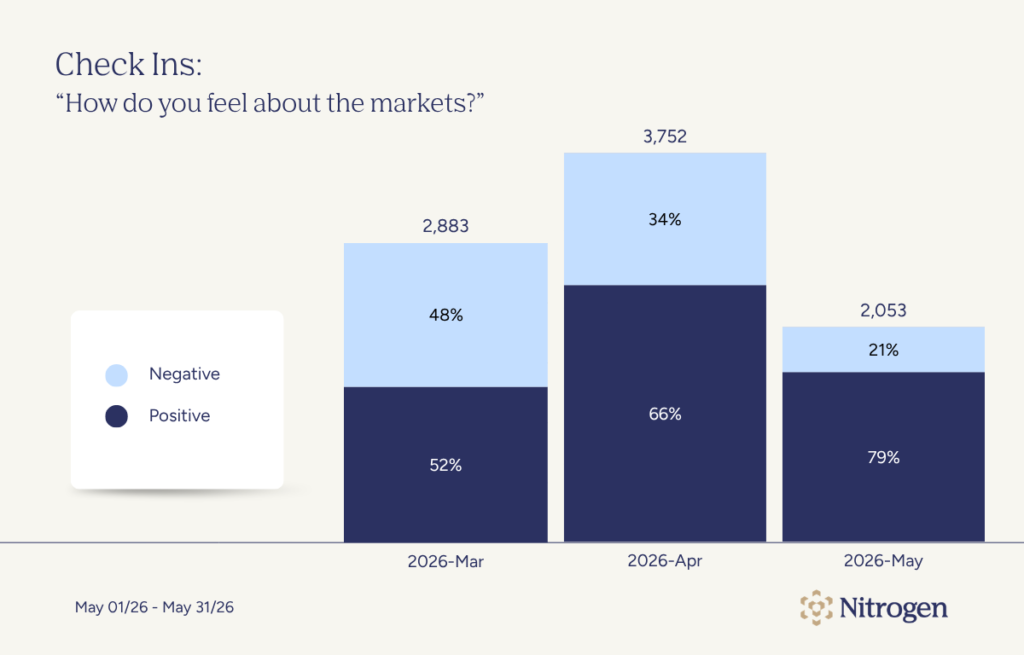
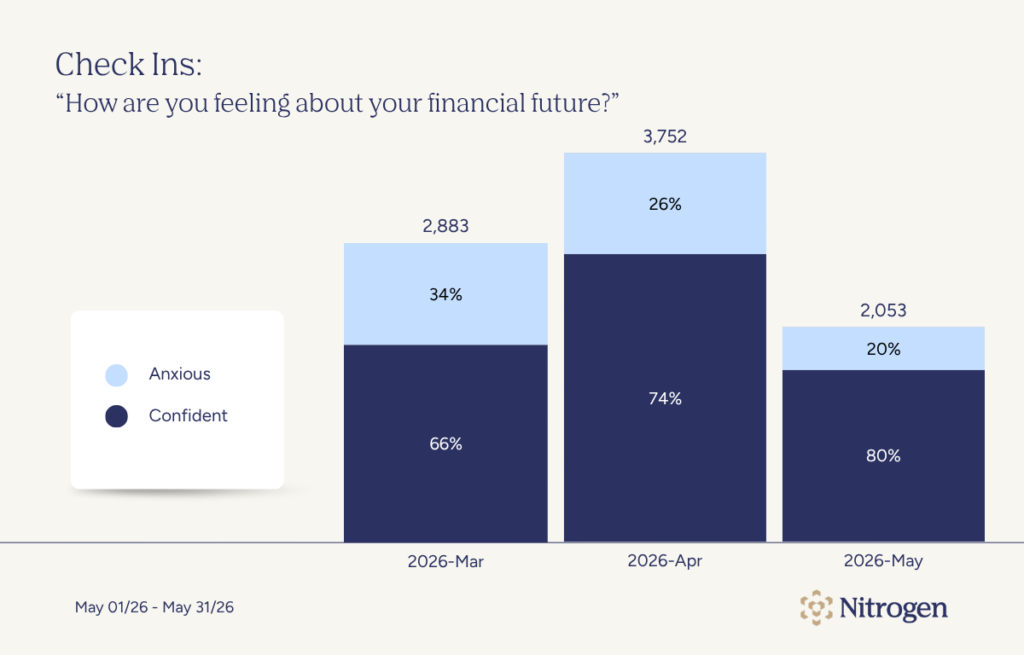
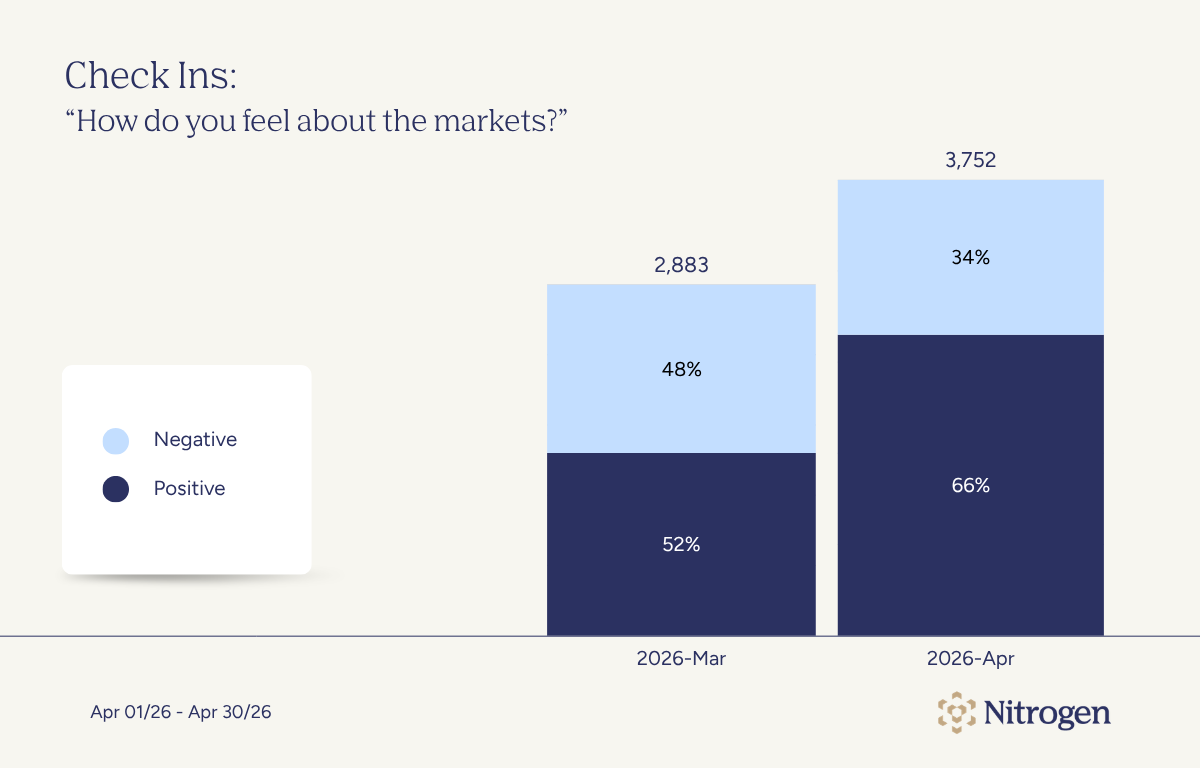
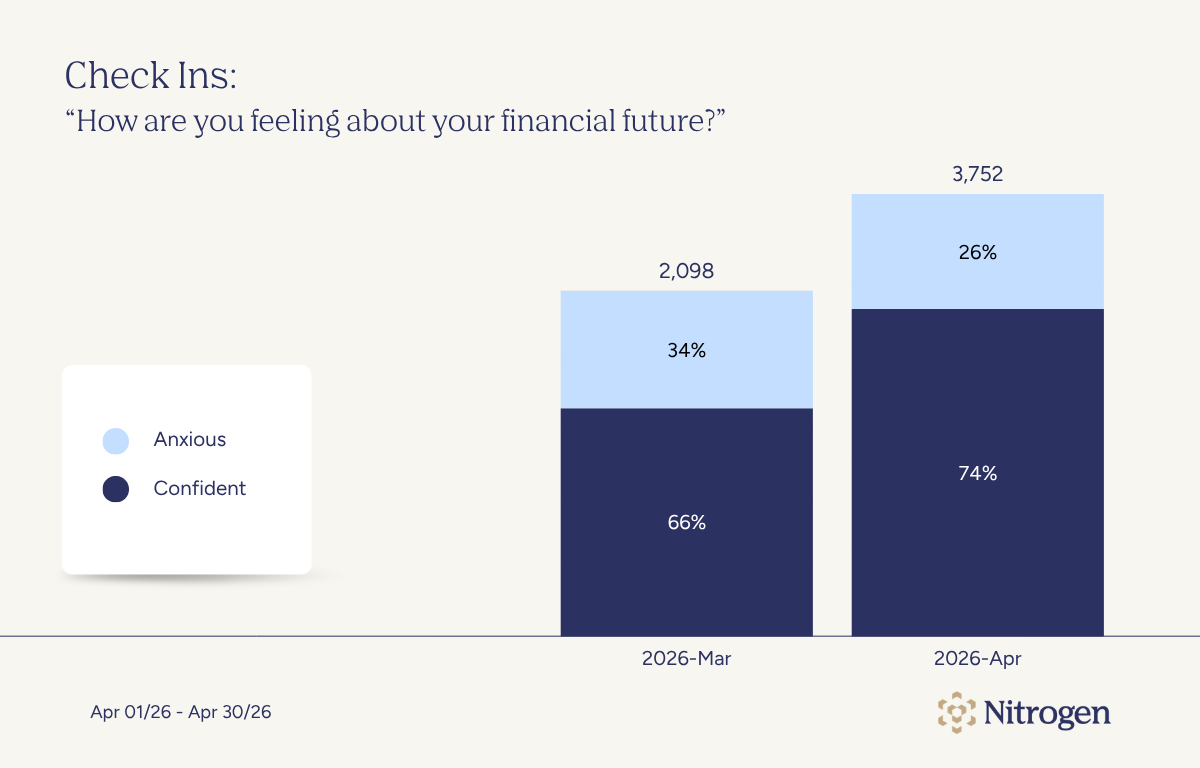
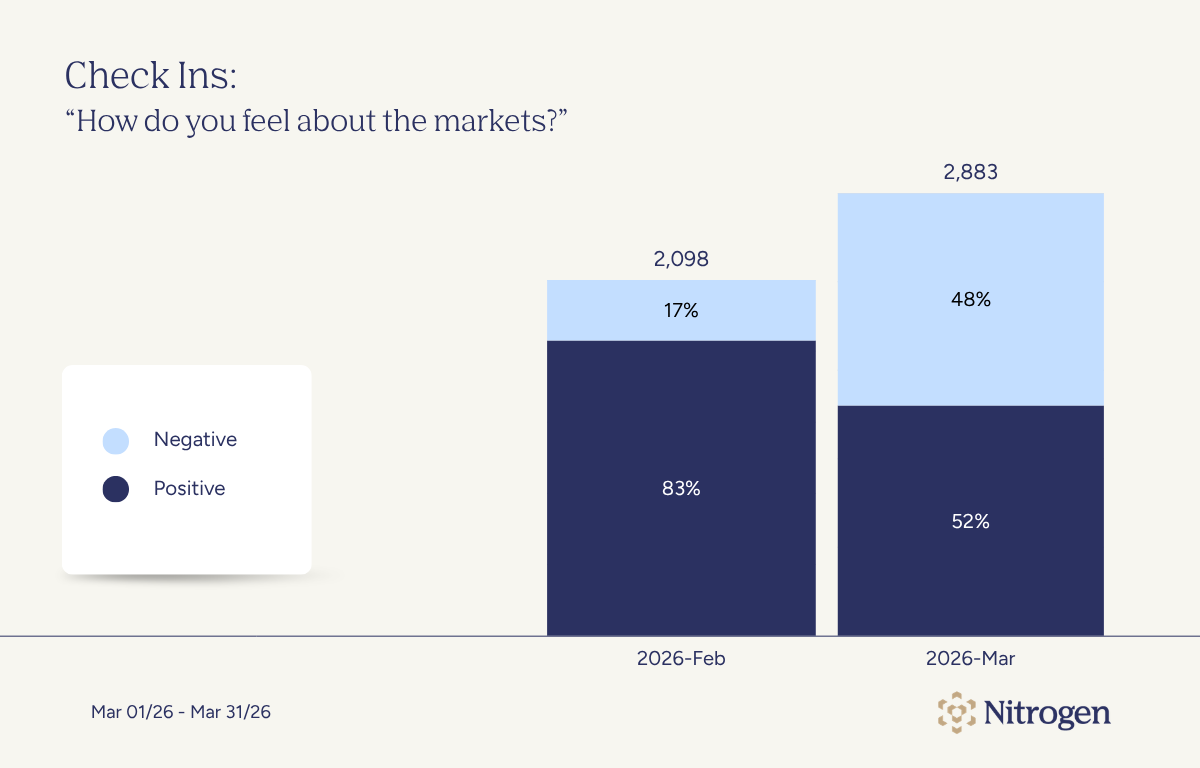
83% of clients reported feeling positive about the markets, while 82% said they feel confident about their financial future.Check Ins: How do you feel about the markets?

This marks a continuation of the steady climb in sentiment seen over the past several months. Confidence has not only recovered from earlier volatility, it has also stabilized at a high level.

Check Ins: How are you feeling about your financial future?

For advisors, this creates a different kind of challenge. When clients feel good, conversations shift away from risk management and toward participation. The question becomes less about protecting downside and more about staying aligned with long-term goals without overextending.

Signal 2: Risk is Being Trimmed, Not Chased

Even as sentiment remains strong, portfolios are not becoming more aggressive.

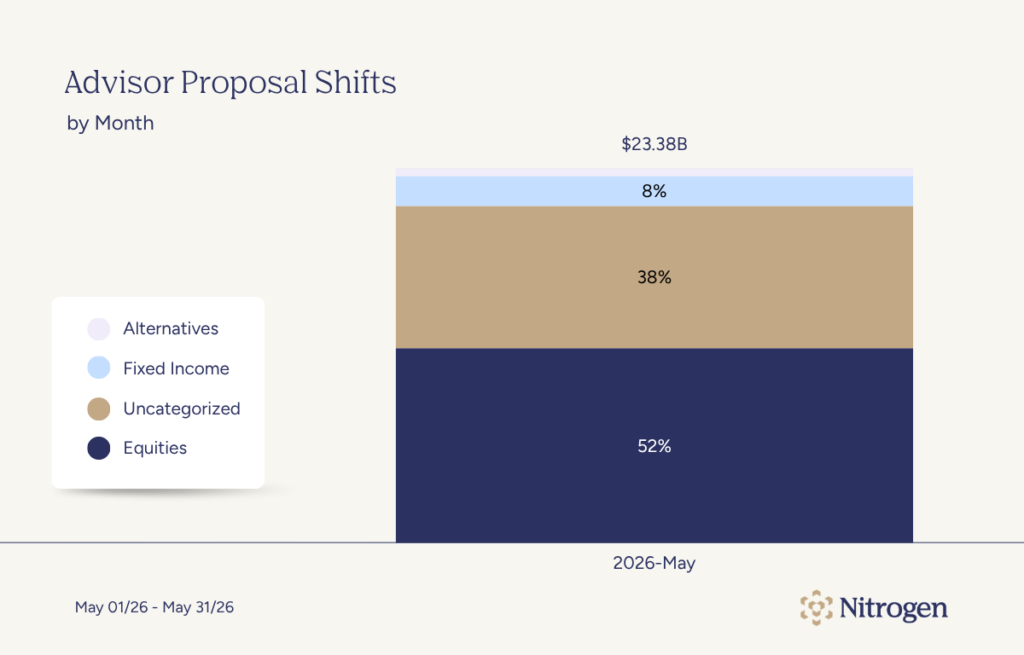
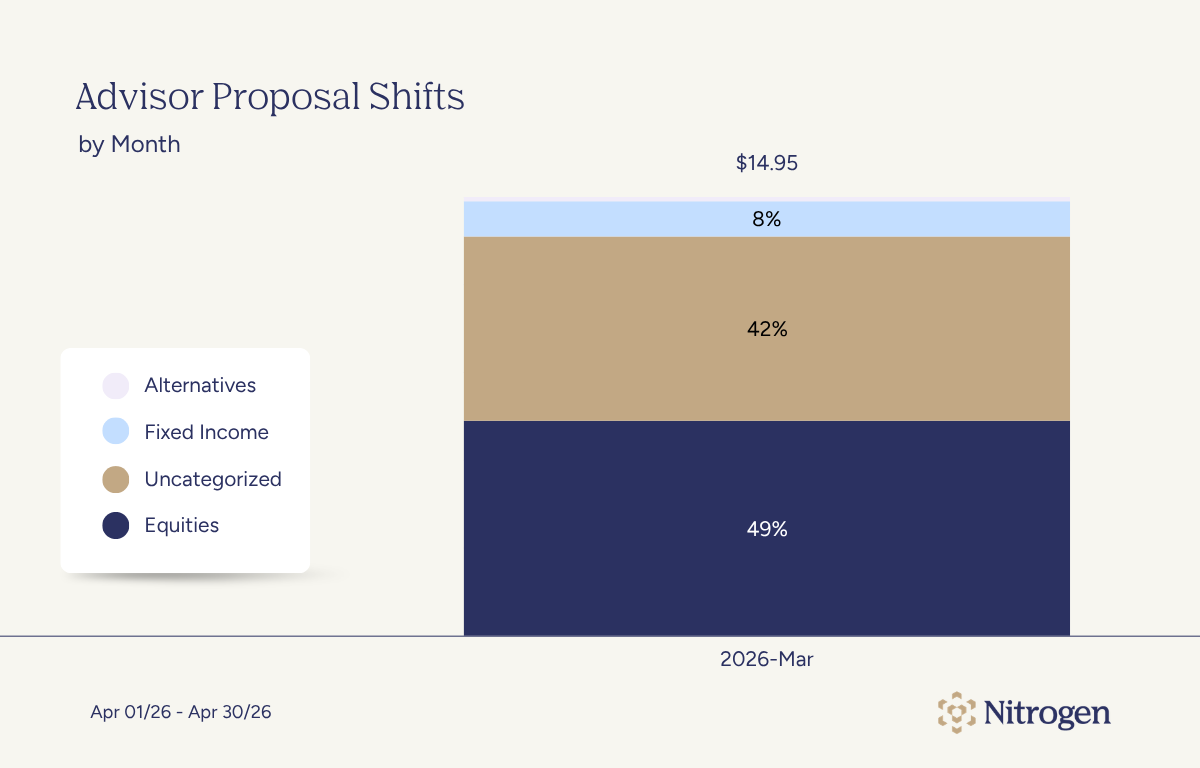
Equities accounted for 50% of portfolio allocations in February, down from 53% in January.

Advisor Proposal Shifts by Month

This is not a large move, but it is a meaningful one. Advisors appear to be using market strength to rebalance rather than increase exposure.

The takeaway: portfolios are being adjusted at the margins, not repositioned wholesale. Advisors are maintaining exposure while quietly managing risk.

Signal 3: Cash Is Becoming Less Prominent, Not Disappearing

Liquidity is starting to move, but slowly.

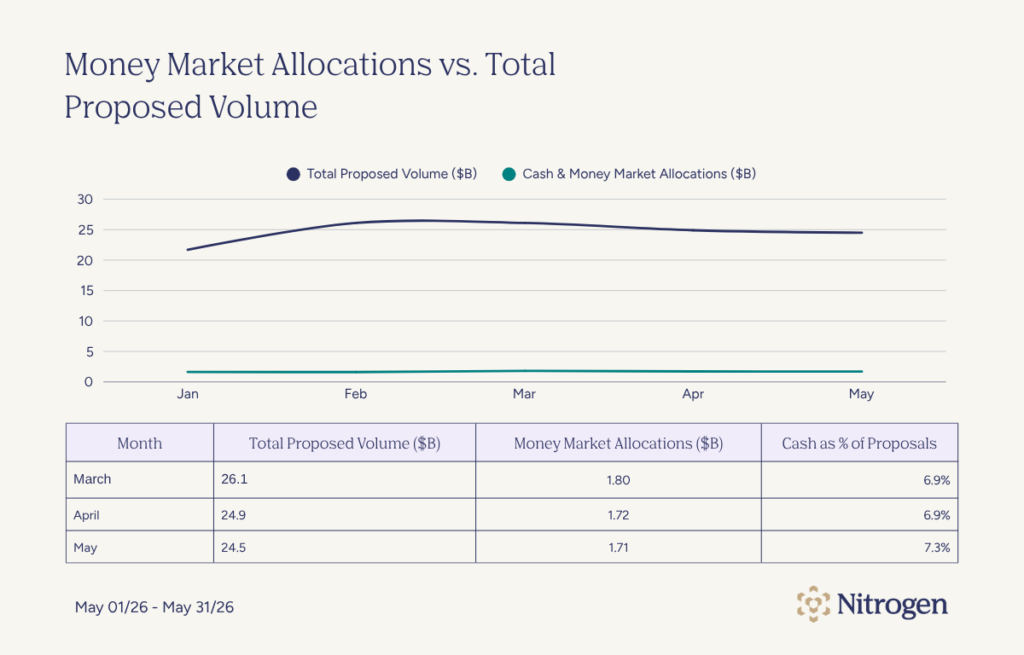
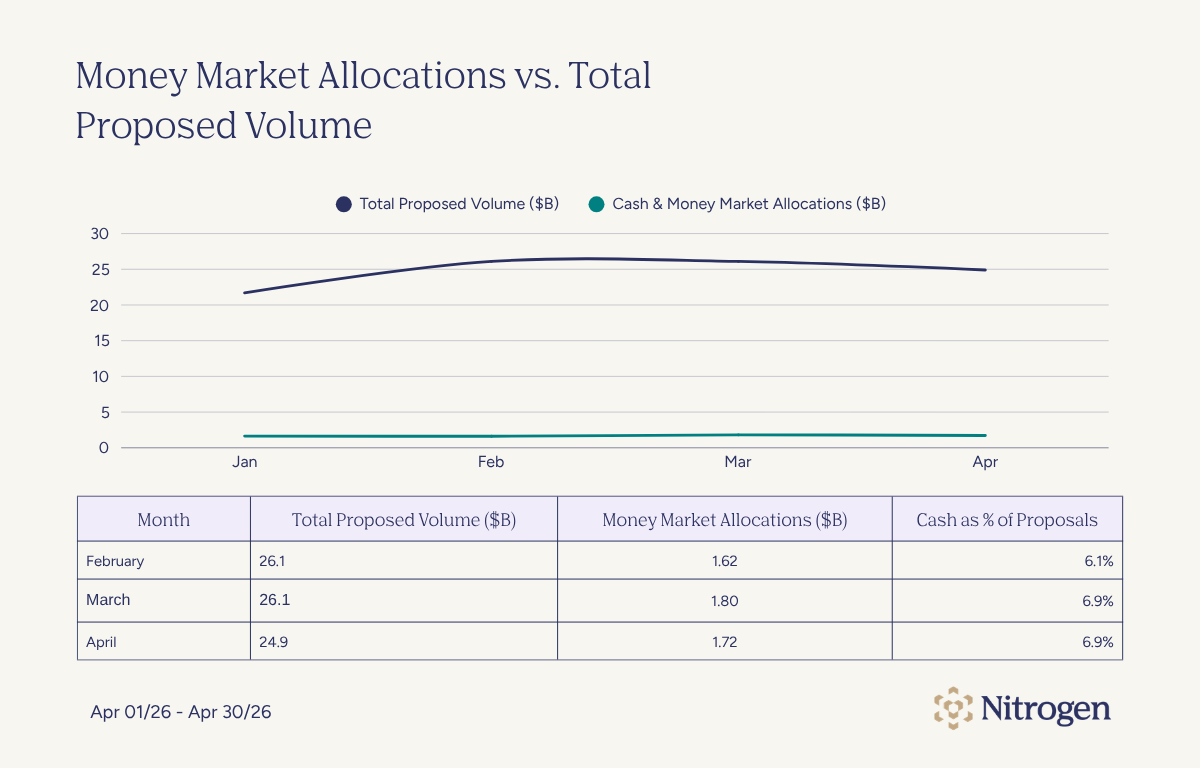
Money market allocations totaled $1.62B in February, compared to $1.64B in January, even as overall proposal volume increased.

Money Marketing Allocations vs. Total Proposed Volume

Importantly, dollar allocations to money markets remained relatively stable month over month. The shift is being driven more by rising activity than by a sharp rotation out of cash.

This suggests advisors are not rushing capital back into the market. Instead, they are redeploying selectively while maintaining flexibility.

Signal 4: Advisor Activity Signals Engagement, Not Urgency

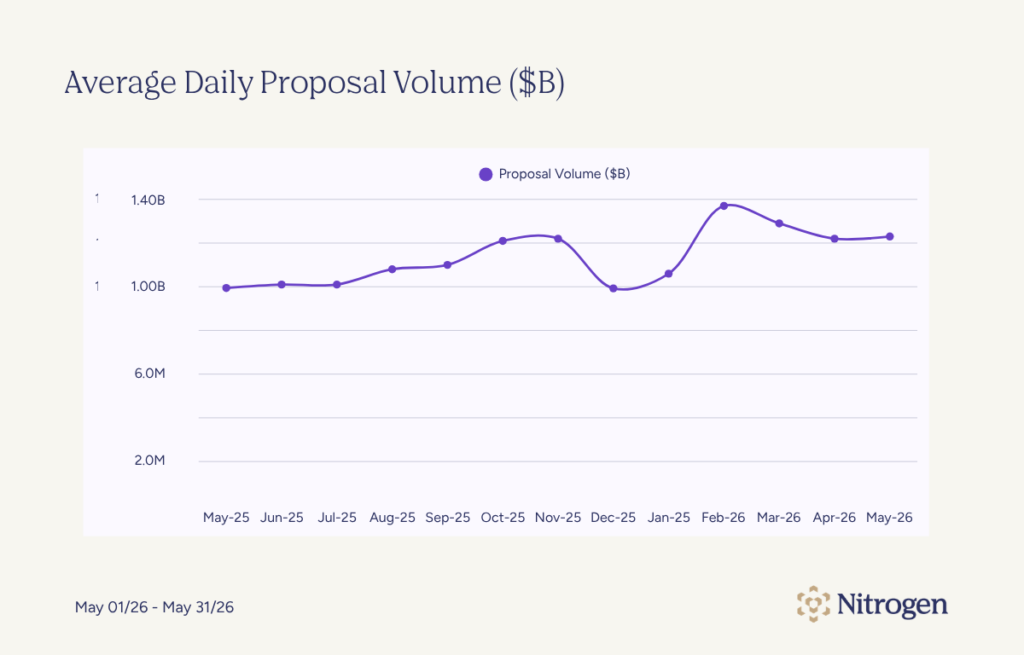
Proposal activity accelerated meaningfully in February and reached all-time highs.

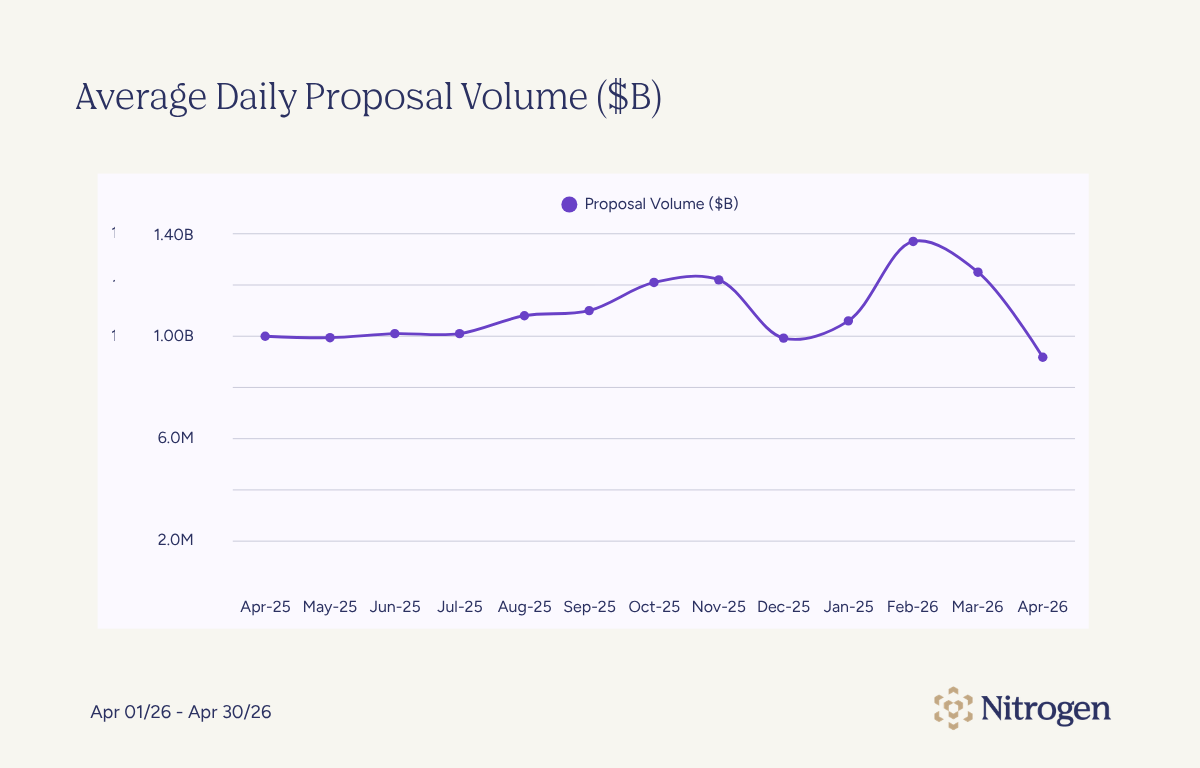
Average daily proposal volume hit $1.37B, up from $1.06B in January.

Average Daily Proposal Volume ($B)

This represents the highest level of activity in the past year and reflects a seasonal surge as advisors reconnect with clients and revisit portfolios after year-end.

But the composition of those proposals matters more than the volume. The data shows increased engagement without a corresponding increase in risk-taking.

Advisors are active, but not reactive.

Signal 5: Portfolio Construction Is Getting More Intentional

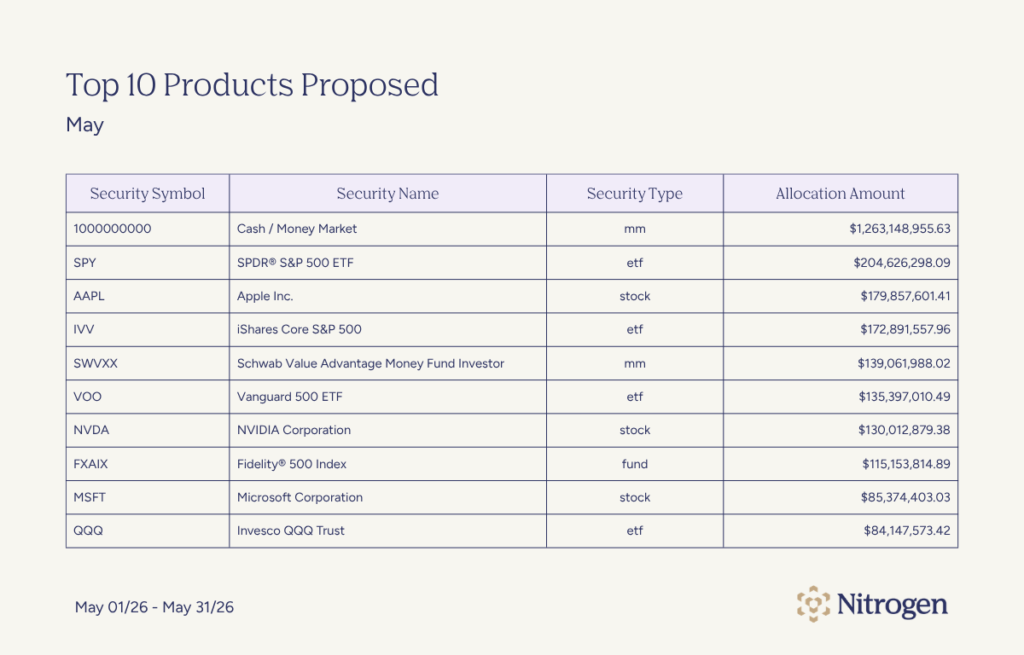
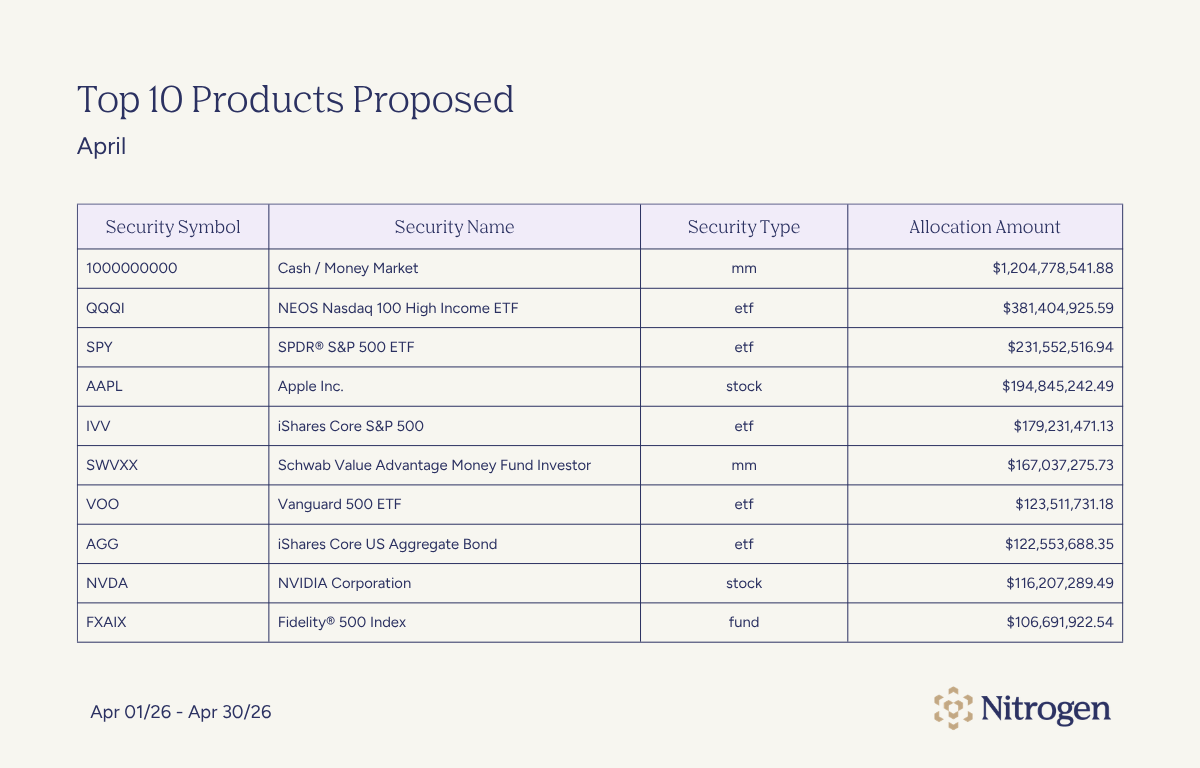
The usual suspects still dominate advisor proposals, but a couple of shifts are worth noting.

Familiar building blocks like the S&P 500 and core bond ETFs remained prominent.

Over the past year, Invesco QQQ Trust (QQQ) ranked as the 10th most commonly proposed product on the platform but in February, it jumped to fourth place.

Top 10 Products Proposed - February

That move suggests some advisors are leaning a bit harder into technology exposure.

Another notable development: direct indexing strategies appeared among the most proposed solutions, pointing to increased demand for customization and tax efficiency.

This combination, broad beta with selective tilts and customization, suggests portfolios are becoming more intentional without becoming more complex.

The Bigger Picture: Discipline in a Strong Market

The data from February points to a clear dynamic.

Clients are confident. Advisors are cautious.

Proposal activity is rising, but risk exposure is being managed carefully. Cash is being redeployed, but not all at once. Portfolios are evolving, but through incremental changes rather than sweeping shifts.

This is what disciplined portfolio management looks like in a strong market.

For advisors, the implication is clear. Periods of optimism are not a signal to take on more risk. They are an opportunity to refine portfolios, reinforce long-term plans, and ensure clients stay aligned with their goals.

The work may be quiet, but it is critical.

Where does your firm stand on these signals and shifts? Join the advisors using data to drive client decisions. Book a demo today.

About Nitrogen Signals & Shifts

Each month, Nitrogen analyzes proposal and sentiment data from across its platform to help advisors understand what’s driving client decisions. With more than 1,000 proposals created daily, these insights highlight how advisors adapt and how investors stay invested. Thank you for reading this edition of Nitrogen Signals & Shifts. The next issue will be published mid-April. Subscribe at the top of this post so you never miss an update.

Nitrogen Achieves ISO 42001 Certification for AI Governance

Certification validates governance behind Nucleus, Nitrogen’s AI-powered advisor empowerment engine

AI is rapidly transforming wealth management. But as more technology platforms begin adding “AI-powered” features, a more important question is emerging:

How is that AI governed?

Today, we’re proud to announce that Nitrogen has achieved ISO/IEC 42001 certification for AI governance, the international standard for Artificial Intelligence Management Systems (AIMS).

Based on our research, Nitrogen is the first known wealthtech company to earn this certification, joining a small group of global technology leaders including Microsoft, AWS, Google Cloud, and Anthropic.

Only a small number of organizations globally have achieved ISO 42001 certification, placing Nitrogen among a select group of companies implementing formal governance standards for artificial intelligence.

What ISO 42001 Certification Means

ISO/IEC 42001 is the international standard for Artificial Intelligence Management Systems. It establishes requirements for how organizations govern, deploy, and oversee AI systems responsibly.

Achieving certification requires an independent third-party audit confirming that a company has implemented formal processes for:

  • AI governance and accountability
  • Risk management and oversight
  • Ethical safeguards
  • Ongoing monitoring and continuous improvement

In short, this certification confirms that Nitrogen’s AI systems are built and operated with clear policies, structured controls, and continuous governance.

Why This Matters for Financial Advisors

Financial advisors operate in one of the most regulated industries in the world. As AI becomes more embedded in advisor technology, compliance teams are increasingly asking vendors not just whether they use AI, but how that AI is governed and monitored over time.

ISO 42001 provides an independently verified answer.

“AI is rapidly becoming foundational to financial advice technology, but trust and governance must come first,” said Dan Zitting, Chief Executive Officer at Nitrogen. “ISO 42001 certification demonstrates that our AI systems are not only powerful but responsibly built, carefully governed, and continuously monitored. Advisors operate in a regulated world, and when compliance teams ask how our AI is managed, we can now provide independently audited proof.”

The Governance Behind Nucleus

The certification reinforces the governance framework behind Nucleus, Nitrogen’s AI-powered advisor empowerment engine embedded directly within individual client profiles.

Rather than operating as a standalone chatbot, Nucleus acts as a task-execution assistant inside the Nitrogen platform, helping advisors complete real work directly within their client workflows.

With Nucleus, advisors can:

  • Translate brokerage statements into portfolios in Nitrogen
  • Turn tax documents into client deliverables and insights
  • Apply security screens with natural language prompts
  • Translate meetings into notes, and notes into talking points
  • Prepare retirement income maps
  • Update details around client information and Risk Number® targets
  • Compare and describe portfolios, proposals and securities
  • Generate client reports for download, print, or email delivery
  • Access client data from CRM
  • Receive coaching on how to get the most out of Nitrogen products

Using a client-specific chat interface connected to live client data, advisors can execute tasks through natural language while remaining in control of every action.

Today, more than 1,000 client proposals are created daily in Nitrogen, representing over $1.1 billion in assets analyzed each day.

“Advisors don’t need another chatbot. They need AI that actually helps them do their work,” said Justin Boatman, Chief Marketing Officer and Head of Product Strategy at Nitrogen. “Nucleus is designed to operate inside the workflows advisors already use while keeping them in control of every action. ISO 42001 certification ensures that the AI powering those capabilities is governed with the rigor advisors and their compliance teams expect.”

What This Means for Compliance Teams

As AI adoption grows across the wealth management industry, compliance teams are increasingly evaluating how advisor technology vendors govern artificial intelligence.

ISO 42001 certification gives advisors a clear and credible answer.

When compliance teams ask about AI governance, advisors using Nitrogen can explain that:

  • Nitrogen has achieved ISO/IEC 42001 certification, the international standard for AI management systems
  • The certification was awarded following a third-party audit verifying formal governance and risk management processes
  • Nitrogen maintains documented policies and oversight procedures for how AI systems are deployed, monitored, and improved over time
  • The AI capabilities powering tools like Nucleus operate within a structured governance framework designed for regulated financial environments

Instead of relying on marketing claims, advisors can point to an independently verified international standard for responsible AI governance.

You can review Nitrogen’s full security and trust documentation at trust.nitrogenwealth.com.

Raising the Bar for AI in WealthTech

As AI adoption accelerates across financial services, governance and accountability will become just as important as innovation itself.

By combining powerful AI capabilities with independently verified governance, Nitrogen aims to set a new standard for how artificial intelligence should be deployed in wealth management technology.

We believe the future of advisor technology isn’t just about building powerful AI.

It’s about building AI the right way.


Frequently Asked Questions

What is ISO/IEC 42001?

ISO/IEC 42001 is the international standard for Artificial Intelligence Management Systems (AIMS). It establishes requirements for how organizations govern, deploy, and oversee AI responsibly.

Why is ISO 42001 important for financial advisors?

Advisors operate in a highly regulated environment where compliance teams increasingly scrutinize technology vendors. ISO 42001 provides independently verified proof that an AI platform has formal governance, oversight, and risk management processes.

Is Nitrogen the first wealthtech company with this certification?

Based on our research, Nitrogen is the first wealthtech company to achieve ISO/IEC 42001 certification.

How does this certification relate to Nucleus?

Nucleus is Nitrogen’s AI-powered advisor empowerment engine embedded directly within the platform. ISO 42001 certification validates the governance framework surrounding the AI systems that power Nucleus.

Does Nucleus replace advisor decision-making?

No. Nucleus is designed to assist advisors by executing workflows, analyzing client data, and preparing insights. Advisors remain in control of every action and decision.

What kinds of tasks can Nucleus help advisors complete?

Nucleus can help advisors:

  • Assign Risk Number® targets
  • Generate client proposals
  • Prepare retirement income maps
  • Convert investment statements into portfolio analytics
  • Initiate workflows within the Nitrogen platform

The Most Overlooked Way Advisors Demonstrate Their Value

Why tax-aware planning conversations create the biggest “aha” moments for clients.

Many advisors have experienced a moment like this in a client meeting.

You’re reviewing the portfolio and discussing long-term strategy. The client nods along politely.

Then a tax question comes up.

Maybe it’s about selling an investment. Or harvesting losses. Or which account to withdraw from in retirement.

You walk through the implications.

The client pauses.

“Wait… I didn’t realize that mattered.”

And suddenly the tone of the meeting changes.

Moments like these often become some of the clearest demonstrations of an advisor’s value. And they frequently happen during tax-aware planning conversations.

Why Advisor Value Can Feel Invisible

Advisors spend much of their time doing work clients rarely see.

Designing portfolios, managing risk, and adjusting strategies are essential parts of long-term financial planning. Yet their impact often unfolds gradually. In a single client meeting, the value of those decisions can feel abstract.

This creates a challenge for many advisors.

The most important parts of their work do not always produce a clear moment when clients recognize the value being delivered.

But certain conversations change that dynamic.

When tax implications enter the discussion, financial advice becomes more tangible. A decision about selling an investment or structuring withdrawals can immediately affect what a client keeps after taxes.

In those moments, the value of planning becomes easier to see.

Clients begin to recognize how financial decisions connect across investments, income, and long-term strategy. And they begin to see the advisor as the professional helping them navigate those connections.

How Tax Conversations Shift Client Perception

Many financial planning conversations begin with investments. Portfolio performance, market conditions, and long-term strategy tend to dominate the discussion.

Taxes, on the other hand, are often treated as a separate conversation. Clients assume their accountant is handling them, and advisors sometimes hesitate to step too far into what feels like another professional’s territory.

As a result, tax implications can remain in the background of financial planning discussions. The advisor’s work can appear narrowly focused on investments, even when their planning process is much broader.

But when taxes do enter the conversation, something often changes.

A client might realize that selling an investment this year could push them into a higher tax bracket.

Or that harvesting losses in one part of the portfolio could offset gains elsewhere.

Or that withdrawing from one account instead of another could change how much retirement income they keep.

That’s often when the meeting pauses.

Clients lean forward.

“Wait… I didn’t realize that mattered.”

“So if we do this now, it changes the taxes I pay this year?”

Moments like that often open the door to another kind of discovery.

When advisors begin looking more closely at a client’s tax situation, they frequently uncover details that never surfaced in earlier conversations. A quick review of a document like a 1040 can reveal income sources or accounts the advisor didn’t previously know about.

  • Interest income from an unfamiliar bank.
  • Dividend payments from a brokerage account held elsewhere.
  • Capital gains activity from investments outside the client’s current strategy.

Each line item raises a simple question.

“Tell me about this account.”

Sometimes the answer leads to an old brokerage account that was never incorporated into the plan. Other times it reveals a legacy portfolio, a large cash balance, or an investment relationship the advisor didn’t realize existed.

Moments like these don’t just clarify tax implications. They often reveal parts of the client’s financial life that had been operating quietly outside the broader plan.

The Line Advisors Worry About Crossing

Of course, tax conversations can also create hesitation for advisors.

Many are careful about stepping into territory that traditionally belongs to accountants or tax preparers. Compliance expectations, liability concerns, and professional boundaries all play a role. No advisor wants to give the impression they’re providing formal tax advice.

That hesitation is understandable.

But there’s an important distinction between tax advice and tax-aware financial planning.

Advisors aren’t responsible for interpreting every detail of the tax code or preparing a client’s return. Instead, their role is often to help clients understand how financial decisions interact with taxes.

Advisors who incorporate tax awareness into planning conversations often follow a few simple guardrails:

  • Start with questions. Rather than prescribing tax strategies, advisors focus on understanding what happened and whether similar situations might occur again.
  • Focus on planning implications. The goal isn’t to fix last year’s tax return. It’s to understand how financial decisions may affect future outcomes.
  • Collaborate with the client’s CPA. If a situation requires deeper tax analysis, bringing the client’s accountant into the conversation keeps everyone aligned.

Approached this way, tax awareness stays firmly within an advisor’s role. It becomes another way to help clients make more informed financial decisions.

The Two “aha” Moments for Clients

In many cases, tax-aware planning conversations create two important “aha” moments for clients.

First, tax insights provide a tangible demonstration of the advisor’s value.

Instead of discussing abstract planning concepts, the advisor is pointing to decisions that have clear financial consequences. Clients can immediately see how thoughtful planning affects what they ultimately keep after taxes.

Second, clients begin to see their advisors in a broader role.

The conversation is no longer just about investments or market performance. It becomes clear that the advisor is helping them think through how financial decisions connect across taxes, income, and long-term planning.

Once those connections become visible, the client’s perception of the advisor often expands.

Financial decisions that might once have happened independently start coming back to the advisor for input. Clients ask about the tax impact of selling a property, exercising stock options, or structuring retirement withdrawals.

Instead of turning to their advisor only for portfolio updates, they begin to see them as someone who helps guide the broader financial decisions shaping their future.

Tax CenterNitrogen’s Tax Center turns any 1040 into clear visuals, making complex tax data easy to understand.

Why That Shift Matters for Advisors

What begins as a simple conversation about taxes can often lead to something much more valuable: deeper client relationships and a stronger advisory practice.

When clients begin to see their advisor as someone coordinating their broader financial life, the relationship often evolves in ways that directly benefit the practice:

  • Discovery and consolidation of held-away assets. Tax documents often reveal accounts or investments the advisor didn’t previously know about. Once those assets come into view, clients frequently ask whether they should be incorporated into the broader strategy.
  • Greater share of the client relationship. As advisors become involved in more financial decisions, they naturally become responsible for a larger portion of the client’s financial life.
  • Stronger client retention. Clients who rely on their advisor for a broader range of decisions are far less likely to look elsewhere for advice.
  • More referral opportunities. When clients see their advisor as a trusted financial guide, they are more likely to introduce them to friends, family members, or colleagues facing similar questions.

In many cases, the path to deeper client relationships can begin with something as simple as a conversation about taxes.

Turning Insight Into Conversation

Many advisors have already seen how powerful tax conversations can be in client meetings. A well-timed insight about capital gains, withdrawal timing, or income strategy can quickly turn an abstract planning discussion into something tangible.

But those conversations don’t have to stop at the desk.

Tax awareness can also create opportunities to educate clients, spark new discussions, and connect with investors who may not yet have an advisor helping them think through those decisions.

Because often the best way to demonstrate the value of advice is to start with the questions investors are already asking.


Frequently asked questions about tax-aware financial planning

Why should financial advisors discuss tax considerations with clients?

Tax considerations often influence how financial decisions play out in real life. Investment sales, retirement withdrawals, and income timing can all affect what clients ultimately keep after taxes. When advisors incorporate tax awareness into planning conversations, they help clients understand how different decisions interact across investments, income, and long-term financial goals. These conversations can also reveal planning opportunities that might otherwise go unnoticed.

Are financial advisors allowed to give tax advice?

Financial advisors typically do not prepare tax returns or provide formal tax advice. However, many advisors incorporate tax awareness into financial planning discussions. This means helping clients understand how investment decisions, withdrawal strategies, or income timing may have tax implications. Advisors often collaborate with a client’s CPA or tax professional to ensure financial decisions align with the client’s broader tax strategy.

How can tax conversations strengthen the advisor–client relationship?

Tax conversations often help clients see how different parts of their financial life connect. When advisors highlight how investments, income decisions, and taxes interact, clients gain a clearer understanding of their financial plan. These discussions can shift the advisor’s role from someone who manages investments to someone who helps guide broader financial decisions, which often strengthens trust and engagement.

What can financial advisors learn from reviewing a client’s tax return?

A client’s tax return can reveal valuable information about their financial situation. Interest income, dividend payments, capital gains, or deductions may indicate accounts, income sources, or investment activity that were not previously discussed. Reviewing these details can help advisors identify planning opportunities and ensure the client’s financial decisions are aligned with their broader strategy.

How can tax-aware conversations help advisors grow their practice?

When advisors incorporate tax awareness into financial planning discussions, they often gain deeper visibility into their clients’ financial lives. These conversations may uncover additional assets, financial decisions, or planning needs that were previously outside the advisor’s scope. Over time, this can lead to broader planning relationships, stronger client retention, and opportunities to consolidate assets into a more coordinated strategy.

How Modern Advisors Are Using Technology to Transform Client Meetings

Advisors today have access to more sophisticated tools than ever before. Yet many client meetings still feel like they did decades ago.

Spreadsheets drive projections. Static PDFs recap discussions. Risk tolerance is reduced to broad labels like “moderate” or “aggressive.” Advisors explain the strategy. Clients receive the report after the fact.

Investor expectations, however, have changed. In Nitrogen’s 2025 Firm Growth Survey, nearly 8 in 10 investors said it’s important that their advisor use modern, user-friendly technology to present financial information. More than two-thirds said they would consider switching to an advisor who does it better.

Clients expect great digital experiences in every other part of their lives. Now they demand the same from their financial advisor. In response, firms seeking to grow in 2026 will need to consider their entire client experience to remain competitive.  

Nitrogen’s platform was built for the modern advisor. It turns advice from something clients are told into something they can see and interact with. And when clients can see it, advisors spend less time defending decisions and more time guiding them.

Here’s how that approach compares to the legacy tools many firms still rely on today.

How modern firms approach risk

In many firms, risk tolerance is reduced to a short questionnaire and a broad label. Conservative. Moderate. Aggressive. The portfolio is aligned to that category, and the conversation moves on.

But those labels leave room for interpretation. They rarely define how much downside a client can truly tolerate. When markets turn volatile, that ambiguity shows up fast. Advisors field anxious calls. Revisit allocations. Defend expectations that were never clearly quantified.

To address this problem, modern firms have started replacing subjective labels with measurable alignment. 

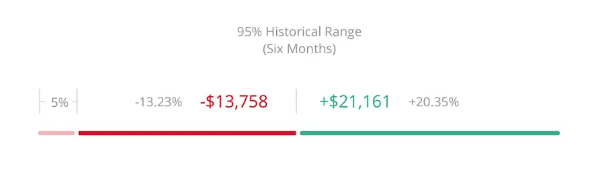
For example, in Nitrogen’s Risk Center, each client receives a Risk Number® on a 1-99 scale, grounded in a proven economic framework. Advisors can quantify the risk in a client’s portfolio and compare it directly to the client’s personal Risk Number. The 95% Historical Range complements this tool further by showing what outcomes are statistically normal over a six-month period. This allows clients to see potential downside before volatility tests their confidence. 

In the meeting, the difference is clear. Instead of explaining what “moderate” means, the advisor can swivel the monitor and show a client’s Risk Number beside their portfolio’s score. If there is misalignment, it’s visible. If the portfolio is aligned, the expected range is clear. This shifts the conversation from interpretation to evidence.

Risk Center Screenshots

For advisors, that clarity reduces friction, and expectations can be defined early. Volatility can become easier to navigate because clients understand what is normal. Documentation is built into the workflow, supporting compliance and due diligence. 

And over time, that consistency protects retention, supports growth, and reinforces the advisor’s role as a disciplined, data-driven decision maker.

How modern firms approach investment research

In many firms, investment research happens behind the scenes. Advisors move between fact sheets, third-party tools, spreadsheets, and performance reports to evaluate funds and build portfolios. The work is thorough, but it’s fragmented and time-consuming. When it’s time to present a recommendation, that analysis is compressed into static charts and summary slides. 

In other words, clients see the conclusion. They don’t see the process behind it.

But research doesn’t have to stay hidden. In Nitrogen’s Research Center, portfolio analytics, modeled performance, comparisons, sector breakdowns, screening, and stress testing live in one place. Research is built, tested, and presented inside a unified platform. The analytics connect directly to the client conversation.

The difference becomes clear when the monitor turns. Allocations adjust. Strategies are compared side by side. Risk and projected outcomes update almost instantly. There’s no need for slide decks or toggling between systems. Clients see the reasoning unfold in real time.

For advisors, the impact goes beyond the meeting. Preparation becomes faster. Recommendations feel more defensible and clearer rationale can help improve close rates. Research stops being a back-office task and becomes a growth driver.

How modern firms approach tax conversations

Taxes quietly erode client wealth. Yet many advisors address them only at a high level. A 1040 gets a quick review or is handed off to a CPA. When tax conversations do happen, they are dense and jargon-heavy. Clients struggle to see what actually matters.

That leaves opportunity on the table. Clients expect tax-aware guidance, but extracting insight from a complex return takes time.

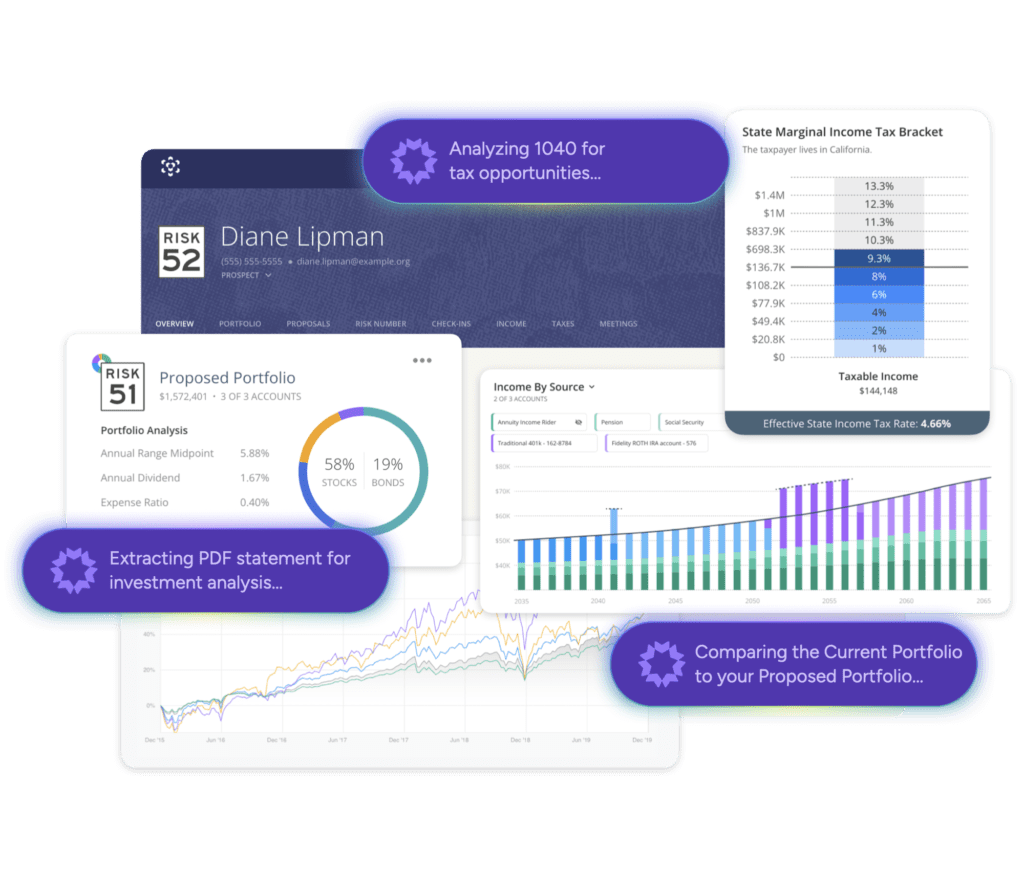
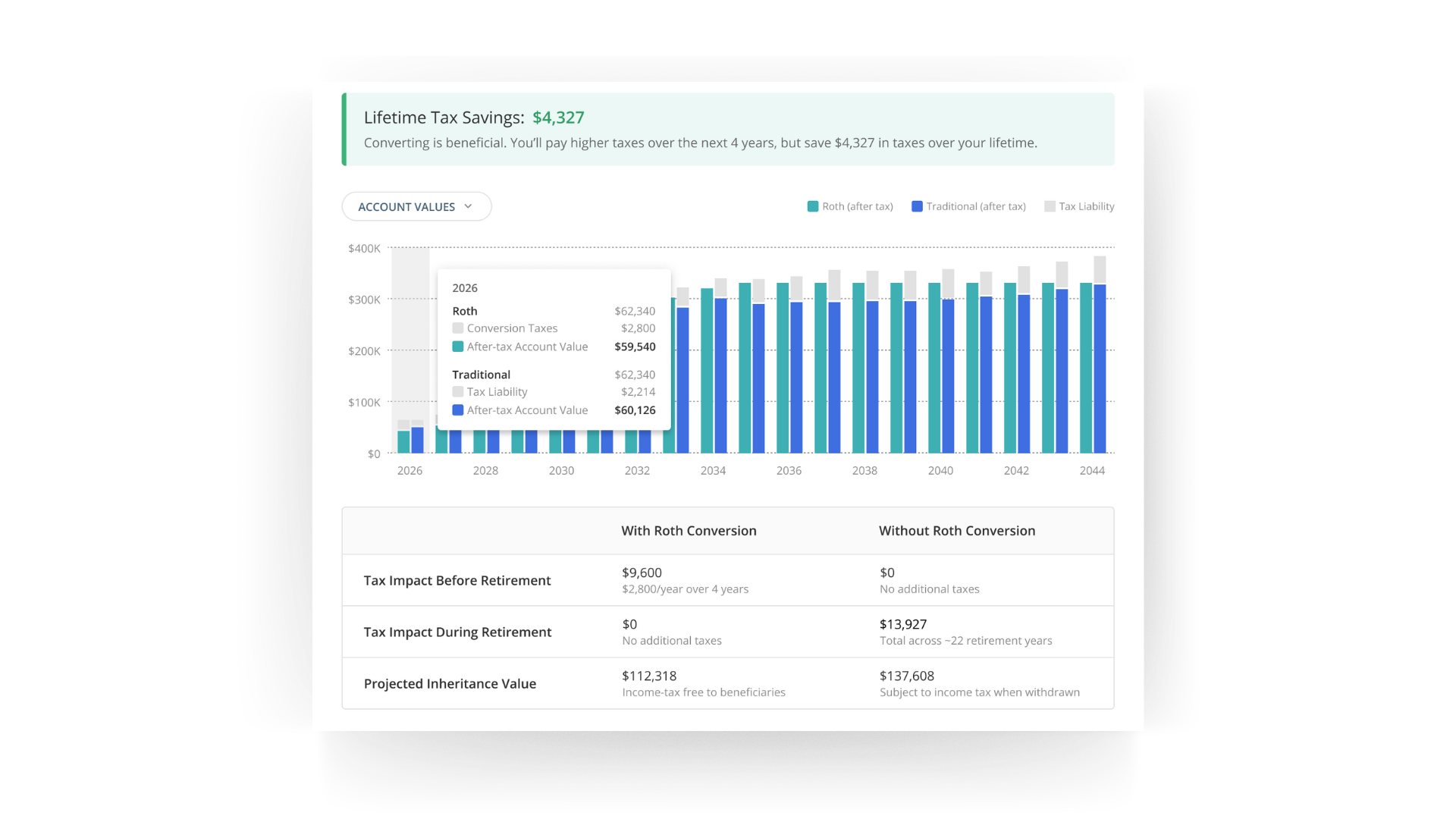
With Nitrogen’s Tax Center, a 1040 becomes a starting point, not a document to decode. Advisors upload the return and generate a clear Tax Snapshot in seconds. Complex data turns into visual summaries and AI-generated insights. Roth conversions. Deduction strategies. Capital gains exposure. High cash balances. The key opportunities surface immediately.

Tax Center

In a client meeting, this changes the dynamics. Instead of walking line by line through a return, the advisor shares a visual snapshot. The client sees their full tax picture at a glance. Questions become sharper. The conversation moves quickly from review to strategy.

The business impact is real. Tax discussions can become more proactive, and prospect meetings can start with insight instead of a pitch. Hidden accounts and held-away assets surface naturally. Over time, that differentiation strengthens trust, increases wallet share, and positions the advisor as a comprehensive, tax-aware partner.

How modern firms approach retirement income

Retirement planning often lives in spreadsheets or heavy planning tools. Hours of data entry come before a real conversation can begin. Projections are built behind the scenes and delivered as a probability score. The connection between risk tolerance, time horizon, and portfolio strategy can feel abstract. 

As a result of these constraints, advisors face a choice: invest significant time building a full plan or rely on high-level assumptions.

Modern firms, however, are making income planning faster and more connected. In Nitrogen’s Income Center, advisors generate a Retirement Map using core client data and immediately show long-term probability of success. Risk tolerance, savings, retirement timing, and investment strategy are modeled together. Adjustments update in real time.

In the meeting, the difference is clear. An advisor can model retiring earlier and what increasing savings will look like. Each change updates the outcome instantly. The conversation shifts from reviewing a static projection to exploring decisions.

Income Center

For advisors, that means fewer hours building plans that stall and more time focused on strategy. Income planning becomes easier to introduce in prospect conversations and client meetings become more productive. The firm gains a repeatable framework that supports retention, referrals, and long-term growth.

How modern firms approach client meetings

According to Kitces, advisors spend an average of 20.7 hours each week preparing, having, or supporting client meetings. That’s half the advisor’s week, and doesn’t even include meetings with prospective clients.

Notes get typed late at night. Summaries are rebuilt from memory. Compliance entries land in multiple systems. The meeting may feel productive in the moment, but the administrative work lingers.

Meeting Notetaker removes that burden from the conversation. Inside Nitrogen, an AI assistant captures, transcribes, and summarizes meetings in real time. Notes are converted into structured, editable, compliant documentation automatically. Extra logins aren’t needed, nor are any additional tools or third-party plug-ins.

During the meeting, the difference is obvious. The advisor stays focused on the client. The platform handles the note-taking. When the conversation ends, the summary is already there.

For advisors, the payoff is immediate with hours that can be reclaimed every week and administrative drag that can shrink. Documentation becomes consistent across the firm. Over time, that efficiency compounds into stronger client service, easier scalability, and a more valuable practice.

The new standard for client experience

Firms don’t grow by stacking more tools on top of each other. They grow by making advice easier to understand. When risk is clear, income planning is interactive, meetings run smoothly, and tax conversations surface real opportunities. Clients feel confident, expectations are set early and volatility can be easier to navigate. 

Strategy is shown, not just explained.

That’s what Nitrogen is built for. It brings risk alignment, investment research, income planning, meeting documentation, and tax insight into one connected platform. Gone are the days of fragmented workflows and disconnected tools. Advisors are left with a client experience that is clear, digital, and built to scale.

If you want to see how it works in practice, book a demo today and explore the platform for yourself.


Frequently Asked Questions (FAQs)

How can financial advisors use technology to improve client communication?

Client-facing technology allows advisors to visually demonstrate how risk, portfolio strategy, income planning, and tax decisions connect to a client’s goals. Interactive tools help clients see trade-offs in real time instead of relying on static reports. This improves clarity, builds trust, and reduces reactive conversations during market swings.

Why are investors leaving advisors for firms with better technology?

Investors increasingly expect transparency, personalization, and data-backed insights. According to Nitrogen’s 2025 Firm Growth Survey, many clients say modern, user-friendly technology influences their trust and decision to stay with an advisor. Firms that provide clear, interactive experiences are better positioned to retain and attract clients.

How does Nitrogen’s Risk Number® work?

Nitrogen’s Risk Number® measures a client’s risk tolerance on a 1-99 scale using a scientifically grounded economic framework. Advisors can calculate both a client’s personal Risk Number and the risk embedded in their portfolio, making alignment visible and measurable. This supports expectation setting, behavioral coaching, and documentation.

How can advisors make retirement income planning more efficient?

Modern planning tools allow advisors to model retirement scenarios in real time. By adjusting savings, retirement age, or risk levels during a meeting, advisors can instantly show how those decisions affect probability of success. This makes income planning more interactive and scalable without requiring a full, time-intensive financial plan.

How can financial advisors incorporate tax planning into client meetings?

Technology can transform a client’s 1040 into a visual snapshot that highlights potential opportunities, such as Roth conversions, capital gains planning, and deduction optimization. This allows advisors to lead tax-aware conversations proactively and uncover opportunities that may otherwise go unnoticed.

What are the business benefits of using an integrated wealth management platform?

An integrated platform connects risk alignment, research, income planning, meeting documentation, and tax insight into one cohesive workflow. This can reduce administrative overhead, improve consistency across advisors, strengthen compliance documentation, and enhance the overall client experience. Over time, that operational efficiency can support retention, referrals, and firm growth.

How Advisors Use the 1040 to Identify Planning Opportunities

For many advisors, the 1040 is something to review during tax season. It’s checked for accuracy, filed away, and rarely referenced again in client conversations.

That’s understandable. Tax preparation usually sits with the client’s CPA, and advisors want to stay within clear boundaries.

But the 1040 isn’t just a tax document. It provides a clear record of what actually happened in a client’s financial life over the past year: income decisions, investment activity, distributions, and timing choices.

Advisors who review the 1040 this way aren’t trying to do tax preparation. They’re using it to understand outcomes and guide better planning conversations.

Reviewing a client’s 1040 can help financial advisors anchor planning conversations in real financial outcomes rather than market headlines.

How reviewing the 1040 changes how clients see you

Without a clear starting point, review meetings can drift.

Markets set the agenda. Headlines drive the questions. Clients walk in reacting to whatever the news cycle delivered that week.

Starting with the 1040 changes that dynamic because it anchors the conversation in the now.

Instead of projections or market commentary, you begin with what actually happened:

  • income that showed up
  • money that moved
  • decisions that played out

There’s no speculation. Both you and the client are looking at the same outcomes.

That simple shift does two things.

First, it gives you control of the meeting. Instead of reacting to market anxiety, you guide the discussion based on real financial activity.

Second, it changes how clients see your role.

Clients expect their CPA to file the return. They don’t expect their advisor to reference it. When you do, it signals that you’re paying attention to the full financial picture, not just the portfolio.

That distinction becomes especially important when markets are uneven. Advisors who rely solely on portfolio performance to demonstrate value are vulnerable in those periods.

But when meetings start with outcomes, the conversation naturally broadens to income planning, distribution timing, and long-term tradeoffs.

Over time, that compounds. Clients stop evaluating you based only on short-term returns and start relying on you to help interpret their financial life as a whole.

Using the 1040 without crossing into tax advice

Advisors often hesitate to use tax returns because they want to stay within clear boundaries.

That caution is reasonable. The 1040 is dense and closely associated with tax advice. It’s easy to worry about contradicting a CPA or getting pulled into technical tax discussions.

But reviewing a return does not mean providing tax advice.

Advisors who use the 1040 effectively focus on understanding outcomes, not fixing the return. They look at what happened last year and what it might mean for planning going forward.

A few guardrails help keep that conversation firmly in planning territory:

  • Lead with questions
    Ask questions like “Was this intentional?” or “Do we expect this again?”
  • Focus on patterns
    Look for trends in income, investment activity, or distributions rather than prescribing strategies.
  • Keep the scope narrow
    One or two meaningful observations are usually enough to move the conversation forward.
  • Collaborate with the CPA
    If something requires deeper tax analysis, bring the CPA into the discussion.

Used this way, reviewing the 1040 strengthens planning conversations without stepping outside an advisor’s role.

Many advisors want to do more around taxes but hesitate because of compliance boundaries. In this on-demand recording, tax expert Steven Jarvis, CPA, explains how advisors can identify real planning opportunities, set clear expectations with clients, and have smarter tax conversations without stepping outside their role. Click here to watch the recording.


A simple framework for reviewing the 1040

Using the 1040 effectively does not require a detailed tax analysis. The goal is simply to identify signals that matter for planning.

A quick, consistent scan is usually enough.

  • Start with what changed
    Look at total income and adjusted gross income. If those numbers moved meaningfully, something happened that deserves a conversation.
  • Scan for unexpected activity
    Look for income sources or investment activity that don’t match how the client describes their situation. Small streams, unexpected gains, or strategy drift often show up here.
  • Flag distributions and one-time events
    Retirement withdrawals, liquidity events, or income spikes usually reveal timing decisions or cash-flow needs.
  • Ask questions instead of prescribing solutions
    The goal isn’t to solve everything in the meeting. It’s to understand what happened and what may matter going forward.

Used this way, the 1040 becomes a quick orientation tool rather than a detailed tax review.

Turning the 1040 into a planning advantage

By the time a client sits down for a review meeting, most of the year’s meaningful financial decisions have already happened. The 1040 captures those decisions in one place, which is why it can anchor better planning conversations.

The challenge for many advisors isn’t understanding the tax return. It’s reviewing it consistently and translating what they see into productive client discussions.

That’s where structure helps.

Tools like the Advisor’s Tax Season Operating Checklist give advisors a repeatable workflow for tax season, from early planning through post-filing reviews.

And when you want to quickly turn a tax return into something clients can understand, Nitrogen’s Tax Center can help generate a visual tax snapshot in minutes. It surfaces key insights from the return and turns them into a clear starting point for planning conversations.

Tax Center Dashboard

Used together, these tools help advisors review returns faster, identify potential planning opportunities, and lead more focused client meetings during the busiest stretch of the year.


Frequently Asked Questions (FAQs)

What is the 1040 form?

The 1040 is the primary federal income tax return used by individuals in the United States. It summarizes income, deductions, credits, taxes owed, and major financial activity for the year. \While it summarizes taxes owed, it also provides a consolidated, backward-looking view of a client’s actual financial behavior.

Why should financial advisors review a client’s 1040?

Because the 1040 reveals what account statements often hide. It helps you anchor conversations in reality, showing exactly where income was earned, when money moved, and which tradeoffs were made. It also helps you uncover hidden accounts and held-away assets (like high cash balances in Schedule B) that a client may have forgotten to mention.

Is reviewing a tax return the same as giving tax advice?

No. There is a clear line between “tax preparation” and “tax-aware planning.” Reviewing a 1040 to identify patterns, Medicare thresholds, or Roth conversion opportunities is a planning service. It allows you to ask smarter questions and coordinate more effectively with the client’s CPA without stepping outside your professional boundaries.

What should advisors look for on a 1040?

Advisors typically focus on changes in income, unusual or recurring income sources, distributions, large one-time events, and activity that does not align with the client’s stated plan. Advisors can also spot opportunities in Roth conversions, deductions, and capital gains, along with undisclosed cash or held-away assets.

How does this improve client meetings?

It shifts the meeting from defending the portfolio to guiding the household. By starting with a visual Tax Snapshot of what actually happened, you establish a shared reality. This builds instant credibility, broadens the conversation beyond market returns, and justifies your value through comprehensive, tax-aware guidance.

Can advisors use a 1040 review for prospecting?

Absolutely. Offering a Tax Snapshot is a low-friction, high-value way to start a relationship. It allows you to lead with a breakthrough insight rather than a sales pitch. Showing a prospect insights they may not have previously discussed with an advisor, like a missed deduction or a hidden account, is one of the most effective ways to convert them into a client.

How does this fit with a client’s CPA relationship?

Reviewing the 1040 can strengthen collaboration. Advisors use it to understand outcomes and planning implications, while CPAs remain responsible for tax preparation and technical tax advice. When questions arise, involving the CPA helps maintain clear roles.

How can advisors review the 1040 efficiently?

Many advisors use structured checklists or tools, such as Nitrogen’s Tax Season Operating Checklist or Tax Center, to quickly surface relevant planning signals without performing a full tax analysis.

84% of Clients Felt Confident in January. Did This Change Proposal Activity?

84% of clients said they felt confident about market conditions in January. That marks one of the highest readings we have seen on the Nitrogen platform, up sharply from 37% during the April selloff.

When confidence shifts that dramatically, advisor behavior tends to shift with it.

January’s proposal data shows how advisors responded. Equity exposure increased to roughly 53%, pushing above late-year levels. Risk appetite expanded, but selectively. Rather than broad reallocations, proposals reflected deliberate positioning in areas of highest conviction.

The result was not a wholesale risk-on move. It was a measured change in posture.

January proposals reflected confidence, not urgency

January typically brings a surge in client check-ins. New statements arrive. A new calendar year begins. Clients want reassurance and direction.

This January, however, looked different.

With markets near all-time highs and portfolios performing well, fewer conversations started from anxiety. Proposal activity across the Nitrogen platform moved modestly higher from December, but it never developed into a typical post-holiday spike.

Advisor Proposal Shifts Jan 1/26 – Jan 31/26

Advisors still reviewed portfolios. They still engaged clients. But proposals centered on refinement rather than repair.

When clients feel aligned with their plans, conversations shift from “What should we change?” to “Are we positioned correctly?” January’s data suggests many firms operated in that second mode.

Confidence rebounded sharply from spring lows

The scale of the sentiment recovery is notable.

During the April selloff, only 37% of clients reported feeling confident about market conditions. By January, that number reached 84%.

Client Check-In Performance comparison of April 2025 (low) with January 2026 (high)

Confidence in personal finances followed a similar path. In April, 52% of clients reported feeling financially secure. By January, that figure climbed to 81%.

Client Market Confidence Performance comparison of Apr 2025 (low) with Jan 2026 (high)

As portfolios recovered and volatility eased, sentiment improved across both market outlook and personal stability measures.

Advisors increased risk, but selectively

Rising optimism can encourage broader risk-taking. January’s data suggests advisors moved higher on equity exposure, but with discipline.

Equity exposure in proposals rose to roughly 53%, pushing above levels seen late last year.

January 2026 Portfolio Composition Breakdown

Advisors reviewed portfolios, evaluated risk, and adjusted exposure where conviction was strongest, rather than shifting portfolios wholesale. Risk moved higher, but it moved with purpose.

As markets felt more accommodating, advisors used optimism as permission to act thoughtfully. Decisions remained anchored to client plans, even as portfolios tilted toward growth. Discipline showed up through focus and selectivity, guiding where risk was added and where it was left unchanged.

Product selection reveals a barbell approach

Product mix provides additional clarity.

January’s top proposed products suggest a familiar but telling pattern: safety on one end, concentrated growth on the other, with less emphasis on the middle.

Top Products in Proposals. Jan 1/26 – Jan 31/26

Cash and money market holdings remained the most proposed category, continuing to anchor portfolios. That positioning signals advisors are still prioritizing liquidity and downside protection, even as optimism improves. Safety has not disappeared from the conversation.

At the same time, growth exposure became more concentrated. Apple climbed into the top tier of proposed products, NVIDIA ranked among the top ten, and Invesco QQQ emerged as a favored vehicle for accessing large-cap growth. Rather than spreading risk broadly, advisors concentrated exposure in a small group of high-conviction positions tied closely to market leadership.

What stands out is what appears less frequently. Traditional fixed income and other incremental risk exposures played a smaller role in January’s top proposals. Advisors were not gradually inching portfolios up the risk spectrum. They were choosing where to be conservative and where to be aggressive.

Together, these choices reflect a barbell-style approach.

Portfolios remained anchored by safety while leaning into growth where confidence and conviction were strongest. It is a clear expression of how advisors put elevated optimism to work without abandoning structure or intent.

What January’s data signals

Confidence changes the nature of decision-making. And January marked a clear change in posture.

Client confidence rebounded to 84%. Advisors responded by increasing equity exposure and concentrating growth allocations, while maintaining portfolio anchors in cash and defensive positions.

January’s data shows how advisors responded as optimism reached new highs. Record confidence created room to act. Advisors used that moment to increase risk thoughtfully, directing capital toward areas of conviction while keeping portfolios aligned with client plans.

Where does your firm stand on these signals and shifts? Join the advisors using data to drive client decisions. Book a demo today.

About Nitrogen Signals & Shifts

Each month, Nitrogen analyzes proposal and sentiment data from across its product suite to help advisors understand what’s driving client decisions. With more than 1,000 proposals created daily, these insights highlight how advisors adapt and how investors stay invested. Thank you for reading this edition of Nitrogen Signals & Shifts.

How One Advisor Uses Nitrogen to Turn “Aha Moments” into New Clients

Most advisors don’t struggle to get meetings. They struggle to get decisions.

Prospects show up engaged. The conversation feels productive. But the meeting ends with a polite, “Let me think about it,” and the client never quite moves forward.

Those stalled meetings add up. Sales cycles stretch longer than they should. Close rates suffer. Advisors spend more time revisiting the same conversations and chasing decisions that never seem to land.

So what’s the difference between meetings that stall and meetings that convert? It’s clarity. The “aha moment” when something finally clicks.

In a recent Nitrogen webinar, advisor Natasha McPherson showed how she creates those aha moments on purpose. Instead of explaining more or selling harder, she structures her meetings so prospects can clearly see their situation and decide what to do next.

The result is a repeatable way to shorten decision cycles, build confidence early, and turn more first meetings into new client relationships.

You can see the strategy in motion in this 10-minute highlight reel from the webinar, or follow along with the step-by-step breakdown of her process below.


1. One Question That Starts Conversations

“Have you ever taken a Nitrogen risk questionnaire?”

That’s the first question Natasha McPherson asks most prospects. Almost every time, the answer is no.

But that simple question creates an early win. Instead of spending the first meeting on introductions and background, Natasha gives prospects an immediate insight into something they’ve never clearly seen before: how much downside risk they’re actually comfortable taking, and whether their current portfolio matches it.

Using the Nitrogen risk questionnaire, she quickly generates a Risk Number® that shows a prospect’s personal risk tolerance. She then compares it to the Risk Number of their existing portfolio. In most cases, there’s a meaningful gap between the two, and the misalignment becomes obvious within minutes.

Risk Number Example

“Usually, 98% of the time, there’s misalignment in the portfolio,” Natasha explains in the webinar. “So I can easily turn someone into a client because I can show them the misalignment in their portfolio.”

That moment changes the tone of the meeting. Prospects aren’t just learning something new about themselves. They can clearly see an issue that needs attention. There’s no pressure, no selling, and no abstract debate. Just a visible mismatch and a process designed to fix it.

For advisors, this creates authority early. It shortens decision cycles, reduces follow-up friction, and makes moving forward feel like the natural next step rather than a leap of faith.


2. Common Language Sets the Stage for Easier Decisions

Most clients can’t tell whether their portfolio is good or bad. They just know it feels complicated.

Too often, advisors walk through diversification, efficiency, or risk-adjusted return and watch clients nod politely. The information is sound, but nothing clicks. Without a clear takeaway, prospects leave thinking, “I should probably think about this more.”

Natasha changes that dynamic by giving the portfolio a grade.

Using Nitrogen’s portfolio GPA score, she shows prospects how efficiently their current portfolio is doing its job. There’s no buildup and no technical explanation upfront. Just a familiar metric on the screen. When someone sees a 2.5 GPA, they don’t need help interpreting it.

“Everybody understands what a GPA is,” Natasha explained in the webinar. “So if you’re showing someone a 2.5, they’re going to say, ‘Ugh, that’s not good!’ You don’t even have to tell them. You just show them.”

That reaction is the point. The conversation immediately shifts. Advisors stop defending opinions and start talking about solutions. Prospects stop wondering whether they should make a change and start asking how to fix the problem.


3. Stop Talking About Risk. Show It.

Downside risk is where most prospect conversations get vague.

Advisors know the discussion matters, but explaining volatility in abstract terms rarely lands. Worst-case scenarios feel uncomfortable to talk through out loud, so the message gets softened or postponed. Prospects leave without a clear picture of what their portfolio could actually do when markets fall.

Natasha doesn’t ease into that conversation. She puts it on the screen.

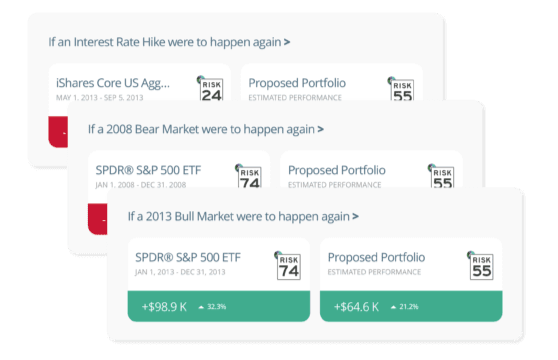
Using Nitrogen’s stress testing scenarios, she walks prospects through how their current portfolio would have performed during real market events like 2008 or the COVID downturn. There’s no forecasting and no hypotheticals. Just historical data showing how this portfolio behaved when conditions were most stressful.

It’s similar to the difference between describing turbulence and letting someone experience it in a flight simulator. Once you see how the plane responds, fear gives way to understanding. The unknown becomes familiar, and what once felt scary starts to feel manageable.

This clarity removes friction. Nothing feels hidden, and expectations are set early. When prospects decide to move forward, they do so with a realistic understanding of downside risk. That leads to stronger trust, fewer surprises, and client relationships that hold up when markets get uncomfortable.


4. Setting Expectations, Not Promises

Stress tests show what did happen. But what about what could happen next?

After walking through historical downturns, Natasha shifts the conversation forward. Instead of relying on averages or long-term market reassurances, she uses Nitrogen’s 95% historical range to set realistic expectations for what a portfolio may experience over a defined period.

In a single view, prospects can see a clear range of potential outcomes based on how similar portfolios have behaved historically. There’s no promise of results and no guesswork. Just a transparent look at both potential downside and upside, grounded in real data.

That clarity matters. Volatility stops being a vague risk and becomes something measurable. Prospects can decide whether the range they’re seeing matches their comfort level before moving forward, not after markets turn.

This is often when a quiet realization sets in. Many prospects ask why they’ve never been shown risk this way before. Not because anything went wrong, but because expectations were never clearly defined.


5. Transparency Secures Client Buy-In

By the time expenses come up, most prospects already sense something is off. They just haven’t seen it clearly yet.

Fees, tax drag, and portfolio inefficiencies are easy to gloss over in conversation. When they stay abstract, prospects underestimate their impact. The meeting keeps moving, but clarity never quite arrives.

So at this point, Natasha slows the conversation down and puts the numbers on the screen.

Using Nitrogen, she walks prospects through expense ratios, estimated tax drag, and total portfolio costs with clear visuals and real dollars. There’s no debate and no explanation required. Prospects can see exactly where money is leaking and how it affects their outcome.

Tax drag is often the turning point. “I always see tax drag really high,” Natasha says. “So I can say, ‘Hey, we’re even going to bring down your taxes in this portfolio.’” When that impact becomes visible, many prospects have the same reaction: why hasn’t anyone shown me this before?


How ‘aha’ Moments Move Decisions Forward

When prospects say they need time to think, it’s rarely about time.

It’s about uncertainty. And Natasha McPherson’s meetings are designed to remove it, step by step. Each “aha” moment builds on the last, replacing vague risk conversations with clear, visible insights. Using Nitrogen, she helps prospects see where they stand, what they’re exposed to, and what to expect next.

If you want to see these “aha” moments unfold in a real prospect meeting, click here to watch the full webinar replay. You’ll hear directly from Natasha McPherson as she walks through how she uses the Risk Number® and portfolio insights to help prospects move from uncertainty to confident decisions.

The difference between a stalled meeting and a signed client is clarity. See how Nitrogen gives you the visual proof you need to win trust faster by booking a demo here.

Why Your “Happy New Year” Emails Aren’t Working (And What to Send Instead)

By late January, most advisors have already sent their early-year outreach. A quick check-in. A market outlook. A polite nudge meant to restart the year. The message goes out. The box gets checked. And then the calendar stays quiet.

Conversations that slowed down in December don’t restart on their own. Interested prospects remain silent. Clients absorb opinions and predictions from other sources while advisors wait for engagement that never quite arrives.

It raises an important question that most advisors don’t stop to ask. If early-year communication doesn’t restart conversations or shape decisions, what actually does?

Advisors who use this window well think differently about communication with prospects and clients. They send messages designed to create movement, not just maintain contact. Each one nudges a conversation forward, shapes how decisions will get made, or clarifies expectations before outside noise takes over. When communication has a job, momentum follows.

This article breaks down three early Q1 communication strategies built for that outcome. Used well, these messages change how the rest of the year unfolds.

Before conversations stall completely

By January, most advisors face a familiar situation. A handful of prospects engaged in the fall, had good conversations, and then went quiet in December. The holidays took over. Calendars filled. Financial decisions got deferred.

The first mistake is trying to restart that momentum with a meeting request. After weeks of silence, a calendar invite feels like a big commitment. It asks for time, preparation, and focus before the prospect feels ready. Even interested prospects often ignore it, not out of disinterest, but because the next step feels too heavy.

A more effective approach is a short email that offers a lightweight, self-directed next step. Something a prospect can complete on their own time, without pressure.

Many advisors use simple tools for this:

  • A retirement readiness calculator
  • A short planning worksheet
  • A quick assessment or exercise

These tools work because they lower friction. Prospects re-engage privately, learn something useful, and regain momentum without committing to a meeting upfront.

This is where Nitrogen’s Risk Number® questionnaire and the Tax Snapshot fit naturally. The Risk Number reveals if a prospect’s portfolio aligns with their comfort zone, while the Tax Snapshot uncovers hidden costs and tax drag just as the new year begins. That clarity gives the follow-up conversation a clear purpose, instead of a sales undertone.

This approach works best with prospects who engaged meaningfully before the holidays but never formally opted out. When interest existed in Q4, offering a simple, informative next step in January gives those conversations a clean, simple way to restart.

Before expectations drift out of alignment

By January and February, most clients and prospects have already absorbed plenty of market opinions. Outlooks circulate. Predictions pile up. Financial media fills uncertainty with confident narratives. Long before clients reach out, expectations about what *should* happen this year start to form.

When advisors stay quiet during that period, those expectations tend to resurface later as urgency. Why aren’t we making changes? Should we be doing something right now? Why didn’t we act sooner?

At that point, the advisor no longer leads the conversation. They respond to assumptions that have already taken hold.

Effective early-year communication helps prevent that shift. This works well as a short email to your client or prospect list, a brief blog post, or even a simple social post clients are likely to see. The goal isn’t to predict markets. It’s to explain how decisions will be evaluated this year. What information matters. What kinds of market moves are expected and planned for. What would actually prompt a change, and what would not.

These messages don’t need to be long or technical. Often, the framing does the work. Simple titles can set expectations without inviting debate or speculation, such as:

  • How we think about market volatility before it shows up
  • Why headlines don’t drive portfolio decisions
  • What “staying the course” really means in practice
  • How we prepare portfolios for uncertainty without guessing

When advisors set expectations early in the year, the payoff shows up later. Fewer panic calls during drawdowns. Fewer reactive emails after alarming headlines. More focused conversations when clients do reach out. One clear message early can make the rest of the year calmer, more controlled, and easier to manage.

Before decisions harden

Q1 is when many clients and prospects quietly begin planning the financial decisions they expect to make later in the year. Large purchases. Investment changes. Business moves. New year resolutions. Liquidity events. Nothing has happened yet, but internal commitments are already taking shape.

That timing matters. Once someone decides what they want to do, advice starts to feel like friction. The conversation shifts from “Is this the right move?” to “Can you help me execute it?” Advisors who wait until then respond to intent instead of shaping it.

Effective early-year communication works upstream of that moment. These messages fit naturally as short emails or brief blog posts that clients can absorb in a few minutes. The goal isn’t to suggest action. It’s to improve how future decisions get evaluated before clients lock themselves into a path.

These communications work best when they focus on judgment and tradeoffs, not tactics. Useful framing might include topics like:

  • What to consider before committing capital this year
  • Why flexibility often matters more than optimization
  • How the timing and order of decisions affect outcomes

Sent early in the year, this type of communication raises the quality of every conversation that follows. Clients arrive clearer, less attached to a single outcome, and more open to guidance. The payoff shows up later in better decisions and far less second-guessing.

Making early-year communication count

The early months of the year quietly determine how the rest of it unfolds. Conversations either regain momentum or remain stalled. Decisions take shape with guidance… or without it.

Advisors who use this window well are selective. They understand that a few high-impact communications in this window can impact the rest of the year. And those choices can show up later in calmer clients, better conversations, and far less reactive work.

Nitrogen helps support that kind of communication. Tools like the Risk Number® questionnaire give advisors an objective way to re-engage prospects, align expectations, and guide better decisions without relying on predictions or guesswork.

The window to capture Q1 momentum is closing. Don’t leave these conversations to chance. Book a demo today to see how Nitrogen brings clarity to your New Year outreach.


Frequently asked questions

Why is early-year communication so important for financial advisors?

The first few months of the year shape how clients and prospects think about decisions long before action happens. Expectations form early, momentum either restarts or stalls, and assumptions take hold quietly. Advisors who communicate during this window can influence how decisions are evaluated instead of reacting after urgency sets in.

What should advisors communicate early in the year?

Effective early-year communication focuses less on predictions and more on framing. That includes setting expectations around how decisions will be made, offering low-pressure ways for prospects to re-engage, and helping clients think through tradeoffs before committing to action.

How can advisors re-engage prospects who went quiet at the end of the year?

Instead of asking for a meeting right away, many advisors use a lightweight, self-directed next step. Tools like short assessments, worksheets, or risk questionnaires allow prospects to re-engage privately and at their own pace, making follow-up conversations easier and more productive.

How does early communication help with client retention?

When advisors set expectations before headlines or volatility drive reactions, clients are less likely to panic or demand reactive changes later. Clear early framing leads to calmer conversations, fewer urgent calls, and stronger trust throughout the year.

What format works best for early-year advisor communication?

Short, focused formats tend to work best. Many advisors use brief emails, blog posts, or simple social posts that clients can absorb quickly. The goal isn’t volume. It’s clarity and timing.

How does Nitrogen support early-year communication strategies?

Nitrogen gives advisors objective tools, like the Risk Number® questionnaire and Tax Snapshot, to support conversations with data rather than predictions. These tools help advisors re-engage prospects, align expectations with clients, and explain decisions through a clear, defensible process.

Client Confidence Hit a Yearly High in December, Here’s Why.

If you followed the news into year-end, the outlook looked grim. The threat of a military invasion in Venezuela dominated headlines. The Labor Department released another weak jobs report. And by late December, the Conference Board reported that consumer confidence had plunged to record lows. On paper, it looked like advisors and their clients would head into January on edge.

That isn’t, however, what showed up in our data.

Across thousands of firms on the Nitrogen product suite, clients remained steady. We saw confidence and follow-through rather than retreat. Activity eased, not because of fear, but because most of the work was already complete. Portfolios stayed aligned, and client optimism finished the year at its highest level.

Clients remain confident despite dour headlines

If you only looked at broader surveys, you’d expect a nervous client base. Between the threat of conflict in Venezuela and a weak job market, consumer confidence has fallen for five straight months. Most households are focused on rising prices and the impact of new tariffs. From that angle, anxiety would seem inevitable.

But our data tells a different story. In December, 83% of clients reported feeling confident about their financial future. That was the highest reading we recorded all year. Confidence rebuilt after a soft spring and strengthened through the second half as markets recovered. While the general public grew more anxious, clients remained steady.

Check-ins graph

The difference could reflect the client base advisors work with every day. More than 60% of advisors on Nitrogen serve households holding over $250,000 in net worth, and a significant share serve clients north of $1.0 million. For these households, economic pressure shows up differently. Strong market gains tend to outweigh higher grocery bills or rising prices for essentials.

Proposals by AUM Tier

This data also lines up with what we heard from advisors throughout the month. The usual year-end “noise” was missing. There were fewer reactive calls and less pressure to make last-minute changes to portfolios. Because client sentiment was so high, reviews stayed focused on progress and long-term positioning rather than reassurance.

Investor sentiment follows the rally

That sense of security was reinforced by what clients saw on their screens every day. It’s much easier to feel confident about the future when the market is performing in the present. While the headlines were full of geopolitical threats, stocks barely noticed. Equity indices finished the year with double-digit gains and sat near record highs.

The sentiment data from our data reflects this tailwind. 

In December, 85% of clients reported feeling positive about the markets. Like personal confidence, this was the highest reading we saw all year. The optimism that began building in the summer carried through to the end of 2025.

When confidence holds at this level, the advisor’s job changes. The role shifts from calming fear to maintaining momentum. Meetings move faster and the planning process stays on track because market anxiety no longer slows things down.

How advisors responded

So, with clients feeling great and the markets hitting record highs, you might expect to see a shift in strategy. It would be natural for some to want to chase the end-of-year rally or lean harder into equities.

The data, however, points in the opposite direction. Advisors encouraged clients to stay the course.

As sentiment climbed, advisors barely adjusted their allocations in proposals. Nitrogen’s data shows that equity allocations held within a very tight range throughout the month. Most hovered around the low-50% mark. Advisors didn’t overhaul their models or ramp up risk just because the mood had improved.

Cash and fixed income allocations followed the same pattern. Allocations to these assets stayed remarkably consistent in December. We saw no rush to dump cash or rotate out of defensive positions to capture more of the equity rally. Advisors simply maintained the balance they had already established.

In other words, this restraint is the real story. Advisors absorbed the holiday optimism without letting it dictate strategy. 

December brings a holiday slowdown

This advisor restraint was likely possible because much of the heavy lifting had already happened. By the time the markets began their year-end sprint, most strategies were already in place. This is reflected in the natural rhythm of the month. December is rarely an urgent time for the wealth management industry. Most advisors see their calendars clear out by the second or third week. Client meetings drop off as families start thinking about the holidays. The focus moves to finishing reviews and locking in allocations while new projects tend to wait until January.

Our data backs up this seasonal shift. 

Average daily proposal volume on Nitrogen dropped to roughly $1.0 billion in December. This was a step down from $1.2 billion proposed in November, which was the most active month of the year.

This looks more like completion than caution. Advisors didn’t pause because they were worried about headlines. They slowed down because most of the work was already done. 

The bottom line

As the year closed, discipline stood out more than any surge or pullback. Advisors finished the year with a clear-eyed restraint in the face of bad news. When the headlines were shouting about invasions and layoffs, the data shows advisors sticking to their plans, reinforcing progress, and staying focused on what matters.

Where does your firm stand on these signals and shifts? Join the advisors using data to drive client decisions. Book a demo today.

About Nitrogen Signals & Shifts

Each month, Nitrogen analyzes proposal and sentiment data from across its product suite to help advisors understand what’s driving client decisions. With more than 1,000 proposals created daily, these insights highlight how advisors adapt and how investors stay invested. Thank you for reading this edition of Nitrogen Signals & Shifts. The next issue will be published in early February. Subscribe at the top of this post so you never miss an update.