

Re igniting Your Organic Growth Strategy: Webinar Recap

About this session:

This session focused on reigniting organic growth strategies for advisors and discussed industry trends, research, and action steps for building an organic growth engine.


Insights Surfaced:

  1. The rate of organic growth for advisors is declining, prompting a focus on marketing strategies.
  2. Advisors should rediscover their marketing muscles and focus on building an organic growth engine.
  3. It’s important to have a clear strategy and target market for marketing efforts.
  4. Differentiated value propositions and content marketing are crucial to attract clients.
  5. Digital marketing channels, such as social media and email campaigns, can help reach potential clients.

Meet the Speakers

Tim Welsh

Timothy D. Welsh, CFP®, is the President, CEO, and founder of Nexus Strategy, LLC, a leading consulting firm specializing in the wealth management industry. With a focus on marketing products, services, and technology to independent advisors, Nexus Strategy works closely with top organizations. Tim has a strong background in business consulting, practice management, and marketing, with experience at Schwab Advisor Services and Merrill Lynch. He is recognized as an industry expert, frequently quoted in media, and actively contributes as an author and speaker. Tim holds a bachelor’s degree in Economics and an MBA in Finance, and he is a Certified Financial Planner (CFP®) who has served on the Financial Planning Association’s National Board of Directors.

Meg Carpenter:

Meg Carpenter is CEO and Co-Founder of FiComm Partners, an award-winning growth marketing and advisor coaching firm. For over 20 years, Meg has enjoyed working alongside advisory firms and wealth management businesses, helping their leadership teams identify meaningful growth opportunities. Meg and her team are widely recognized across the industry for their New Skool mindset, which is all about embracing vulnerability and authenticity to drive impact and change. Meg serves on multiple boards and is currently the Chair of the CFP Board’s Workforce Development Advisory Group. She is also a sought after industry speaker and contributor to the media, and is honored to have been the recipient of many industry awards including InvestmentNews 40 Under 40.

Gary Foodim:

Gary brings 20 years of marketing experience to the Mercer Advisors team. In his role as CMO, Gary leads new client acquisition efforts, helps drive client engagement, develops a prospect and client event strategy, and the evolution of the Mercer Advisors brand. Prior to joining Mercer Advisors, Gary was the CMO of Strategic Financial Solutions, a financial services firm focused on helping Americans in challenging financial situations. Before joining Strategic, Gary was the VP of Consumer Marketing at Conde Nast where he oversaw all consumer marketing efforts for many of their iconic brands. Gary earned an MBA from the McDonough School of Business at Georgetown University and an undergraduate degree from Binghamton University. Gary lives in New York City with his wife and children.


Watch the Entire Webinar


Takeaways

Takeaway 1: Organic growth is crucial for financial advisors

Organic growth requires a combination of strategy, targeting specific audiences, and leveraging digital channels.

The panelists discussed the importance of organic growth in the financial advisory industry. Meg stated that “there are so many different lanes for every type of advisor that exists.” Gary emphasized the need for advisors to focus on their target market and differentiate their value proposition, as well as the importance of using digital channels like social media and search engine optimization. Meg also highlighted the need for a strong strategy, starting with understanding the “why” and the “who” of an advisor’s business.

Gary explained that to achieve organic growth, financial advisors must be willing to test and learn, using a balanced approach to marketing tactics. He mentioned paid search, social media, and content marketing as some channels to leverage. Meg also encouraged advisors to start small, be consistent, and only invest in marketing tools that make sense for their specific business. She said, “pick one thing that you believe will get you in front of more of the type of people that you want to serve and commit to doing it.”

Takeaway 2: Marketing should be viewed as a critical component of an advisor’s business 

A successful marketing strategy should focus on providing a seamless prospect and client experience.

Meg explained that marketing needs to be integrated across all aspects of a financial advisor’s business, from the executive level down to the individual advisor. She suggested focusing on building a prospect experience that nurtures relationships before connecting with the potential client. This includes providing a seamless client experience, providing value-added resources, and delivering personalized, authentic messaging.

Gary agreed, emphasizing the importance of focusing on the middle and bottom of the marketing funnel to drive conversions and nurture leads effectively. He suggested that advisors should have a keen focus on landing pages, email campaigns, and the overall prospect experience. Meg added, “We’re seeing a lot of firms in the industry today who are like marketing firms who do wealth management, which gets me super excited because I think that there’s this subset of advisory firms who no one knows, who are really going to change the face of the industry in coming years.”

Takeaway 3: Leveraging AI and new marketing technologies can help financial advisors gain efficiencies and scale their businesses.

The panelists discussed the potential impact of artificial intelligence (AI) on the financial advisory industry. Meg stated that there are many new tools and platforms available to help advisors take advantage of AI to improve their marketing efforts. She mentioned Catchlight as an example of an AI-driven tool that can help advisors target specific audiences and predict which prospects are more likely to convert.

Gary suggested that while it’s still early days for AI in the industry, advisors should stay up-to-date on the latest developments and be prepared to pivot their strategies as needed. He also emphasized that AI should be viewed as a way to drive efficiency and scale, rather than replacing traditional marketing tactics. Meg agreed, saying, “I think a lot of the custodial benchmarking studies lump business development and marketing together.”


Looking for more?

We love to hear it! Take a look at our current line-up to register for future live webinars or browse other replays like this one.
View Webinars

Win Prospects Faster with Tax Drag

When it comes to meeting with prospects, you often build a compelling proposal, complete your due diligence process with Discovery, Individual Security Analysis, or Stats, and then you know what comes next…

Meeting with the prospective client for the first time.

It’s time to win the business and bring a new client aboard! If you’ve been using Nitrogen for a while… you know the formula.

There’s a really solid chance that the prospect has more risk in their current portfolio than they want or need. It’s about 88% of the time. When you’re able to show a client that they are off track, that’s a powerful recipe for growth — we call it the ACAT form moment.

But that means about 12% of the time, the prospect’s current risk might actually line up with where they want to be. So, what do we do then?

Over the last few years, advisors have been using Riskalyze GPA to answer that question. GPA is an easy-to-understand metric that illustrates how much return a portfolio is typically delivering in exchange for its risk.

But let’s say that the prospect’s risk is in line, and their GPA isn’t too shabby either. That’s where the third lever—Tax Drag—comes into play.

We recently added Tax Drag on individual securities, but, today, we’re proud to announce Tax Drag is available in the All-New Portfolios Experience and Stats.

Today, we’re proud to announce Tax Drag is available in the All-New Portfolios Experience and Stats.

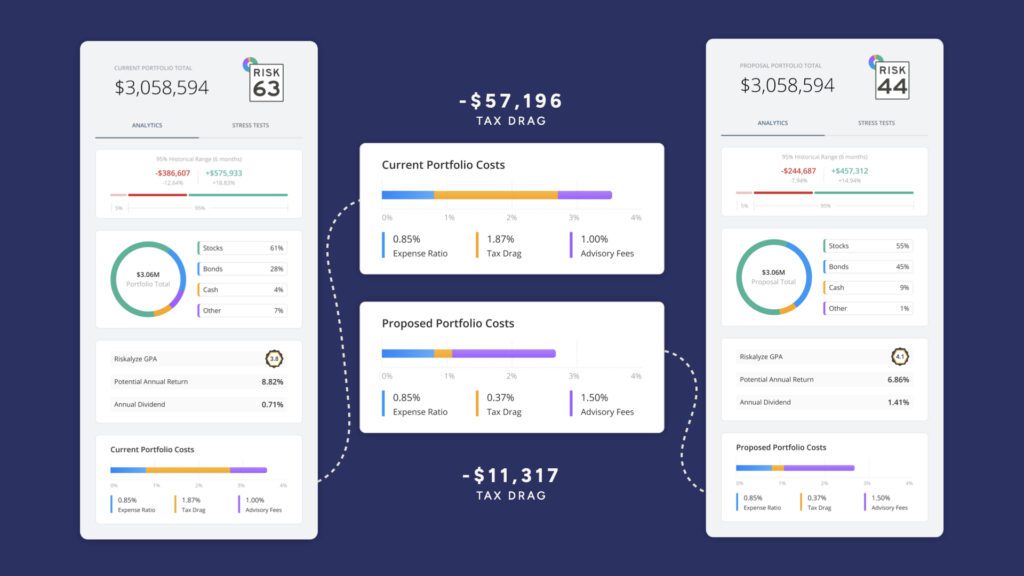
Current portfolio costs versus proposed portfolio costs in a Nitrogen proposal

Tax Drag is defined as the reduction of a portfolio’s annualized return due to taxes. Very simply, it’s the tax liability triggered by distributions and capital gains in a non-qualified account.

Every financial advisor talks about tax efficiency, but very few provide understandable metrics to demonstrate it.

Just like high expense ratios drag down returns, inefficient tax management has a massive impact on your clients and the assets they have invested with you. And Tax Drag illustrates this beautifully!

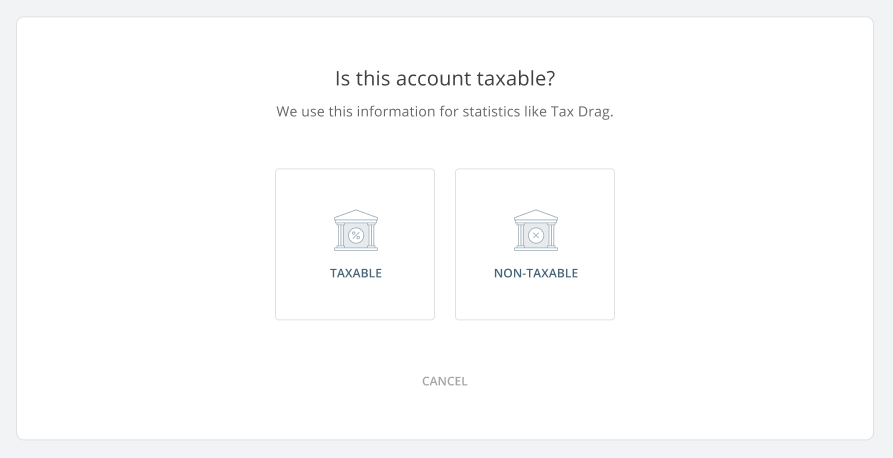
Once you’ve started building a proposal or portfolio, it’s easy to assign the account a tax status—taxable or non-taxable. This information is critical to calculating the Tax Drag on a portfolio or proposal.

View of tax drag within the Nitrogen Growth Platform

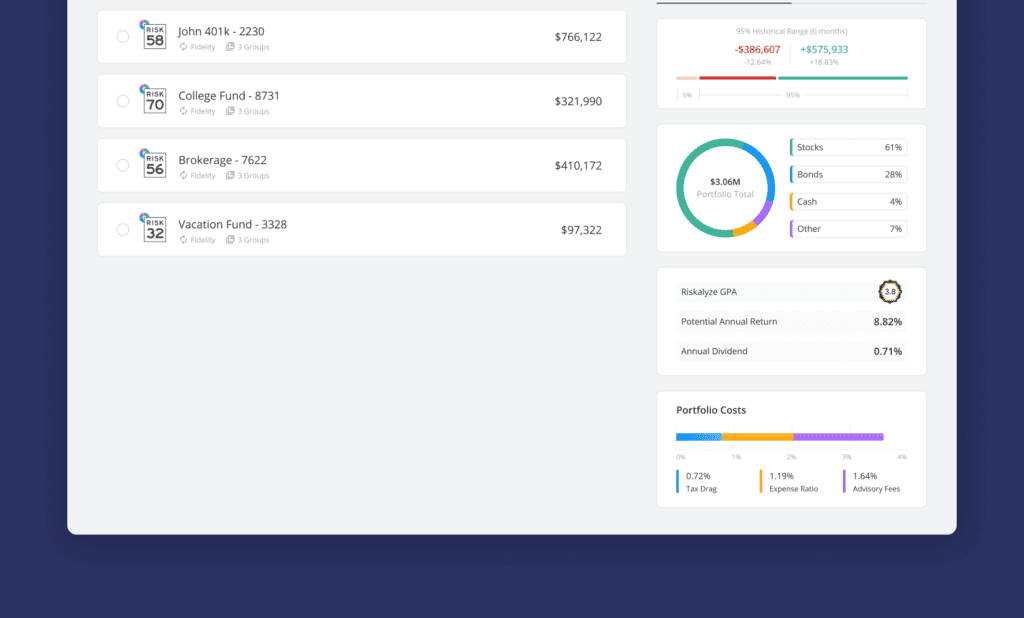
Once your holdings have been entered, it’s easy to see the effects of Tax Drag on a given portfolio. Take a look at this existing portfolio—it’s losing 1.87% of its return to tax drag. It’s so powerful to dollarize it — on a $3 million portfolio, that’s $57,000 of real portfolio value every year, vanishing with taxes.

But if we pull up a proposal you’ve built for your client, it’s a very different story — just 0.37% tax drag. And that saves $46,000 a year that keeps compounding for the client, and by the way, increases your AUM!

How to assign an account a tax status–taxable or non-taxable–in Nitrogen

This can be a real game changer to drive client engagement and conversions. In many cases the cost to transition a taxable portfolio can be offset by reducing tax drag!
There’s something magical that happens when you can save clients money on taxes. It’s one of the most powerful things you can do as a financial advisor.

But that’s not all. Tax Drag can be accessed in Detailed Portfolio Stats! This means you can take your analysis to the next level and dive even further into your portfolios and proposals to ensure you are building the most tax-efficient portfolios for your clients.

5 Compliance Process Improvements to Help Your RIA Scale

What holds most advisory firms back from faster growth and continued success? The answer might surprise you.

It’s not certain sales techniques or the need for more marketing. Instead, it’s often the processes that are (or are not) being followed.

Advisors can’t afford to have loose or undefined processes in place, as established workflows help keep firms compliant and above board. This is especially true when it comes to ensuring your firm is operating in a compliant manner. Compliance is one part of your firm where following well-established processes is a must.

But it’s easier said than done for large advisory firms to halt everything, develop new processes, and then successfully implement them across the company. The good news is, there’s a much, much easier way to immediately improve compliance processes for RIAs using Nitrogen’s Compliance features.

In this blog, we’re showing you how the Nitrogen Growth Platform works to increase your team’s efficiency and help you build a process-oriented firm that keeps compliance top-of-mind.

Continue reading “5 Compliance Process Improvements to Help Your RIA Scale” →

Portfolio Stress Tests just got an upgrade

Have you ever noticed how most clients always feel like the grass is greener on the other side? 

You know better than anybody that clients want to know what’s “normal” for their portfolio. And you also know setting expectations based on average return doesn’t work — after all — the market almost never hits its own average!

Even when clients understand their Risk Number® and 95% Historical Range, they still get tempted by the latest news and updates about the market. They start comparing their portfolios with their friends and family, and start wondering why they aren’t doing as well. Or they ask the question, “Why is the market beating my portfolio?”

It’s enough to drive any advisor insane.

We built portfolio Stress Tests to answer that very question. And today, we’re announcing that Stress Tests have been rebuilt from the ground up so that you can run any of your client’s portfolios through a market timeline and compare them to just the right benchmark to make your point.

Continue reading “Portfolio Stress Tests just got an upgrade” →

A letter from our CEO

It was just about ten years ago that we launched Riskalyze into beta — and it took off like a rocket.

Since then, the Risk Number® has transformed how tens of thousands of advisors turn leads into meetings, meetings into clients, and clients into referral champions. And it didn’t take us long to realize that we hadn’t just invented a better way to talk about risk — we’d invented a better way to help wealth management firms grow.

And we haven’t let up this past decade, investing more than $50 million dollars into R&D to build out an incredible platform for you — deep portfolio analytics, stress testing, proposals, investment policy statements, client check ins, lead generation, and a host of other industry-first features.

It’s time for our name to reflect not just who we are today, but who we will be in the future.

Last year, at our Fearless Investing Summit, I said we planned to rebrand our company in 2023, and that day is here.

Continue reading “A letter from our CEO” →

Social Media Marketing for Financial Advisors

If your firm desires to scale or grow, there are two primary ways to do it: inorganic growth or organic growth.

Inorganic growth happens when firms experience a merger and acquisition (M&A). But for this article, we’re going to focus on the vast opportunities you’ll find by pursuing organic growth.

Organic growth can be broken down into two categories: outbound marketing and inbound marketing.

Outbound marketing refers to strategies you use (and typically pay for) to put yourself in front of your desired audience: ads, email lists, billboards, commercials, etc. By comparison, inbound marketing includes the strategies you use to attract your audience to you: blog writing, email newsletters (not through a paid list), Ebooks, checklists, videos, and social media.

In this blog, we’ll show you the best ways to use social media to grow your brand and, eventually, scale your firm.

5 Tips for Social Media Marketing That Works

Social media is saturated with posts from millions of people and firms. Even if your network is small, people still tend to swipe or scroll until they see something that catches their eye.

Use Visually Driven Content

It’s essential that your social posts are visually driven and reflect your firm’s branding. People absorb and register images much, much faster than text. In fact, social media posts with images receive 650% more engagement than posts with text only.

Focus on Your Clients

People don’t come to Facebook or Twitter to read a sales pitch (in fact, they’re probably trying to avoid sales pitches while on social media). So give the people what they want!

Identify their biggest pain points and offer solutions, answers, or resources to address them. If your target audience is tech employees, share posts about equity compensation planning, wealth building, homebuying, etc.

Understand Each Platform’s Algorithms

Every platform has developed its own algorithm to determine the visibility of a post. This can get fairly complex and is certainly not an exact science. But knowing what time of day is best to post, or what type of content (links, photos, videos, etc.) the platform tends to favor can be helpful.

More important than trying to game an algorithm, though, is consistency. If the old quote about success in life is mostly about showing up, that sentiment also applies to social media.

Use Testimonials If Possible

Testimonials offer proof of your ability to help others and (when done in a compliance-friendly manner) can be powerful tools for attracting new clients.

The SEC has recently ruled that RIAs are allowed to share testimonials on social media. This is still a fairly new change, so we recommend proceeding cautiously. Before incorporating this into your social media strategy, talk to your compliance officer or department.

Engage More Than You Post

Sometimes, people forget the social part of social media.

As a general rule of thumb, engage with others 80% of the time and post your own content 20% of the time. Doing so will broaden your visibility beyond your network, so you can extend your reach and find new audiences who see your comments on other peoples’ posts.

The Social Platforms Financial Advisors Should Use

Start by looking at your target demographic and consider what platforms they’re using.

For example, LinkedIn may not be the right place to reach people in retirement, but it could be a great way to connect with wealth builders or those reaching their peak earning years.

Twitter is an effective platform for growing your professional network or talking to journalists and publications. It tends to work best for connecting with other people in the financial services industry, as opposed to connecting directly with new potential clients.

Once you have an idea of where your clients may be spending their time, start to test the waters and see where you find success.

If this is your first time managing a business social media account, don’t feel like you have to jump onto every platform all at once. Start with one, maybe two, and figure out what works well and what doesn’t. Get comfortable with maintaining a regular schedule, engaging with others, and gradually you’ll be able to grow your network.

Eventually, you may want to check out another platform. But it’s better to put your effort into growing a presence on one platform consistently than to try to overwhelm yourself with multiple platforms. If that happens, it’s possible you won’t be able to devote enough time to any of them to really make a difference.

Creating a Social Media Marketing Calendar

A social calendar keeps you accountable and helps to maintain a regular, consistent online presence. You can use it to identify timely opportunities to post, such as holidays, special months, tax or financial deadlines, and more.

The benefit of creating a calendar is that you can give yourself time to think about upcoming topics to post on, create relevant graphics, search for relevant hashtags or keywords or make a quick video to enhance the post.

By thinking ahead, you can use a social media scheduling tool that allows you to load and schedule multiple posts at once instead of manually posting something new every day. This can help put more time back in your day to share, comment, and interact with other posts instead.

As you create your social media calendar, don’t forget to include time each week or month to check the analytics. This information will help you determine how many people saw your posts, clicked on links, shared them, etc. You’ll be able to see what types of posts are performing well and which aren’t.

When analyzing this data, look for patterns, such as posts with images or videos or posts that use certain hashtags. Eventually, you’ll be able to figure out your own “secret sauce” for boosting engagement.

How Often Should You Post?

It’s not a hard and fast rule, but trying to post daily on the social platform you’ve decided to commit to may be the fastest route to achieving your goals.

Things move very quickly on social media. A tweet, for example, has a lifespan of about 15 minutes. On LinkedIn, posts show up on user feeds for about 24 hours.

Because of this, posting regularly helps maintain visibility with your network. It’s likely not everyone will see every post you share, so no need to worry about coming across as too “spammy.” In fact, you can use this to your advantage by tweaking and resharing the same messaging or content multiple times. You don’t have to reinvent the wheel every time you want to post something.

Ready to Start Your Social Media Journey?

We know social media can be intimidating, especially as a financial advisor who may have shied away from it in the past.

To help out, we created this free social media calendar template that you can use to start mapping out your posts, follow a schedule, and grow your presence online.

Five Features to Grow Your Client Base as a Financial Advisor

As a financial advisor or firm executive, you know how important it is to focus on consistent business growth. The truth is that once you factor in market growth, most wealth management firms are only growing ~3% each year.

If finding clients as a financial advisor is challenging, and you’re looking for ways to grow your client base, you may need a growth platform. The Nitrogen growth platform is a powerful tool that helps convert leads to clients, creates a personalized client process at scale, and much more.

Whether you’re new to the growth platform or a seasoned veteran, this blog will provide in-depth insights into how your firm can grow today. So, let’s dive in and discover the five key features that your firm can leverage to perform investment research, win prospects faster, retain clients, and protect your business.

Continue reading “Five Features to Grow Your Client Base as a Financial Advisor” →

How Your RIA can Embrace the New SEC Marketing Rule

If scaling and attracting new clients is a priority for your firm, have you thought about how, exactly, you’re working to achieve this goal?

RIAs face an ever changing set out challenges to growth, yet many aren’t adjusting their marketing efforts accordingly to engage prospects. One area to consider is making the most out of the SEC marketing rule. Cold calling and waiting for referrals to walk through the door may still work for some, but these marketing tactics have long been losing traction due to the robust capabilities of digital marketing and changing attitudes of today’s investors. Having top-notch financial advisor branding and website content is the key to staying competitive.

Sometimes, it might feel like marketing for financial advisors hasn’t undergone much change since the 1940 Investment Act.

In reality, advisor marketing is undergoing an exciting evolution. The SEC has passed new rules regarding testimonials, firms are opting to go virtual, and advice is being pushed out to younger generations from B2C startups across the globe.

With all these changes happening, the question you’re likely asking is, “How do I make my RIA stand out from other advisors and financial influencers?”

Here are five fresh ideas you can use today to jumpstart your marketing efforts, support your growth goals, and stand out as an RIA firm.

Continue reading “How Your RIA can Embrace the New SEC Marketing Rule” →

Win Clients During Market Volatility: Webinar Recap

Executive Summary

Market volatility can be a major challenge for financial advisor firms, as it can lead to uncertainty and anxiety among clients, and can also make it difficult for advisors to achieve their growth goals. The webinar titled “Best Practices to Engage with Clients during Market Volatility” aims to provide advisors with the tools and strategies they need to effectively communicate with clients and navigate volatile markets, while also exploring ways that they can use market volatility to grow their firms.

The first part of the webinar addresses key questions such as how to interact with clients, what resources to provide to help clients understand and manage market fluctuations, and how to set realistic expectations for clients during volatile markets. Additionally, it covers how to use technology to facilitate communication and engagement with clients during volatile markets and how to address clients’ concerns and manage their emotions during times of market turmoil.

The second part of the webinar focuses on providing examples of how successful navigation of market volatility with clients can be achieved. It covers strategies for ensuring that clients’ portfolios are aligned with their risk tolerance and financial goals. This section aims to provide financial advisors with practical examples and case studies to help them navigate market volatility with their clients.

The third part of the webinar covers ways to grow during market volatility. This section addresses questions such as what strategies to use to attract new clients during volatile markets, how to use market volatility as an opportunity to engage with current clients and potentially bring in new business, and how to stay up-to-date on market trends and changes in order to better serve clients and grow the business. Additionally, it covers the use of Nitrogen to create an effective advisor workflow and communicate with clients.

In conclusion, the webinar provides financial advisors with the tools and strategies they need to effectively communicate with clients, align their portfolios with their clients’ risk tolerance and goals, and use market volatility as an opportunity to grow their business. By the end of the webinar, advisors will be equipped with the knowledge and resources to navigate volatile markets and achieve their growth goals.


Meet the Speakers

Bill Simonet, CFP®, AIF®, CEPA

Bill Simonet, CFP® is a Certified Financial Planner and Principal Advisor at Simonet Wealth Management with almost 10 years of experience. He is dedicated to helping individuals, businesses, and families achieve their financial goals and holds the prestigious CFP® certification. A graduate of Everglades University, Bill is committed to fiduciary duty and has a strong reputation for honesty and integrity. He is also a decorated veteran and active in his community.

Chris Quandt:

Chris Quandt is a Success Engagement Manager at Nitrogen. Over the last 7 years he has served on both the Marketing and Advisor Success team. Chris delights in helping advisors understand how Nitrogen can help as a growth platform and business development tool. Given the choice between Reese’s Pieces or M&Ms. Reese’s Pieces every time.


Watch the Entire Webinar

Keep scrolling for highlight snippets!


Highlights

How Do You Communicate With Clients Regarding Market Volatility?

Learn how Bill communicates with clients during a downturn in the market. He recommends using the Nitrogen Check-In tool and reaching out to clients who may be feeling nervous or uncertain about the market. He suggests being proactive in retaining clients by regularly checking in with them and reviewing their portfolio relative to their long-term goals.

<script>

How Can You Leverage Market Volatility to Fuel Firm Growth?

Bill Simonet discusses using volatility as an opportunity for growth and presents strategies for attracting new clients during volatile markets. He mentions the availability of cash and the opportunity for growth depending on the time period and investments and covers the example of the COVID market crash to illustrate the potential for growth for those who were able to invest during that time.<script>

How Can You Leverage Market Volatility to Fuel Firm Growth?

Bill demonstrates how he ensures his clients’ portfolios align with their risk tolerance and financial goals using Riskalize. He uses the statistics and scenarios sections within Nitrogen to break down and analyze the portfolio during different time periods, including market crashes like the one in 2008. He also uses the tool to show prospective clients how their portfolio compares to the market and their cash flow.<script>


Looking for more?

We love to hear it! Take a look at our current line-up to register for future live webinars or browse other replays like this one.
View Webinars

Improve Your Bottom Line With Compliance Technology

When you consider the traditional role compliance plays in your firm, the idea of it being a “revenue generator” may not make much sense. In fact, it seems that many advisory firms have viewed compliance as a drain on resources. Compliance and regulation add steps and processes that feel inefficient and unorganized, while simultaneously taking time and energy away from the things advisors want to spend their time on.

The problem is, the SEC is aware of how advisory firms feel, and they’re taking note of the lack of resources devoted to compliance initiatives. In a recent Risk Alert, the SEC noted that growing RIAs in particular are at risk of falling out of compliance with their policies and procedures.

The Compliance Rule outlines a strict standard of compliance documentation, policies and procedures. Yet, many firms are choosing to refocus their time and resources toward achieving their growth goals. Allowing compliance efforts to fall by the wayside can result in an SEC audit and, if found out of compliance, advisors may incur hefty penalties.

Does this mean your firm should forgo its goals for growth to focus on shoring up its compliance efforts? While this may have been the only option in the past, it is possible to meet financial advisor compliance requirements while utilizing today’s technology to grow your firm too.

Remove the red tape, be proactive, and scale your firm effectively by implementing RIA compliance technology into your firm’s tech stack.

Continue reading “Improve Your Bottom Line With Compliance Technology” →