4 Simple Tips for Boosting Your Advisor Marketing Efforts

Is there a “secret sauce” to building a successful wealth management firm? What makes some capable of doubling – even tripling – their AUM while others struggle to retain clients? 

While there’s no one specific reason why some find more success than others, there are a few common (and perhaps surprising) retention and client acquisition strategies for financial advisors that these successful firms employ (and you can, too).

Related: Advisor Wins 8-Figure Client and Projects 40% Growth in One Year with Nitrogen

If you’re interested in attracting more of your ideal clients and growing your AUM, here are four tips we recommend:


4 Marketing Strategies for Financial Advisors That Really Work

1. Revisit your approach – and change course when needed

If you find that you’re struggling to bring new (and qualified) clients through the doors, it may be time to revisit your existing marketing strategies. Or, if you have solely depended on referrals to get your name out, this is a good time to work on building a digital footprint. 

That’s because more than three-fourths of consumers “look for a company’s online presence before visiting in-person.” In today’s tech-driven world, your presence online will be a requirement of your future clients (especially once you begin working with the next generation of investors).

Your digital presence can include:

  • Your website: Make sure it’s visually appealing, easy to navigate, and provides all the necessary information about your firm (without overwhelming readers).
  • Social media: If your firm and advisors haven’t already, they may want to create profiles on social platforms like LinkedIn, Twitter, and Facebook. Here, they can share updates, provide educational information, connect with current or prospective clients, and encourage action (like booking an appointment).
  • Online publications: To build your reputation as a knowledgeable and trusted thought leader, consider submitting articles or quotes to online publications. Make sure the article links back to your social profiles and/or website.

As you work to build out or revamp your presence online, keep in mind who your target market is. Think about what sort of clients you’d like to attract to your firm and consider their pain points. Make sure to tailor your content and messaging to speak directly to that audience.

Related: Understanding Lead Generation for Advisory Firms

2. Prioritize client retention (even above client acquisition)

When your clients are happy, they’re much more likely to encourage others to come see you as well. In fact, satisfied clients are typically the number one source for obtaining new, high-quality clients

Why? Because people tend to gravitate toward others with similar interests, jobs, or socioeconomic levels. If your current client represents your target audience, there’s a good chance the people they refer to your firm will be well-qualified prospects from similar backgrounds.

The catch: Those referrals will only happen if your current clients are delighted with your service. 

Client engagement (and subsequent client retention) is critical to both your long-term client relationships as well as your firm’s growth goals.

 And it doesn’t have to be time-consuming or expensive to keep a pulse on your clients – platforms like Nitrogen can help you better nurture those relationships by initiating automatic check-ins, stress testing certain scenarios, identifying warning signs, and otherwise tracking client sentiment on your behalf.

3. With the above in mind, communicate more than you think you need to

Few things are more personal to your clients than their wealth and financial well-being, meaning it’s important to them that you’re always communicative and transparent. A recent study found that 85% of clients consider your communication style when deciding to stay with your firm or look elsewhere for financial advice. 

Give your clients clear expectations of how to contact you, your operating hours, and how long it will take you to return a message.

In addition, it’s important to find opportunities to be proactive with your client communications, particularly around life milestones. Share market updates, send birthday cards, check in during a hard time (such as a death or divorce), and just let them know you’re thinking of them on a personal level.

When you take your communication up a notch, it can make a big impression on your clients. Incorporating automation and AI-driven tools into your tech stack helps you continue to deliver that personalized communication – even as you scale.

4. Think of progress in terms of what you can measure

The one step too many advisory firms forget during this process is to pause, reflect on their progress, and measure their success

Unless you track the changes made, how long they’ve been in place, and the results, you won’t know which of the above strategies is yielding the best ROI.

Check in regularly (say quarterly or annually) on your efforts to attract and retain high-quality clients to determine what’s working best and what needs to be tweaked or changed. 

Related: How to Measure Client Retention in Your Wealth Management Firm

If you find that your social media presence is growing significantly in terms of followers or engagement metrics, for example, there may be an opportunity to double down your efforts in that arena. Or, if you notice you have a lower number of referrals from clients in this quarter, it may be time to reflect on the client experience you’re delivering and identify opportunities for improvement.

Don’t be afraid to ask for feedback from your clients, peers, and professional network. They can help you better understand how your efforts may be perceived by others, or provide actionable insights you can incorporate into your firm moving forward. 

Related: Click here to watch the on-demand webinar, “Measure and Manage the Growth of Your Firm with Nitrogen Ignite”

Leverage the Latest Technology with Nitrogen

Finding success as a financial advisor depends largely on your ability to deliver an impeccable and scalable client experience. Nitrogen’s holistic approach to elevating how you work is meant to bridge the gap between advisors and their clients – while enabling you to focus on building your book of business.Take a tour of the Nitrogen platform and see for yourself how we can help you unlock your firm’s full potential. Book your demo today.

Improve Your Client Experience With These Thoughtful Engagement Strategies

With so many financial resources available at investors’ fingertips today, clients are looking for their advisors to provide more than investment advice. In fact, 60% of clients believe more frequent and personalized communication with their advisor would give them more confidence in their financial plan.

Clients need to feel heard, cared for, and included in the conversation, and that requires a lot of positive and personalized communication.

But what often gets overlooked here is the fact that positive client engagement isn’t just good for clients, it’s essential for advisor well-being and success too. Without productive conversations, advisors may not have the information needed to serve their clients to the best of their abilities.

Transforming your firm’s client engagement responsibilities from what feels like a burden into a mutual benefit requires a shift in strategy – but it doesn’t have to be difficult. Read on to explore challenges to positive client engagement, strategies to overcome them, and tools to help you along the way.


Challenges to Positive and Sustainable Client Engagement

With an understanding of why client engagement is important for both you and your clients, let’s consider what potential challenges are standing in the way from the perspective of both parties.

As an advisor, you are probably busy. You tend to work long hours in the office, juggling many tasks, while trying to please multiple clients. As you stretch too thin, you may become easily stressed, burnt out, and feel too busy to take on another recurring responsibility. The result: Non-essentials like client engagement and proactive check-ins tend to fall on the back burner, and you focus on more immediate and tangible tasks. 

You may also find it difficult to identify clients’ specific concerns before they escalate into an urgent phone call or email, especially if they haven’t prioritized proactive communication in the past. In turn, clients may not feel particularly inclined to share information or reach out beyond their annual or quarterly meetings. 

Related: 5 Client Personas Every Financial Advisor Eventually Encounters

If the lack of positive communication continues over time, it can crack the foundation of trust in your relationship. As a result, the partnership may even end prematurely or otherwise detract from your clients’ overall experience working with your firm.


3 Ways to Make Client Engagement a Positive Experience for Everyone


1. Communicate on Your Schedule

One thing’s clear: Your clients want to hear from you more. 

Anytime you’re able to let your clients know you’re thinking about them and their financial or personal well-being, you’re building up your credibility and exceeding their expectations. Those small moments compound over time to create a concrete foundation of trust, and they’re what help build a long-term successful relationship.

Of course, dropping everything and turning your attention to a client when they feel stressed can be difficult. Rather than wait for clients to approach you, try taking a few proactive measures to ensure you’re communicating on your schedule. 

Provide regular check-ins to anticipate issues and answer your clients’ questions before they’re even asked. This will satisfy your clients’ craving for regular communication without sacrificing your productivity.


2. Focus on Quality

When it comes to communication, quality is just as important as quantity. 

Yes, you should be communicating often, but those communications should be personalized and value-driven (as opposed to sounding impersonal or irrelevant). As technology has advanced in recent years, clients are now accustomed to receiving personalized communications, meaning the days of generic mass emails are gone. 

Consider tailoring your message to address each client’s specific needs, goals, and risk tolerance. Creating those real moments of connection with your clients will likely feel more meaningful and purposeful for you, too! 

Related: Steal These 5 Client Engagement Examples

If you could use some help creating and sharing hyper-personalized communications, the Nitrogen platform empowers you to send targeted emails and messages based on how your client lists are segmented. That way, you can leverage client data to personalize content and ensure your communication resonates with each individual.


3. Automate Your Processes

The great thing about using a platform like Nitrogen to boost your client engagement efforts is that you can automate certain aspects of your operations. In fact, technology can be an incredibly effective tool for prioritizing client engagement. 

While you’re focused on serving your clients, automated processes and workflows can operate in the background of your firm to handle things like:

  • Portfolio spot-checks
  • Risk tolerance assessments
  • Simple client communications or alerts
  • And more

Related: Why and How to Automate Client Engagement

How Nitrogen’s Client Engagement Tools Make a More Enjoyable Advisor Experience

If you’re committing to regular check-ins with your clients (as you should!), Nitrogen’s Check-ins feature serves as a built-in early warning system to help you closely monitor your client’s thoughts and concerns about the markets, their financial goals, or anything else on their mind. With client communication tools and engagement features, Nitrogen helps you build stronger client relationships and create a positive and engaging experience for everyone involved. See for yourself how Nitrogen powers positive client engagement by scheduling a demo today.

How To Use Analytics to Win Clients

Written by Shari Hensrud, VP Risk & Analytics at Nitrogen

In the competitive landscape of investment and wealth management, effectively using portfolio analytics significantly enhances your ability to win clients. Analytics are a powerful tool, allowing you to showcase your expertise, build trust, and demonstrate the value of your services.  

Portfolio analytics offer many options, each component telling a part of the portfolio’s story. Ranging from basic measures like performance, to more complex ones like Value-at-Risk. However, analytics alone is not a one size fits all approach to win clients. Not everyone has an appetite for the complex.

The first and most important step to using analytics to win clients is understanding your clients, their needs, and their goals. Start asking questions like: 

  • Does my client prefer detailed data or executive summaries? 
  • Does my client want to examine the details of the portfolio holdings or prefer to focus solely on the total portfolio value? 
  • Do they want to spend time discussing the minutiae or receive simple reassurance that everything is going according to plan? 

The key is communicating with your clients in a manner that resonates best with them.

Portfolio analytics should be seen as a series of chapters in a story. Each chapter builds upon the previous one, and the story can end at any point; it does not need to be told in its entirety for every client.  

All stories should begin with demonstrating your understanding of the client and their goals. This chapter of the story draws from analytics around risk tolerance, goals, and personal preferences. The Nitrogen Risk Number, worst case from the 95% range, and retirement maps are examples of a clear and concise set of analytics that do this exactly. These metrics show the client that you are tailoring the portfolio to their specific preferences with their specific goals in mind.  

For some clients, the story ends here. For others, you may need to go further. Other chapters of the portfolio story that can be added include;

Risk Management Analytics

Risk analytics such as standard deviation, Value-at-Risk (95% range), or stress tests and scenario analyses, allow you to showcase how you manage and mitigate risk. Utilizing these analytics proactively reassures clients about your preparedness to handle risks. 

Historical Performance:

Historical performance is often where advisors start their story, but performance should come later in the story.  Performance can be a double-edged sword and work against you when times are rough or as styles move in and out of favor.  When adding performance to the story the focus should be on consistency and progress toward goals.  Utilizing charts or graphs makes the performance data easily understood and allows for an easier grasp of complex information.

Related: learn more about Nitrogen’s Scenarios tool.

Benchmarking

Performance is often shown against relevant benchmarks.  Ensuring the benchmark is relevant and adding this component keeps clients informed about how their investments measure up, building confidence in your management.  Benchmarking can also create a need to add additional analytics to explain performance differences. 

Advanced Portfolio Analysis

Portfolio analysis can include more straight-forward analytics such as sector distributions, asset class distributions, country or region, yields, financial statistics, or complex analytics such as Sharpe Ratio, Alpha, Beta, Downside Risk, or R-squared.  For some clients, elements of these are important and including them as a chapter of your story enhances those clients’ engagement and satisfaction.

Diversification

Analytics around asset allocation or correlation demonstrate the benefits of the portfolio strategy and how you are working to reduce risk and enhance returns.  These analytics further help clients understand the robustness of the investments and the level of expertise you offer with regard to their investments. 

Market analysis and insights 

Market analytics can identify potential investment opportunities and threats or simply provide the backdrop to a performance attribution discussion. Either way, for those clients with interest in a deeper understanding of the “why” in performance this level of detail can impress clients and underscore your expertise.

Regardless of how many chapters your story contains, keep it informative and educational. By effectively leveraging portfolio analytics, you can provide clear evidence of your expertise, build trust with clients, and demonstrate the value of your services. Starting with a deep understanding of your clients, you can tailor your approach to meet their specific needs and preferences. The strategic use of analytics not only helps in acquiring new clients, but also in retaining existing ones. Focus on transparency, customization, and analytics to set yourself apart in the competitive investment landscape and win clients with confidence. We all have a story to tell but without the power of analytics it can quickly turn into overwhelming words on a page. Learn more about the Nitrogen Platform and how we create the common language between investors and advisors.

Matching Clients with the Right Investments

As a financial advisors, you’re given an immense amount of trust and value in your ability to identify your client’s long-term goals, find their tolerance for risk, and build a diversified, forward-focused portfolio that’s customized to their needs.

Simply put, matching your clients with the right investments for their portfolios is as sure a way as you can find to create fearless investors within your firm. 

But more than that, aligning the appropriate securities with the right clients can help move them closer to their investment goals. In turn, your clients become more loyal and appreciative, stick with you for the long run, and refer other like-minded investors over to your firm (another bonus: Research shows that those client referrals tend to be the most promising prospects!).

And perhaps most importantly, it’s your fiduciary duty to recommend the right kinds of investments to the clients in your care. Let’s explore how a focus on client risk tolerance and quality, risk-centric proposals can help your firm find growth opportunities.


First, Focus on Risk Tolerance

When tasked to find investment opportunities for your client, one of the first factors to consider is the level of risk your client is willing and able to take on (aka, risk tolerance). Their risk tolerance can be used to essentially set the right expectations and provide guidelines you can then use to determine if a certain security may or may not be in the client’s best interest.

For example, those nearing retirement often have a lower tolerance for risk than their younger counterparts. Why? Because their portfolio will have less time to recover in the event of a market downturn before they begin withdrawing from it. 

Related: Client Engagement Tools Every RIA Needs

Why Risk Tolerance Matters

Knowing a client’s risk tolerance not only helps you select appropriate securities, but it also enables you to assess their current asset allocation. You can better determine whether they’re invested in a way that may not suit their needs, goals, and/or tolerance for market fluctuations and make swift adjustments accordingly.

It can also help the client you’re working with to understand how different strategies could affect their finances in the long-term. With risk tolerance in the conversation, your clients are able to take abstract numbers and financial jargon and relate it to their vision of success.


What Is a Risk Number®?

A Risk Number essentially quantifies an investor and his or her portfolio risk, as opposed to leaving the determination up to each individual advisor’s qualitative analysis. 

A Risk Number ranges from 1 to 99, and it’s calculated based on downside risk – the greater the potential loss, the higher the number. In addition, the Risk Number gives advisors and investors a common language to use when setting expectations, recognizing risk, and making portfolio selections.

Click here to read the case study, “Family Legacy Financial Doubles Their Business in One Year with the Risk Number®

When advisors are able to explain the importance and relevance of a Risk Number, clients have a better understanding of the relationship between risk and reward – not to mention, they can feel confident that their advisor is acting in their best interests.


Connecting Risk Tolerance to Proposals

Another big benefit of operating with an investor-centric and risk-aligned process? Your fiduciary duty can really shine.

Nitrogen’s Proposals solution enables advisors to build multiple portfolio proposals for a client, move them through the process from draft to selection, and archive every recommendation to satisfy compliance standards. 

Better yet, those proposals are able to center around your client’s individual Risk Number, meaning you can more accurately propose the right portfolio with the appropriate amount of risk. The result? Your client feels more empowered to buy into their plan and invest fearlessly. 

Related: Monitor Proposals and Drive Growth with Command Center

By using risk as the guide, you can clearly show clients through the risk-driven proposal process how their previous portfolio was misaligned and what they need to change in order to be invested correctly in regards to their personal risk tolerance moving forward.

Too often, complex industry jargon drives so many clients and prospects away from working with real, trusted financial professionals who act in their best interest. But because Nitrogen’s proposals and Risk Numbers are created using real-world, simple language, you and your client can discuss investment options and next steps with ease. 

Related: Helping Clients Fall in Love with their Risk Assessments

Leverage Risk to Find the Right Investments

Your clients depend on you to guide their portfolios in the right direction – that includes assessing their current asset allocation and making any necessary adjustments. By leveraging innovative industry insights like Nitrogen’s client Risk Numbers and risk-driven proposals, you can better deliver on your fiduciary duty as an advisor.

To learn more about the effectiveness of Nitrogen’s tools and platforms, check out our latest case studies now.

The Key to Client Satisfaction and Retention: Managing Expectations

What’s the one thing you need to nail down in order to grow successfully? 

Hint: It’s your client service. 

Unless you’re able to deliver a standardized, repeatable, and scalable level of service, the client experience may begin to suffer over time, stagnating your growth. 

The key to enjoying a long and successful relationship with clients is to set clear expectations from the very beginning, and then deliver on them.  

And while figuring out how to engage with clients effectively is a problem with no single right answer, with a clear understanding of both your and your clients’ goals, you can craft an experience that not only meets their requirements, but exceeds their expectations.

To help you get started, we’ve rounded up a few of our top tips for setting expectations with your clients in order to scale your firm more effectively.


Managing Client Expectations: Where to Begin?

One of the worst mistakes an advisor can make in terms of client relationships is assuming expectations instead of communicating them. Assumptions tend to go unsaid until it’s too late, meaning they can often result in unintentional confusion, frustration, and (in the worst-case scenario) fractured relationships.

Not sure where to start with clarifying and managing expectations? Start with:


1. Clear and Transparent Communication

Financial and investment jargon can be complex, but when it comes to your relationship with clients? Stick to simple terms and easy conversations. 

Make your expectations crystal clear, and be certain you’re both on the same page – and that includes what they can expect from you as well as what you expect from them. Give them the opportunity to ask questions and share their own concerns or expectations.

When possible, put your expectations in writing and make them easily available for both parties to refer back to at any time (share via email or a document storage site, for example). You may even make it mandatory for clients to sign the expectations sheet, to ensure they take it seriously and protect yourself from future misunderstandings or allegations.

Related: Develop an Effective Client Communication Strategy

2. Active Listening

Do you consider yourself a good listener? Unfortunately, most people aren’t as good at listening as they think they are. In fact, only about half of us retain information right after listening to someone speak. After 48 hours? That figure drops to just 25% of listeners.

Engaging in active listening is a skill that requires practice and concentration, but it’s an especially important area for advisors to work on. Some of the most meaningful conversations you’ll have with clients may have nothing to do with their portfolio or finances, but if you’re not listening closely enough, you may miss them.


3. Responsiveness

When a client reaches out to you or your office, do they know when you’ll get back to them? 

People are protective about their money, meaning they can feel especially stressed if they have questions – and they often want answers immediately. So if you take three, four, five or more days to reply, that can be a frustrating and anxiety-inducing experience.

But if you set the expectation from the start of when and how (phone call, email, text, etc.) you’ll respond to questions, you can better ease their concerns.


Client Expectations vs. Their Budget

A large part of your job as a financial advisor is to help your clients understand their fiances and develop realistic expectations of what they’re able to accomplish with what they have. In these instances, it’s a good idea to lean on educational strategies to guide them. 

One especially helpful tool you can use to accomplish this is Nitrogen’s Portfolio Analysis tools, which can model different scenarios and show clients what sort of outcomes they can anticipate based on various decisions made today about their wealth.

Portfolio Analysis can also:

  • Screen for appropriate securities
  • Run stress tests
  • Craft client-centric and customizable reports
  • Provide detailed portfolio statistics

By establishing clear expectations about future performance and the ability to achieve long-term goals can help keep you and your client in alignment moving forward.


Going Beyond the Basics: How to Exceed Client Expectations

With all this talk of how to manage client expectations, now the question is… What can you do to actually exceed your clients’ expectations?

First and foremost, it never hurts to be proactive within your advisor-client relationship. From sending out a spontaneous check-in to providing an unprompted security analysis or keeping their Risk Number in check – there are plenty of steps you can take to let your clients know you’re thinking of them all year round. The more you’re able to do without a client asking, the higher your perceived value will likely be.

In the same vein, find opportunities to personalize your service where possible. You may find it easier to accomplish this by incorporating automation into your firm’s operations and developing pre-made client correspondences that can be easily and quickly customized to address each client individually.

And finally, don’t be afraid to ask others for feedback or advice. Be open to continual evolution and improvement. Talk to your colleagues, attend conferences like the Fearless Investing Summit to connect with your peers, and continue accelerating your offers to improve and perfect them.


Learn More About Nitrogen

Leverage Nitrogen’s sophisticated Portfolio Analysis capabilities to impress even your most financially savvy clients with clear, thoughtful, and comprehensive investment analysis. And to learn more about how others have used Nitrogen to manage and exceed client expectations, check out our success stories today.

Midyear Mastery: The Financial Advisor’s Checklist for Strategic Reflection and Proactive Growth

As we navigate through the year, the halfway mark offers a unique moment to pause and reflect on our progress, challenges, and opportunities that lie ahead. The Nitrogen Midyear Strategy Checklist is designed to empower you to conduct a thorough review of your firm, identify areas of success, and uncover potential for growth and improvement. This checklist will guide you through over 40 items focused on client engagement, financial planning, investment management, marketing, operations, compliance, and technology to help you complete your midyear check-in. 

Whether you’re looking to enhance client satisfaction, refine your investment strategies, or optimize your marketing efforts, this checklist is your step-by-step guide to advancing your practice and achieving your goals for the remainder of the year and beyond.


Client Engagement and Retention

  • Review Client Satisfaction: Conduct surveys or meetings to gauge client satisfaction levels.
  • Assess Communication Strategies: Evaluate the effectiveness and frequency of your communication channels. Have you enabled Check-ins for your clients? With Nitrogen, it’s free to automate routine communication with clients to assess their view of the markets and their investments. Learn more here.
  • Check on Financial Goals Alignment: Ensure clients’ financial plans still align with their goals and their Risk Number®. 
  • Client Portfolio Reviews: Ensure all clients have had recent portfolio reviews.
  • Referral Program Assessment: Evaluate the effectiveness and engagement of your referral programs. 

Financial Planning and Analysis

  • Financial Plan Updates: Identify any clients who may need updates to their financial plans. 
  • Tax Planning Strategies: Review any midyear tax planning opportunities.
  • Retirement Planning Check: Ensure retirement plans are on track and adjust if necessary.
  • Education Funding Plans: Review and adjust education funding plans as needed.
  • Estate Planning Review: Ensure clients’ estate plans are up to date and reflect any life changes. 

Investment Management

  • Portfolio Performance Analysis: Review the performance of client portfolios against benchmarks.
  • Risk Management Evaluation: Assess the Risk Numbers of clients and their portfolios and adjust if needed.
  • Asset Allocation Review: Check if the asset allocations are still aligned with client goals.
  • Review of Investment Strategies: Evaluate the effectiveness of your investment strategies.
    Learn tips for creating a portfolio management strategy here.
  • Market Trends Analysis: Stay updated on market trends and adjust strategies accordingly. 

Marketing and Business Growth

  • Content Marketing Performance: Review the performance of your content marketing efforts.
  • Digital Marketing Strategies: Evaluate the effectiveness of your digital marketing strategies.
    Learn about Nitrogen’s Advisor Marketing Kit
  • Client Acquisition Review: Analyze the effectiveness of your client acquisition strategies.
  • Networking and Partnerships: Assess the value of your networking efforts and partnerships.
  • Brand Positioning Check: Ensure your brand messaging is clear and targeted appropriately. Now is a good time to learn more about getting ‘Googled Screened’ and positioning your firm at the top of Google’s search results. 

Operations and Efficiency

  • Process Improvement Review: Identify any operational bottlenecks and plan for improvements.
  • Technology Utilization: Assess how you’re leveraging technology to improve efficiency.
    Learn more about Essential Tech Tools for Advisors.
  • Staff Performance Review: Conduct reviews to assess staff performance and development needs.
  • Outsourcing and Delegation: Evaluate tasks that could be outsourced or delegated for better efficiency.
  • Client Onboarding Process: Review and refine the client onboarding experience. 

Compliance 

  • Regulatory Compliance Check: Ensure all practices are up to date with current regulations.
  • Client Data Protection: Review cybersecurity measures and data protection policies.
  • Document and Record Keeping: Assess the completeness and organization of records.
  • Ethics and Conduct Review: Ensure all business practices adhere to ethical standards.
  • Continuity Planning: Review and update your business continuity plan.


Technology and Tools

  • Software and Tools Evaluation: Assess the effectiveness of current technology tools.
  • CRM System Review: Ensure your CRM system is up-to-date and fully utilized.
  • Client Portal Check: Evaluate the functionality and user experience of your client portal.
  • Automated Reporting Tools: Review the efficiency and accuracy of reporting tools.
  • Cybersecurity Measures: Update and strengthen cybersecurity measures. 

Personal Development and Team Building

  • Review Nitrogen Training Opportunities: Identify areas where you and your firm can better utilize Nitrogen. Whether it’s learning more about product upgrades or just getting a quick refresh, nitrogenwealth.com/training is your resource for growth. 
  • Team Building Activities: Plan team-building activities to strengthen team cohesion.
  • Feedback and Communication: Enhance feedback mechanisms within the team for better communication.
  • Book Your Trip to the Fearless Investing Summit: Dedicate the time now to the conference kitces.com named the Top Advisor Marketing Conference of 2024. Invest in your professional development and learn more at nitrogenwealth.com/fearless
  • Work-Life Balance: Promote work-life balance initiatives to support team well-being.

Download the Midyear Mastery Checklist to help enable strategic reflection and proactive growth.  

Summer OOO Messages for Financial Advisors

Summer is right around the corner! Can you believe it? 

While you’re getting ready to take some well-deserved time off, we’ve come up with some Summer out of office emails so it’s one less thing you need to think about. The key is to include the period of time in which you will be away from your work, and leaving a point of contact in case of an emergency. From professional, to a little playful, choose from any of the below to let your clients know you’ll be back and ready to connect soon!


1. The Basic OOO 

Subject: Out of Office

Hello,

Thank you for your email. I am currently out of the office and will return on [insert return date]. I will respond to your email as soon as possible upon my return.

Best regards,

[Your Name]


2. The Professional OOO

Subject: Out of Office [date-date]

Hello,

Thank you for your email. I am currently out of the office with limited access to email until [insert return date]. If your matter is urgent, please contact [insert colleague’s name and contact information] who will be happy to assist you.

Warm regards,

[Your Name]


3. The Playful OOO

Subject: On a Financial Timeout!

Hi there!

I’m currently off the grid recharging my batteries and counting stars instead of spreadsheets! I’ll be back and ready to crunch numbers with renewed energy on [insert return date]. If your inquiry is urgent and can’t wait, please reach out to [insert colleague’s name and contact information].

Cheers,

[Your Name]


4. The Witty OOO

Subject: Gone Fishing (But Not for Compliments)

Hello,

I’m out of the office and on a quest to find the secret formula for work-life balance. I’ll return on [insert return date], hopefully having discovered it. If you need immediate assistance, please email [insert colleague’s name and contact information]. They’re a bit less adventurous but just as helpful!

Best,

[Your Name]


5. An OOO for Industry Conferences

Subject: Learning Today, Leading Tomorrow

Hello,

Thank you for reaching out. I am currently attending [insert conference name] to bring even more value to our interactions. I will be back in the office on [insert return date]. For immediate assistance, please contact [insert colleague’s name and contact information].

Best regards,

[Your Name]


6. The Friendly OOO

Subject: Away But Not For Long!

Hi,

Thanks for your message! I’m currently out of the office until [insert return date]. I’m looking forward to addressing your needs as soon as I return. If you require immediate assistance, please reach out to [insert colleague’s name and contact information].

Best,

[Your Name]


7. An OOO for Vacation

Subject: Out Soaking Up Some Sun!

Hello,

I am currently on vacation, enjoying some downtime and will be back on [insert return date]. For urgent matters, please contact [insert colleague’s name and contact information] who will be able to assist you.

Warm regards,

[Your Name]


How to Master Your Next Conference: The Financial Advisor’s Ultimate Playbook

Attending financial advisor conferences can be a game-changer, providing dedicated opportunities to learn, connect, and grow. However, without a strategic approach, it’s easy to miss out on the full potential these wealth management events offer.

This playbook is designed to transform your conference experience from simply attending to actively winning. By following these guidelines, you’ll be well-prepared to make meaningful connections, present your best self, and turn every interaction into a valuable opportunity that extends well past the few days of the actual event. Get ready to elevate your networking game and leave a lasting impression at your next conference.

Tailored Preparation

Before you even set foot at the conference, dive into the agenda. Research the speakers, companies, and attendees. Pre-register or mark the sessions that align with your interests. Tailored preparation ensures every moment is maximized for meaningful engagement.

Quick Tips:
  • Update your LinkedIn profile
  • Create or refresh your personal website
  • Pack plenty of business cards
  • Prepare insightful questions
  • Plan your outfits (you’ll inevitably spill on one)
  • Book dinners and lunches in advance
  • Perfect Your Story and elevator pitch

You want to attract and connect with interesting people, so make it easy for them. Develop a concise, compelling narrative about your role, firm, goals, and what you’re looking for in potential contacts. Practice telling your story until it feels natural.

Prioritize Connections

Identify individuals and organizations that align with your strategic goals. If you’re interested in new technology, let the vendor know you’ll visit their booth. If you want to meet someone specific, send a LinkedIn message or a note through the conference app.

Remember: Quality connections are more valuable than a large number of superficial interactions. Craft a list of must-meet attendees and plan your approach.

First Impressions Matter

Dress well to communicate professionalism and competence, but add a personal touch to stand out. A memorable first impression can significantly enhance your networking success. Cultivate an approachable demeanor—smile, maintain open body language, and show genuine interest in others. This approachability makes conversations and connections flow more easily.

Be Active and Engage

Participate actively in sessions and social events. Ask insightful questions and contribute to discussions to showcase your expertise and interest in the field.

Networking is all about building relationships, so make sure to engage with others in a meaningful way. Listen attentively to what others have to say and show genuine interest in their work or interests. This will not only make you more memorable, but also help you establish a strong connection with them.

Master the Follow-Up

Promptly follow up with new contacts after the conference. A thoughtful message referencing your conversation can solidify the connection and lay the foundation for future interactions. Some advisors use an Excel tracker for this—consider doing the same.

Send a personalized message or email thanking them for their time and expressing your interest in staying in touch. Networking is not just about making initial contact, but also about nurturing and maintaining relationships over time. Remember to exchange contact information and connect on social media platforms to continue the conversation beyond the conference. By prioritizing connections and perfecting your story, you’ll be well-equipped to make the most out of your networking opportunities at the event.

Bring Value

Aim to provide value in every interaction, whether through insights, connections, or opportunities. Networking is a two-way street; offering value increases the likelihood of receiving it in return. Be consistent in your messaging and interactions both during and after the conference. Consistency builds trust and helps contacts remember you and your value proposition.

Be an Active Listener

Practice active listening during conversations. Understanding others’ needs and challenges can help you provide or suggest solutions, establishing you as a valuable contact. A simple line like “You should meet…” can be incredibly powerful.

Active listening goes beyond simply hearing words; it involves fully engaging with the speaker, understanding their message, and responding thoughtfully. Show genuine interest by maintaining eye contact, nodding, and putting away distractions. Reflect on and clarify points made by summarizing or asking questions like, “Can you elaborate on that?” Avoid interrupting, letting the speaker finish their thoughts to demonstrate respect and patience.

Respond thoughtfully to build on the conversation and identify underlying needs and opportunities, positioning yourself as a resourceful contact. After the conference, follow up by referencing specific details from your conversations to reinforce your active listening skills and strengthen the relationship.

Personalization Wins

Be adaptable in your networking approach, tailoring your interactions to the individual and context. Flexibility can lead to more meaningful and productive connections. If someone amazing invites you to dinner and they fit your networking goals, be ready to adapt and personalize your stories.

Pay attention to cues and interests shared by others to customize your conversation and make a lasting impression. This level of personalization demonstrates genuine interest and can significantly enhance the quality of your interactions. Remember, a tailored approach can turn a casual meeting into a valuable, long-term relationship.

Consistent Engagement

Networking doesn’t end when the conference does. Continuously engage with your contacts through LinkedIn, emails, and meetings to nurture and deepen relationships. Share relevant articles, congratulate them on their achievements, and comment on their posts to stay on their radar.

Regular, thoughtful interactions help build a strong foundation for lasting professional relationships. Consistency in your engagement efforts shows that you value the connection and are committed to fostering mutual growth.

Be Generous

Extend generosity by offering to buy a beverage for a new contact. This gesture not only breaks the ice but also relaxes the atmosphere. Remember, the true value of networking lies not in what you gain but in what you give.

By following this ultimate playbook, you can transform your conference experience from ordinary to extraordinary. Once you master these, you’ll be well prepared to attend the top financial advisor conferences and make an immediate impact. Remember, success lies in preparation, meaningful connections, and consistent follow-up.

Want to attend the top advisor marketing conference of the year, as ranked by Kitces.com and an event consistently ranked as one of the best wealth management conferences? Registration is filling up fast for the Fearless Investing Summit. Learn more at NitrogenWealth.com/fearless

3 Competitive Advantages of Integrating APIs with Your Firm’s Home-Grown Technology

Imagine this scenario:

Your firm values custom-built technology – so much so that you’ve poured years (and several tens of thousands of dollars) into developing a proprietary system that fits your advisor and client needs like a glove. But client expectations are also quickly growing, from instant access to information to 24/7 communication with their advisor, real-time portfolio monitoring, and more. 

A dilemma presents itself: You can choose to push your home-grown technology to the side in favor of new, off-the-shelf solutions, or put even more resources into modernizing what you have to stay up-to-date. 

Sound familiar? If your firm is facing the “buy it or build it” dilemma, it can feel like there’s only two paths forward. However, there is a third option – which utilizes third-party APIs integrated with your tech for a fast, cost-effective solution. 

Related: How Technology Can Increase an Advisor’s Valuation

What If You Could Build and Buy? The Case for an API-Integrated Tech Stack

Quick Refresh: What’s an API?
An Application Programming Interface (API) acts as a “messenger” between different software applications. It allows them to communicate and exchange data securely, and enables one application to request specific functions or information from another application. For wealth management firms, APIs can be used to securely integrate features from various fintech companies into their existing technology platform. 

There are a few reasons why an API-integrated solution often outweighs the benefits of either buying or building your technology – each of which center around the individuals who actually need the tech in the first place. 

  • Think of your advisors, who crave efficiency: Juggling multiple, siloed applications with disparate logins and interfaces can be both time-consuming and frustrating. And while leading fintech companies are continuously developing tools for portfolio analysis, client communication, and a whole host of other functionalities, it can be overwhelming to constantly learn how to use those new tools. 

And keeping your advisors tech-happy is key to retention, too. NASDAQ found that 51% of financial advisors are thinking of leaving their current firm for an alternative with better technology. Moreover, “57% of advisors say the lack of integration between their core applications is the most significant pain point with technology.”

  • And your clients have raised the bar, too: An eMoney survey reports that “71 percent of Millennials – and 57 percent of all respondents – would prefer to do most of their financial business at one institution that can bring together the specialists and services they need.” The more cohesive experience you can offer, the better. 

A sustainable, competitive advantage exists when a firm leverages APIs to integrate best-in-class functionalities developed by leading fintech companies into already existing systems. Portfolio analysis tools, risk management software, and client communication platforms are just a few examples of functionalities that can be seamlessly integrated through APIs.

Related: Develop an Effective Client Communication Strategy

3 Benefits of Leveraging APIs in Your Home-Grown Tech

  1. Unlock Hyper-Customization with a Trusted Technology Partner

Your firm can leverage APIs to utilize applications that complement existing workflows, advisor needs, and client demographics. You pick the API and decide where it belongs, working with your partner of choice to get it just right. 

Related: 6 Financial Advisor Tools You Need to Level Up Your Firm

  1. Enjoy Faster Implementation 

Did you know that developing a fintech app takes an estimated 5.5 to 11 months from the initial discovery period to the launch phase (and that’s assuming there are no major delays or issues involved)? Building new functionalities into your system seems doable, but it can also put you months or even years behind other firms.

With an API partnership, you don’t have to wait for your developers to create DIY software – it’s already available for rollout to your team. 

For example, Nitrogen’s various APIs (including our Risk Tolerance Questionnaire) can be integrated into your home-grown systems while matching your existing brand image and messaging. The result? You get to go to market faster. 

  1. Preserve Legacy Investments

You’ve spent valuable time and money developing your technology, and your growing team is familiar and comfortable with that system. Rather than throwing entirely new processes to your advisors and clients, you can retain those legacy systems by giving them a little boost. 

Ultimately, an API integration allows you to leverage those past investments while still creating a more robust platform.

Wondering if you should build or buy? Consider an API integration – By combining the strengths of existing systems with the power of best-in-class APIs, your firm can deliver exceptional tech experiences for both your advisors and their clients.


Meet Nitrogen’s Proprietary APIs – And Then Make Them Your Own

Nitrogen currently offers six different APIs to fit your needs, including the Risk Number®, GPA®, Risk Tolerance Questionnaire, Retirement Maps, Get Client, and Models and Portfolios. Each of these tools can be seamlessly layered into your firm’s systems to retain your customization while adding functionality. 

Want to see Nitrogen’s APIs in action? Click here to learn more or get in touch to schedule a demo of our API tooling and systems. 


Q2 2024 Product Release: Driving growth and engagement for firms with Command Center, Retirement Income By Source, and more

We held our second quarterly product launch of the year on May 14th 2024 and it was an awesome turnout! If you weren’t able to tune in live last week, you can watch the full recording here!

We love shipping new products that change the way wealth management firms and advisors interact with clients and grow their businesses. This latest launch introduces a ton of powerful new features that are all about putting you in control of how you manage and measure the growth of your firm, engage with clients, and build retirement plans.

Click here to read the full press release

Let’s dive into the latest and greatest on the Nitrogen platform!


1 – Build Custom Securities with Command Center  

We are launching an all-new Securities Builder! This gives firms the ability to create custom securities, upload monthly historical performance, and share those securities with all of their advisors. 

Even though Nitrogen has industry-leading security coverage with a 97% recognition rate, there are a lot of reasons a firm may want to manage custom securities on their own. Maybe your models are tactical in nature, and you want the analytics on them rolled up into an SMA. Now your advisors can propose them just how you configure them. Security Builder enables firm executives on Nitrogen Ultimate to create custom securities that can be proposed by all the advisors in your firm. 

Learn more about Securities Builder > 

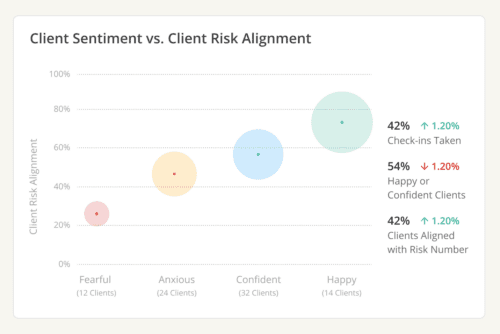
2 – Measure Client Sentiment Across Your Firm

We’ve talked to countless scaling RIA firms that are looking for a scalable, measurable way to see client satisfaction. However, asking investors to rate their advisor on a scale from 1-10 can feel a little cheap in such a relational business.

How do we find out which advisors are truly taking care of their clients and empowering them to invest fearlessly?

That’s why we’ve brought insights from our Check-ins feature into Command Center.

Advisors love using Check-ins, right? It’s their favorite way to get an automated checkup from clients on a regular basis. Their client just has to give them two taps on their smartphone, letting the advisor know how they’re feeling about the markets, and about their own plan, and the advisor gets an early warning sign when a client needs a little engagement.

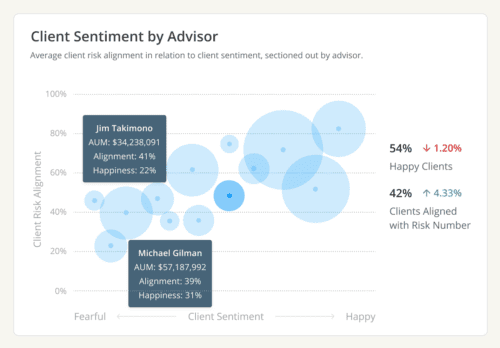
Now with Client Sentiment Insights in Command Center, you can drill in to see where advisors are on a scale of client sentiment and risk alignment. You can take this one step further by drilling into specific advisors to see which of their clients are fearful, anxious, confident, or happy.

And that’s where these Insights really come to life — it helps you finally answer the question, “how do I tell my advisors apart?”

You can drill in on any advisor at your firm and see their zoomed-in version of all metrics on the Insights dashboard and see who’s above or below trend. As you can see, this is quickly going to become a critical part of your platform. Because you can’t grow what you can’t measure

Learn more about Insights > 

3 – Build a Retirement Plan with Income By Source

We love learning from advisors. We asked a panel of advisors, “What’s the number one question you get from your clients?” And every single advisor on the panel agreed on this: “Am I going to be okay?” Retirement Maps does a great job of framing up that conversation and advisors love  it for a bunch of reasons:

  1. It puts risk capacity in context. For the client who want to take on zero risk, retire early, and live like a king (do you have any of those?) …you can illustrate why they might need to take on more risk. Because they can’t make it from Los Angeles to New York in six hours if they’re afraid to fly.
  2. It helps uncover held-away assets. Clients love seeing their map bounce into the green. And you’d be surprised how often a client’s desire to bolster their Retirement Map jogs their memory about an old account you don’t manage.
  3. The underlying analytics are powerful. We’ve got the distinct advantage of having security-level risk analytics under the hood. We don’t have to rely on assumptions, we know which securities and asset classes facilitate more or less volatility, letting us model a Retirement Map in a way nobody else can.  It resonates with clients in a way that a monte carlo simply can’t.
  4. With Timeline events, you can dynamically model the impacts of major financial decisions like paying for a child’s college education or shifting Risk Numbers in retirement. It’s incredibly powerful when you can plot events onto the Timeline and show clients the impact on the Retirement Map in real-time.
  5. It all displays beautifully in our reports. By popular demand, reports display each timeline event, making this the fastest way to generate a simple, one-page financial plan.

So, when it comes to that question — “Am I going to be okay?” — Retirement Maps allows you to say, “Yes.” But for retirees, we don’t think simply treating it as a yes or no question goes far enough. It doesn’t truly empower them to invest fearlessly unless you can help them answer the how and why for that question.

That’s why we’re announcing a brand new view we’re calling Retirement Income By Source.

With just a single tap, you can switch from Retirement Maps to Income By Source giving your clients a dynamic view into each account and product that is going to supply their income needs in retirement. You can even add Timeline events to visualize real-time impacts on their retirement income.

Have a client with a low Risk Number that is concerned about outliving their accounts? Retirement Income by Source gives you the tools to illustrate how much income they can generate with just their social security and pension income.

With just a few clicks, you can add additional income streams like annuities or insurance products to boost their likelihood of generating enough income in retirement.

Learn more about Retirement Income By Source > 


Join us this fall for the Fearless Investing Summit

So, that’s a wrap on our second quarterly launch event of the year. But the fun doesn’t stop here, we’ll be launching more upgrades and enhancements to the Nitrogen platform at the Fearless Investing Summit this October 23-25 in Nashville. And boy do we have some exciting things in store. 

Now if you haven’t been, this isn’t just our annual customer conference or the event where we give a sneak peek at the latest product innovations our team is launching, it has turned into an industry gathering. Michael Kitces named it the Top Advisor Marketing Conference to attend in 2024, US News has featured it as a top conference in wealth management, and we have so much in store this year. 

Check out the website and block off your calendar for the highlight of the year. The agenda and many of our speakers are now live on fearleslessinvestingsummit.com.

Want to experience the Nitrogen platform yourself? Enjoy an interactive tour of Nitrogen today.