Say Goodbye to Disconnected Data: 4 Advisor Integrations to Save the Day

Feeling overwhelmed by data and disconnected systems?

Juggling multiple systems can easily stifle your productivity and hinder client service. One recent report noted that “only 32% of advisors say their technology is ‘very well prepared’ to support clients’ needs” – citing a lack of integration capabilities as a core issue. 

With what seems like endless amounts of advisor software available, each tool promises to help you do more in less time. But if all these solutions remain isolated from one another, they can actually create more work for you and your team. 

Related: What Software Will Financial Advisors Use in 2024?

Through integrations, you can use each piece of your tech stack to its full potential, while also delivering a smoother experience for your clients. In today’s blog, we’re exploring how disconnected systems can hinder progress and client service, which types of integrations are key to advisory success, and more.


Advisor Experiences without Integrations: Common Problems

Managing a patchwork of siloed financial advisor tools can result in everything from mild annoyances to unhappy clients and even burnout. Some of the most common pain points advisors face with siloed solutions include:

  • Disconnected Data: Scattered information across platforms creates a fragmented view of your clients’ financial picture – making it tougher to find the right information when you (or your clients) need it. 
  • Manual Data Entry: Transferring data between systems via manual download and reupload is time-consuming, leaves room for costly errors, and even increases risk of security breaches. 
  • Fragmented Client Experience: Clients shouldn’t have to jump through hoops to access their information or communicate with you – instead, your tech should facilitate consistent and seamless interactions.

Related: Click here to read “Integration, Not Isolation: Why Your WealthTech Matters for Growth”

Nitrogen is proud to offer over 40 integrations (and counting) with your favorite wealth management tools, allowing you to centralize your data and streamline workflows.


Unleash Your Superpower: 4 Must-Have Advisor Integrations in Action


1. CRM Integrations

Per the 2024 Growth Survey, over half of advisors rank CRMs as one of the most important technologies for advisory firm growth. When your tech stack communicates directly with your CRM, you can:

  • Track client touchpoints 
  • Schedule appointments and meetings
  • Easily manage upcoming and completed tasks
  • Gain valuable insights into client relationships
  • And more

Nitrogen currently offers CRM integrations, allowing you to easily sync client data across platforms, simplify client communication, and manage relationships effortlessly.

Related: Click here to watch the on-demand webinar, “Nitrogen + Wealthbox Integration in Action”

2. Portfolio Management Integrations

Portfolio management integration allows you to gain a comprehensive view of your clients’ assets and make data-driven decisions without having to switch between applications. 

It’s important to know if a client’s risk level has changed when making recommendations for their portfolio – which is why you should feel confident that any client profile updates are synced across systems.

For example, if you use Black Diamond for portfolio management, you can create your proposal in Nitrogen and then implement that plan on the Black Diamond platform. When client information is updated in one system, it’s automatically synced to the other, saving you time so you can get back to your clients more quickly. 

In addition to Black Diamond, Nitrogen currently offers portfolio management integrations for:


3. Financial Planning Integrations

A financial planning integration empowers you to deliver comprehensive financial planning services with automated reports and goal tracking. 

Our planning integrations include a variety of benefits for you, your clients, and your firm, such as:

  • The ability to import Nitrogen model portfolios and corresponding Risk Numbers into your planning software
  • Automate plan monitoring in your financial planning tool to stay updated with accurate client information
  • View key client insights, accounts, holdings, and more in one place
  • And more

Nitrogen has integrations ready for all your favorite financial planning software, including:


4. Client Portal Integrations

Lastly, an integration with your client engagement tools makes it easier for you to stay connected with your clients while also giving them access to their financial information. 

Client communication is key to your business growth, as Nasdaq reports: “88.2% of surveyed clients would consider their advisors’ frequency and style of communication when deciding to retain his/her services.” That same report also found that nearly half of all advisory clients wish their advisors would reach out more often. 

Related: Essential Tools for Remote-First Financial Advisors

Nitrogen recently announced enhancements to our integration with popular client portal software Orion – which now offers more data organization options and configuration options in addition to the existing integration (which connected proposals, client accounts, and portfolio modeling).

Related: Click here to read “Unlocking Success: A Wealth Management Firm’s Guide to Effective Software Onboarding”

A powerful and integrated tech stack can streamline your work, improve client relationships, and drive growth. If you’re wondering where to get started, your portfolio management software, CRM, financial planning tools, and client portal platforms are likely to make the biggest impact.


Ready to Utilize Integrations?

Nitrogen’s business growth platform helps advisors like you save the day with secure integrations and exceptional client service. Click here to schedule a free demo of Nitrogen and get started. 

6 Financial Advisor Tools You Need to Level Up Your Firm

With hundreds of options available for your advisory firm’s tech stack, it can be difficult to know exactly which wealth management tools are must-haves, which will give your firm that extra “edge,” and which cost more than their worth. 

With data from our recent 2024 Growth Survey, we know that most advisors are ranking CRM, financial planning, and risk tolerance software highest on their priority list. But after you’ve ticked those three boxes, where should you look next?

Related: Click here to read “Nitrogen’s 2024 Growth Survey: 5 Key Trends Shaping Wealth Management”

Today, we’re exploring six key pieces of advisor technology that can help you bring new growth and efficiency to your firm, and how you can get started with each.


6 Financial Advisor Tools You Need to Level Up Your Firm in 2024 (and Beyond)


1. A Lead Generation Machine

Barron’s reports that “advisors spend anywhere from 7.5 to 9 hours a week on prospecting” – that’s nearly an entire day!

If you’re still focusing your prospecting efforts on cold-calling from a list, it might be time to embrace new tools that can automate the process. 

Nitrogen offers a lead generation solution you can implement in your prospecting process. The Lead Gen Questionnaire captures attention with a powerful but simple question: “What’s your Risk Number?”

You can also use the questionnaire in your social media content, emails, newsletters, and other marketing materials – all with customizable branding that reflects your firm’s messaging and look. The key to the questionnaire’s success is that it’s interactive – you’re inviting the prospects into a conversation from the very first moment they arrive on your site, or even prior.


2. Risk Tolerance Software

Speaking of risk tolerance – let’s talk about risk tolerance software. 

Gone are the days when vague terminology like “high-risk” or “moderate risk” sufficed. To accurately assess your clients’ and prospects’ risk tolerance, you need real insights based on accurate data. 

With our proprietary Risk Number® technology, you can feel confident in how much risk clients want, have, and need, and ensure their portfolios are on track. 

Nitrogen’s Risk Number delivers:

  • A common language both you and your clients can understand, using a scale of 1-99 based on a Nobel Prize-winning scientific framework.
  • Fewer opportunities for bias based on age, gender, or other factors (which aids in documenting compliance with best interest laws).
  • A proactive way to manage client expectations and pinpoint any portfolios in misalignment.
  • And more

Related: Click here to read “Nitrogen 101: What is the Risk Number?”

3. Data-driven Engagement Insights 

Next up on our list: client engagement tools.

Convincing a prospect to join your advisory firm is just the first step – now, you need to make sure they’re engaged in the financial planning process. With our Check-Ins, Stress Tests, and Scenarios tools, you can keep a pulse on clients that might need a little extra attention. 

Check-Ins: Receive data points that uncover how your clients are feeling about their progress, and share adaptive analytics that show clients what’s really “normal” for them. 

Stress Tests: Show clients how their portfolios would perform under historical events, like the 2008 Financial Crisis, to illustrate the importance of risk alignment.

Scenarios: Take stress tests to the next level with custom Scenarios, which can combine several historical contexts to create a comprehensive narrative. 

Related: How to Increase Client Engagement for Financial Advisors  

4. Proposal and Report Generation

If you’re creating every proposal from scratch, it’s time to embrace a systematized process. 

Nitrogen makes it easy to build out models and implement those across your firm. This gives your firm the ability to build the perfect proposal and portfolio for every client. When it’s time to generate a report, Reports Builder gives you the power to customize every element and highlight your clients’ unique investing story.

Reports Builder creates consistency across your firm, saves you time, and provides a more professional experience for your prospects and clients.

Clients aren’t interested in reading a 40-page report. That’s why our reports are built with the client in mind – so they can easily understand your value on page one. 

The Proposals Dashboard in Command Center also allows you to track where each client is in their journey with you, including which prospects have received proposals, Risk Numbers, a Form CRS, and more. 

Related: Monitor Proposals and Drive Growth with Command Center

5. A Filter-friendly and Searchable Fund Screening Tool

Looking to save time without sacrificing your quality of service? Consider adding a fund screening tool to your tech stack, like Nitrogen’s Discovery.

With Discovery, you can filter a million securities down to just the ones that fit your clients’ needs, based on their Risk Number, equity sectors, market cap size, annual dividend, and more. Curate lists and favorite funds you want to come back to later – no manual boolean searches necessary.

Related: Searching for Fixed Income Investments in Discovery

6. Firm-wide Growth Analytics

Without real data, you can’t really know if (or how) your firm is growing. Embrace analytics to keep a bird’s-eye view on your book of business and grow your AUM in a quantifiable way. 

Command Center allow you to review portfolios quickly and efficiently. With this tech tool in your arsenal, you can say goodbye to manual spot checking and feel confident that your attention is focused on where it should be. 

Wondering where your tech should grow next? With the above tools in your financial planning arsenal, your firm is poised to successfully tackle compliance, client care, and prospecting in 2024.

Enhancec your firm’s tech stack and streamline client engagement with Nitrogen. Click here to schedule a free demo and get started today.

8 Simple Ways Financial Advisors Can Stay Compliant

Did you know that only 17% of advisors are using compliance technology on a daily basis? Yet nearly half of advisors are spending three or more hours each week on Reg BI compliance alone!

Even though compliance is famously regarded for its tediousness, many professionals have yet to embrace financial advisor tools that can speed up the process and free up more of their time. 

If you’re thinking of easing your firm’s compliance burden, we have you covered – here are eight simple ways you can ensure you and your firm will stay compliant.


Financial Advisor Tools: 8 Easy Ways to Stay Compliant


1. Automate whenever possible

One of the best ways to make compliance tasks easier is to simply remove them from your to-do list by allowing automation tools to do the work for you. Of course, there are compliance tasks that cannot be automated, but if you can identify and automate the tasks that can, you could save yourself countless hours.

Many advisors spend a day each week (or more) on regulatory tasks alone. When you let software handle repetitive tasks like account aggregation and report generation, you’re left with more time to meet with clients, grow your prospect list, and find new ways to stay proactive about compliance. 

Nitrogen uses Firmwide data to feed automation for client onboarding. When firms set up their data feed, all client data becomes immediately available, virtually eliminating onboarding time altogether.


2. Standardize your proposals 

According to the 2024 Growth Survey, roughly 90% of advisors believe having dedicated tools for client communication and proposal generation is important – yet only about one-third are actually using such tools. Similarly, only one-third of advisors reported having any sort of standardized proposal generation process throughout their advisory firm. 

Related: Click here to read “Nitrogen’s 2024 Growth Survey: 5 Key Trends Shaping Wealth Management”

With the Proposals Dashboard in Command Center, you can determine how many of your active clients, leads, and prospects have Risk Numbers and which advisors are building proposals in alignment with clients’ risk tolerance. 

These proposals:

  • Can be generated in just moments
  • Are customized to the prospective client
  • Offer a compliance-friendly audit trail
  • Ensure a consistent client experience 

3. Put clear data behind all those “What if…?” conversations

Showing clients potential scenarios brings a new level of understanding and clarity to the conversation.

With Detailed Portfolio Stats, you can test portfolios and proposals against hypothetical regulatory changes, all through the lens of risk. It also allows you to show regulators exactly what drove your recommendations in the event of an audit.


4. Pinpoint  risk misalignment with ease

The most valuable wealth management tools are the ones that facilitate proactiveness over reactiveness. 

For example, the Holdings Dashboard in Command Center gives your firm the tools to see when accounts or portfolios have drifted out of alignment with their targets. Now your firm can address any problems before they actually occur – saving you time and keeping your accounts compliant. 

Related: Explore the Risk/Reward Heat Map

5. Keep client data and credentials safe

Maintaining client confidentiality and cybersecurity is critical to staying compliant. In fact, the SEC has nearly doubled the size of its cybersecurity teams in recent years to facilitate more focus on digital safety. 

Whether you’re meeting with clients virtually or asking for prospects’ logins for outside accounts, it’s key to have a standard, secure process in place, so you’ll be prepared if the SEC comes knocking. 

Nitrogen’s Outside Asset Sync allows your clients to login to their held-away accounts , so you don’t have to spend hours manually entering in holdings.


6. Eliminate manual spot-checking

Traditional methods of spot-checking simply don’t allow you to check your entire book of clients, and attempts to do so could take weeks of your time. 

The Holdings Dashboard on the Nitrogen Platform provides real-time account updates and customizable alerts, so you can confirm current holdings match the investment advisory agreement for each and every client. Set Investment Objective ranges and Risk Target ranges so you know what may be out of alignment.


7. Use data-based insights to create a consistent client experience

Leveraging insights that are backed by real client data can help streamline client experiences, making them consistent and compliant. By analyzing client data, advisors can customize their services to meet individual needs while maintaining the standard regulations. 

Nitogren’s Check-Ins tool allows advisors to take a pulse check on their client’s psychology.  Advisors get data points on how their clients are feeling about the markets and their financial future. This allows them to take action at the first sign of trouble, while also ensuring they are providing clients with the appropriate plan based on their unique data. Additionally, Nitrogen’s Insights Dashboard gives executives the ability to see which advisors’ clients are nervous, fearful, happy, or confident with their financial plans, ensuring their advisors are assisting their clients properly. 

Related: Keep Clients Happy and Grow Your Business with These Game-Changing Tools

8. Embrace built-in documentation

Lastly, let’s talk about the golden rule of compliance: Document everything. 

Documenting every client interaction and correctly storing those records is crucial for compliance with SEC laws (especially now, as document retention is a current focus of the organization). 

Nitrogen keeps a paper trail of current and past portfolios, proposals, and risk tolerance questionnaires, creating a complete and auditable trail you can access at any time. No more scrambling to gather paperwork for audits – we’ve got you covered. 

These eight easy wins can free up your time and reduce your compliance burden along the way. The best part? With an intuitive platform and easy implementation like Nitrogen, you can begin tackling compliance more efficiently right away.


Keep Compliant with the Nitrogen Platform

Ready to automate your compliance tasks with a comprehensive business wealth management platform? Click here to schedule a complimentary demo of Nitrogen today. 

5 Client Personas Every Financial Advisor Eventually Encounters

Financial advisors consistently cite client meetings as one of their favorite parts of what they do. It makes sense considering that many advisors got into this line of work to serve people. 

That being said, every client is different and brings their own unique set of goals and challenges. By understanding where your clients are coming from, you can be better positioned to serve them. 

In today’s blog, we’re sharing five types of client personas you may have run into (plus tips for how to best serve them).

5 Types of Clients Every Financial Advisor Eventually Meets


1. The Quiet Client

Profile: Some clients may be individuals of few words – and while you don’t necessarily mind the quiet, it’s could be hard to gauge their feelings. Are they confused? Unimpressed? Just going through the motions?

What to Do: As an industry, we often talk about the anxious clients – those who perhaps over-communicate. The Quiet Client may require more nuanced tactics to lure them from their shell and get down to real, meaningful conversations. 

Start with open-ended questions. It may be that the Quiet Clients have a negative money script when discussing finances specifically. In fact, 62% of Americans consider it a taboo topic, and would rather opt for more “fun” discussions.

You can slowly build a rapport by asking questions about work, family, and hobbies instead, and build a client relationship up from there. 

Consider even offering pre-meeting surveys with multiple-choice and free-response options, allowing them to share their thoughts at their own pace and in an environment where they feel comfortable.

Related: Click here to read, “Client Experience Surveys for Financial Advisors: Unlocking Valuable Insights”


2. The Anxious Client

Profile: You’ve most likely met an Anxious Client already, especially since 71% of clients report some level of financial anxiety. They need reassurance when things stray from the plan, and when the market takes a sudden dip, you are likely already expecting them to reach out. 

What to Do: The best way to help out your Anxious Clients (and your email inbox) is to develop a clear communication plan. Let them know your “office hours,” so they know when they can expect to hear back from you. 

Related: Why Clients Leave a Financial Advisor (and What You Can Do About It)

You can also offer more resources for the anxiety-ridden folks, like blogs, brochures, or helpful videos that explain the inevitable tide of market volatility. Check out Nitrogen’s Resource Library and Nitrogen’s blogs for free resources you can share at any time. 

In conversations with your Anxious Clients, remind them about your long-term strategy and the importance of staying calm, and try to steer them away from news sources that might stoke their stress.


3. The Busy Bee

Profile: This client materializes for the initial consultations, then can become hard to get ahold of. Emails bounce, calls go unanswered, and carrier pigeons return empty-beaked (okay, maybe not that last one). 

The Busy Bee client shows up often enough to let you know they’re alive, and they even seem enthusiastic about financial planning, but getting them to commit to an annual meeting could be a tough challenge with their busy schedules. 

What to Do: It can be frustrating to put in meeting prep and end up with wasted efforts due to scheduling conflicts. Thankfully, there are a few strategies you can use to gain a little more control over the situation and boost their engagement.

Your best bet is to offer a secure online portal for document exchange, so they can send you any necessary information or messages on their own time. You may also want to embrace a multi-channel approach, which opens communication to text, email, and phone calls.

When you do have a rare moment with your Busy Bee and are trying to schedule a follow-up, be sure to explain the why behind your next meeting – why are these moments necessary to their financial health? They might just need a little motivation to get on the ball!


4. The Hands-On Client

Profile: If you thought the SEC was looking over your shoulder, the Hands-On client brings a whole new tier to the game. Of course they appreciate your help, but they may be overwhelming for advisors as they like to get involved in every detail. And while an engaged, focused client is a good thing, you also need some level of trust for this relationship to work long-term. 

Related: The SEC is About to Rock Your World on Cybersecurity

What to Do: With a Hands-On client, the answer usually lies in education, which can help you to acknowledge their desire for involvement and embrace their willingness to learn. Sending resources their way can keep them independently involved but still part of the equation. For example, if they’ve shown interest in alternative investments, maybe you have a book (or list of books) they’d enjoy. 

You can also embrace hyper-personalization, which shows them they aren’t just another number in your book of clients.

Related: Turbocharge Client Relationships with These 6 Personalization Examples


5. The Knowledgable Client

Profile: This client often comes well equipped with knowledge and financial wisdom gleaned from the vast, ever-shifting landscape of the internet, or from their circle of family and friends. This can be great, but it can also come with some concerning distractions.  

What to Do: Keep in mind that a little questioning from your client shows they’re engaged, and it’s most likely well-intended. Use these opportunities to explain complex concepts in a clear, concise way, and bring your sources to help ease their read-to-learn minds. Remember, you are the financial expert, and your experience provides valuable context! 

Financial planning has as much to do with personality and relationships as it does the numbers. As you delve deeper into meetings, keep in mind that each client has different needs as far as communication. 

With these tailored tips (and Nitrogen’s suite of personalization tools) you can effectively serve each client in your book of business.


Customize Your Client Communication

Want to tackle every client meeting with confidence? Click here to schedule a free demo of Nitrogen’s comprehensive client engagement and growth platform today. 

3 Ways Financial Advisors Can Maintain Work-Life Balance

Spring can often come with endless to-do lists for financial advisors. This means it’s a good time to check in on your overall well-being and work-life balance to avoid potential burnout.

Unfortunately, burnout is a common pitfall in the wealth management industry. A staggering 77% of advisors say they’ve experienced burnout, and close to half report that their stress has increased in the last five years. 

Moreover, most advisors leave the field early on, with one recent report stating “72% of rookie advisors fail out of the industry.” Another report found that the four-year retention rate for advisors hovers around just 16%. 

If you don’t want to become another statistic, then it’s important that you address burnout before it becomes a problem. Here’s how to prevent burnout at work, allowing you to maintain productivity and client satisfaction throughout your career. Let’s dive in!

Understanding Burnout in the Financial Sector

Financial advisors face a unique set of stressors in their line of work. The demand on your time and emotional labor involved in managing client relationships, the constant pressure to deliver results, and the ever-changing regulatory landscape can all contribute to feeling overwhelmed. Recognizing the triggers and symptoms of burnout is the first step to keeping them under control.

Common symptoms include:

  • Irritability and/or apathy
  • Lower work performance, such as missing deadlines 
  • Insomnia 
  • Low energy and difficulty concentrating
  • Changes in eating habits
  • Headaches
  • Depression and anxiety


How to Overcome Burnout at Work: 3 Steps for a Healthy Work-Life Balance


1. Create boundaries

The first line of defense against burnout is setting clear boundaries between your work and personal life, which can be especially difficult if you work and live in the same space. While the flexibility of a work-from-home schedule is great, you may be more susceptible to remote work burnout if you don’t have clear boundaries between “work” and “home.” 

Related: Essential Tools for Remote-First Financial Advisors

But whether you’re in a corner office in the city or looking out into your backyard, there are a few ways you can set yourself up for success:

  • Stick to a schedule. Create a daily routine that includes set start and end times, and communicate that schedule to your colleagues and clients. If an email comes in after you’ve “clocked out,” remind yourself that it will still be there tomorrow!
  • Create a calming environment. Sometimes the small things can have the biggest impact – like the plant on your desk or your favorite podcast playing in the background. Make a list of ten small things that help you de-stress, and find ways to work them into your day. 
  • Take regular breaks. Block out dedicated time in your calendar for breaks, lunch, and exercise. Treat these breaks like appointments you can’t miss!

Additionally, it’s also a good idea to practice saying “no.” If your plate is already full, it’s okay to prioritize your well-being before you stretch yourself too thin. When you feel confident in your workload, you’re better prepared to serve your clients, too. 

Related: Keep Clients Happy and Grow Your Business with These Game-Changing Tools


2. Prioritize Self-Care

Self-care is a necessary part of overcoming burnout in your work life. Your version of self-care might look different from others, and that’s okay. If you’ve been off the self-care train for a while, you may also need to try out a few things to see what really works for you. Here are a few ways you can get started:

  • Get Moving. Regular physical activity is a powerful stress reliever and mood booster. Find an activity you enjoy, whether it’s a brisk walk in nature or a quick gym session before work.
  • Eating Well: Take time to grab your favorite drink before work a few days a week, and fuel your body with nutritious foods that will give you sustained energy throughout the day.
  • Practicing Mindfulness: Techniques like meditation and deep breathing can help you manage stress in the moment and improve overall mental well-being. Even a few minutes a day can make a difference!
  • Getting Enough Sleep: A well-rested mind is more productive and resilient and can set you up for a productive day ahead. 


3. Seek Support

Building a strong support network of friends and family members can be invaluable during busy periods. Consider reaching out to colleagues or a mentor when your stress levels are getting higher than normal to see if they have any tips or advice – sometimes just talking about your work stress with someone who “gets” it can help!

There are also professional networks for advisors, like Females & Finance, that can connect you with professionals who face similar work challenges.

While there’s no magic bullet for burnout, these strategies can help you stay afloat during the busy seasons that happen throughout the year. By regularly checking in on your stress, practicing self-care techniques, and finding a community of support to lean on, you can cultivate a better work-life balance in the long run.


Make Your Work Life Easier with Nitrogen

Want to find new ways to streamline your daily tasks? Click here to learn more about Nitrogen or schedule a free demo today

7 Must-Experience Highlights at the Fearless Investing Summit 2024: Your Ultimate Guide

The Fearless Investing Summit is more than just a three-day conference; it’s a convergence point for financial professionals, thought leaders, fintech innovators, and industry up-and-comers. It’s where transformative strategies are born, propelling your firm forward with fresh ideas, cutting-edge innovations, and invaluable new connections. But don’t just take our word for it—our attendees’ experiences speak volumes:

  • “This is the best conference I have ever attended! I am going to tell everyone they have to attend!” – Amanda J.
  • “Gosh, it was amazing. You all put on an incredible event… Being in an environment such as your Summit really helped bring some new thought to our processes.” – Brian C.
  • “What an amazing conference… An extremely well-run conference by an extremely well-run company. Already looking forward to next year!” – Ryan K.
  • “Thank you for the abundance of inclusion, fun, and thoughtfulness at the conference… The dueling-piano dance-party is a cherished memory.” – Chris S.

These endorsements underscore why the Summit was hailed as one of the must-attend events for financial advisors by U.S. News and why Michael Kitces named it the best advisor marketing conference for 2024. As we prepare to welcome 1,000 industry leaders and innovators at this year’s conference, read on to discover the seven key highlights that await you at this year’s Fearless Investing Summit.


7 Things You Can Expect at Fearless Investing Summit 2024


1. We’ll meet you at the luxurious Grand Hyatt Nashville

This year’s event is kicking off on October 23 at the Grand Hyatt Nashville, located in downtown Nashville, Tennessee. Named the number one new hotel by USA Today, the Grand Hyatt features the highest rooftop lounges in Nashville, in addition to a rooftop pool and luxury spa.

After wrapping up the day’s festivities, you can keep the networking party going at one of the seven food and beverage experiences offered on-location. Need a bit of fresh air? Take a quick walk to The Gulch or explore the famed Midtown neighborhood. And because no visit to Nashville is complete without its legendary music, we’ve arranged for live artists to perform each evening right outside the lobby lounge.

Plus, when you book your room through Nitrogen, you unlock exceptional value—enjoy exclusive pricing that offers more than 40% off standard room rates, plus waived hotel fees. It’s the perfect way to experience Nashville’s charm and the Summit experience, all while enjoying significant savings.

*Note that hotel spots are limited, and accommodations are excluded from registration costs


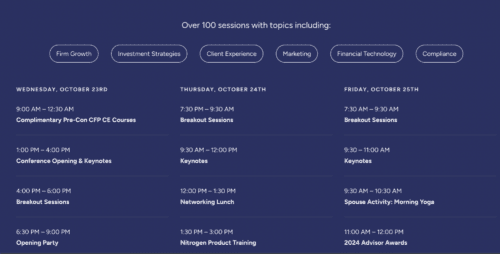
2. You’ll have over 100 sessions to choose from

With over 100 events packed into three days, Summit offers a diverse variety of sessions, including:

  • Keynote sessions
  • Breakout sessions with industry experts
  • An opening night party
  • Nitrogen-specific training and general wealth management presentations
  • Nightcap Networking, an after-hours event taking place on the rooftop lounge
  • Physical activities, including morning runs and yoga classes for spouses in attendance
  • And more

Want a sneak peek of the agenda? Click here to view the schedule.


3. Even with over 1,000 attendees, you won’t be lost in the crowd

We’ve intentionally designed Summit to optimize your experience through an industry-best 10:1 attendee-to-staff ratio. 

Our dedicated team is committed to ensuring a personalized and enriching experience for all attendees – so you’ll have the chance to connect with specific communities through breakout sessions and events. For example, the annual Fearless Women’s Summit will feature keynotes, panels, and networking opportunities centered around the unique experiences women encounter in the wealth management industry.


4. You can gain CE credits by attending

Take advantage of over 15 hours of continuing education (CE) credits available for CFP® attendees

To plan your CE-eligible sessions, you can check the event agenda – which notes which events qualify for the credits. CE credit information is also available in our filter-friendly online agenda.


5. Meet world-class speakers

Prepare to be inspired by our stellar lineup of speakers at this year’s Summit. We’ve gathered a mix of leaders, each bringing their unique insights and experiences to the stage:

  • NFL Hall of Famer Emmitt Smith will lead a session on having A Championship Vision. 
  • Industry expert Michael Kitces is presenting on scaling your wealth management firm
  • Marketing virtuoso Samantha Russell of FMG Suite will lead a masterclass on marketing
  • New York Times bestselling author Jon Acuff will inspire and motivate with a keynote on setting goals for your wealth management firm. 
  • Plus, Aaron Klein, Tina Powell, Joy Lere, Craig Iskowitz, and a host of other luminaries are set to share their knowledge, experiences, and strategies for success.

Don’t miss the chance to gain valuable insights from these industry leaders and innovators with our ever-expanding roster of speakers at this year’s Fearless Investing Summit.


6. You can relax knowing we’ve taken care of the details

In addition to all your meals and limitless cups of coffee, we’ve secured discounted travel rates and negotiated a special room rate of $329/night at the Grand Hyatt Nashville. 

We also understand that life is full of the unexpected, and are happy to offer a flexible refund policy that allows for ticket transfers or rollovers up until September 1. 

Click here to find more travel and transportation information for Summit 2024.


7. You’ll get up close and personal with Nitrogen’s newest enhancements

Summit offers ample opportunities for one-on-one deep dives with Nitrogen experts. You’re invited to participate in “Ask Me Anything” sessions, share insights with fellow users and learn valuable tips and tricks from our team.

A few of the Nitrogen-specific sessions we’re most excited for include:

  • The Future of Wealth Management: Nitrogen’s Vision and Product Roadmap
  • Advisor Excellence: Nitrogen Power Users Unveil Their Secrets
  • Winning with Integrations: Custodians, CRM, Financial Planning, and more in Nitrogen

You can also drop by Nitrogen Central, which is an interactive space staffed by Nitrogen team members ready to answer any questions you may have. 

Related: Click here to read “Q1 2024 Product Release: Drive Client Engagement and Business Growth With Nitrogen’s Newest Features”

The Fearless Investing Summit isn’t just a conference; it’s an investment in your future – a chance to forge lasting connections with industry peers, gain insights from the best minds in finance, and discover how to leverage cutting-edge technology to propel your firm’s growth. 

You’ll return to your practice brimming with fresh ideas, a renewed sense of purpose, and a network of accomplished professionals who can support you on your journey.


Register Now for Fearless Investing Summit 2024

Nitrogen’s Fearless Investing Summit has sold out five years in a row – but it’s not too late to save your spot! 

Purchase an event ticket today and enjoy discounted prices for financial advisors, advisory firms, service providers, firm staff, and even spouses.

Tax Prep for Advisors: Your Checklist for Delivering Tax Drag Analysis

Tax prep is one of the most valuable services you can offer as a financial advisor. No client wants to pay more in taxes than they have to – but few have the desire or capability of getting in the IRS-ridden weeds, so to speak. 

Moreover, a staggering 80% of investors think their advisors should be focusing on tax minimization, and 90% believe taxes can erode their investment accounts over time. Perhaps without even knowing what to call this phenomenon, your clients are likely worried about tax drag. 

But how can you prepare yourself for those conversations?

This blog explains what tax drag is, how Nitrogen calculates it, and gives advisors a step-by-step checklist to run tax drag analysis during tax prep season.

What is Tax Drag?

Here’s what you need to know to get yourself ready for tax prep time with your clients:

  • Funds withdrawn from investment accounts to pay taxes are missed opportunities for potential growth – that money would likely serve clients better by staying invested and compounding over time. That loss is called “tax drag.”
  • Clients are often focused on the bottom line (i.e., returns), and may not even be aware of just how much of an impact tax drag can have on their long-term finances. With complex portfolios, it becomes difficult to explain that concept in a way that resonates. 
  • Providing next-level advice through tax drag analysis and optimization is a great way to show your value and keep clients engaged – it can show them that you’re able to manage their portfolio more tax-efficiently than other advisors. 
  • With Nitrogen’s built-in Tax Drag calculators, you have access to Tax Drag analysis at the security and portfolio level, as well as simple visualizations you can share with your clients.

Related: Win Prospects Faster with Tax Drag

Tax drag data is also shedding light on trends that can help you make informed recommendations. For example, we found that in 2023, the top ten growth ETF offered significantly less tax drag than their mutual fund counterparts (at .39% and 6.69%, respectively)!

Analyzing Portfolios for Tax Drag in Nitrogen: A Step-by-Step Checklist

Before you dive into tax prep with your clients, let’s ensure you’re comfortable with the calculators. To determine tax drag at the portfolio level for a new client account, you’ll need to follow a few simple steps:

  1. Login to your Nitrogen account. Note that Tax Drag is available for customers on Nitrogen Elite, Ignite, or Ultimate. 
  2. Click “Add Account, Funds, Stocks, Other” for the new account. 
  3. As you add account information, you’ll be prompted to set the tax status of the account as either taxable or non-taxable. 

If you need to change this setting later, you can do so by going to the account and selecting Menu > Setting > Tax Status. Note that tax drag is available for taxable accounts only.

  • You can now view the tax drag, along with expense ratios and advisory fees, for the portfolio at any time by clicking into the Portfolios screen or the Detailed Portfolio Stats section. 
  • Easily share the tax drag analysis with clients and prospects by sharing the Portfolio Snapshot report or through a custom Nitrogen proposal. You can also show side-by-side comparisons of your proposed portfolio and the existing portfolio’s tax drag. 

Related: Click here to read “Tax Drag: The New Competitive Advantage in Investment Management”

Accounts already created already have tax drag information available for Nitrogen Elite users, accessible in the Portfolios screen, Detailed Portfolio Stats, and Portfolio Snapshot reports. 

3 Ways Tax Drag Analysis Helps You Tackle Tax Prep with Ease

  1. The simple tax drag visualizations provided by Nitrogen make it easy to show your clients why a certain recommendation might be more beneficial than another – without the need for heavy jargon. 
  2. You have access to a standardized and structured way to share seemingly complex tax concepts in just a moment, keeping your clients’ confidence high and meetings on track.
  3. You set yourself apart from competitors and wow prospects, without adding more to your to-do list.

How Nitrogen Crunches the Numbers

At the portfolio level, Nitrogen automatically calculates the tax drag of each security held and averages those amounts under the assumption that the current holdings and respective weights have remained consistent for three years.

We use the following formula, which divides the after-tax return by the pre-tax return, to calculate tax drag for specific securities:

Tax Drag = [1 – ((1+AT) / (1+PT))] x 100, where AT = 3-Year Annualized Distribution After-Tax Return and PT = 3-Year Annualized Return (Pre-Tax)

Note that Tax Drag:

  • Assumes your client pays the maximum federal rate on capital gains and ordinary income rate
  • Reflects the after-tax distribution return without the inclusion of any tax consequences due to selling or liquidating positions
  • Assumes distributions are reinvested on the pay date
  • Does not include state or local tax liabilities

By mastering tax drag concepts, leveraging Nitrogen’s powerful tools, and standardizing tax conversations, you’ll be well on your way to delivering impactful tax drag analysis for your clients. This translates to happier clients, stronger relationships, and a thriving tax season for you.

Get ready for tax prep time with Nitrogen’s suite of advisor and client-facing solutions, including AI Tax Center. Join our pre-order list today and be one of the first to access AI Tax center when it launches. 

The Top 10 Business Write-Offs for Small Advisory Firms

Running a small advisory firm requires not just financial acumen when managing clients’ portfolios but also savvy business management skills. One key aspect of business management is understanding tax deductions. As financial advisors, you may be adept at guiding clients through complex financial landscapes, but it’s equally important to navigate your own business expenses efficiently. 

Here are the top 10 business write-offs that small advisory shops like yours should consider to optimize your tax position.


1. Software and Technology

Investments in software and technology not only streamline operations but also qualify as deductible business expenses. Platforms like Nitrogen, formerly known as Riskalyze, are indispensable tools for enhancing growth and client engagement. They’re not just operational expenses; they’re investments in your firm’s scalability and efficiency. These tools can be written off as business expenses since they are essential for assessing risk tolerance, portfolio management, and client reporting. 

Remember, the cost of software subscriptions, CRM systems, financial planning tools, and cybersecurity measures are all deductible. Even the ACH transaction fees associated with a software purchase are a deductible business expense.

Related: How Nitrogen’s Analytics Help Advisors Reduce Tax Drag


2. Professional Development

Continuing education is not just a requirement but a cornerstone for growth in the financial advisory sector. Expenses related to certifications, courses, and seminars are fully deductible, ensuring your expertise remains sharp and relevant.

One of the premier opportunities for professional development in the coming year is the Fearless Investing Summit, scheduled for October 23-25, 2024, in Nashville, TN. This event offers 15+ hours of CFP CE, making it an efficient way to meet your continuing education requirements while engaging in meaningful learning experiences. 

You can learn more about the event by visiting www.fearlessinvestingsummit.com


3. Office Expenses

Whether you lease or own office space, the costs associated with maintaining your office are deductible. This includes rent, utilities, office supplies, and furniture. 

If you work from home, a portion of your home expenses may be deductible through the home office deduction. This also includes rent, utilities, and even internet charges.


4. Marketing and Advertising

Investments in marketing and advertising are not just growth drivers; they’re also deductible expenses. This can range from digital marketing campaigns to traditional print ads and sponsoring local events. These expenses are fully deductible as they are directly related to promoting your business.

Related: The SEC’s New Advertising Rules


5. Insurance Premiums

Insurance premiums for professional liability, property insurance, and even health insurance for employees can be significant. These are generally deductible business expenses, helping to lower the overall cost of ensuring your business and staff are protected.


6. Travel and Entertainment

Meeting clients or attending industry conferences? Travel expenses, including airfare, hotel stays, and even a portion of your meals during business trips, can be written off, provided they are strictly business-related. Keep in mind that there are limits and substantiation requirements for these deductions.

Related: Understanding Business Travel Deductions


7. Communication Expenses

Your phone and internet costs are a lifeline to your clients and the outside world. Whether it’s a landline, cell phone, or internet service used for business purposes, these costs are deductible.


8. Depreciation of Assets

If you’ve purchased equipment for your office, such as computers, desks, or even artwork, you can’t write off the full cost in the year of purchase. Instead, you can depreciate these assets over their useful life, providing a deduction for a portion of the cost each year.


9. Salaries and Benefits

Compensation paid to employees, including salaries, bonuses, and retirement contributions, are deductible. This also includes any subcontractor payments if you outsource certain business functions.


10. Legal and Professional Fees

The fees paid to attorneys, accountants, and consultants that help you manage and grow your business are fully deductible. This includes the cost of tax preparation and any legal advice pertaining to your business operations. These services not only support your business’s compliance and strategic planning but also offer tax advantages.


In conclusion, understanding and applying these write-offs can significantly impact your advisory shop’s operational efficiency and profitability. It’s not just about reducing expenses but strategically investing in areas that drive growth and client satisfaction. Keep meticulous records and consult with a tax professional to ensure you’re maximizing your deductions while remaining compliant with tax laws.

As part of your firm’s strategic toolkit, consider how software solutions like Nitrogen can not only enhance your advisory capabilities but also serve as a smart investment for your business’s growth. Investing in such tools is not merely an operational cost but a strategic move that positions your firm for success—and it’s a deductible one at that. Remember, a penny saved in taxes is a penny that can be reinvested into growing your advisory firm or returned to your pocket. In embracing these top business write-offs, small advisory shops can unlock new levels of growth and efficiency, ensuring that while you focus on your clients’ financial success, your business’s foundation is equally robust and prosperous.


Citations:

https://www.forbes.com/sites/forbesfinancecouncil/2023/04/12/maximizing-your-tax-savings-15-overlooked-deductions-for-business-owners/?sh=3e6474725759

https://www.investopedia.com/articles/tax/11/tax-tips-for-advisors.asp

https://money.usnews.com/financial-advisors/articles/tax-deductions-for-financial-advisor-fees

https://money.usnews.com/financial-advisors/articles/tax-advice-for-independent-financial-advisors

https://smartasset.com/financial-advisor/are-financial-advisor-fees-tax-deductible

https://www.nerdwallet.com/article/investing/tax-efficient-investing

https://www.occ.gov/publications-and-resources/publications/comptrollers-handbook/files/payment-sys-funds-transfer-activities/pub-ch-payment-systems.pdf

https://home.treasury.gov/system/files/136/Future-of-Money-and-Payments.pdf

The Ultimate Tax Prep Checklist To Send To Your Clients

Taxes can be a daunting task for both the client and the advisor filing on their behalf. To help make the process more manageable and less stressful, we created this Tax Prep Checklist you can send to your clients to make sure they’re well prepared to file and help make your job a bit easier. 

Income Documentation

  • W-2 forms: From all employers over the tax year. Include one for you and your spouse if applicable.
  • 1099 forms: Various types (1099-MISC, 1099-NEC, 1099-G, etc.) for independent contracting work, interest earned, dividends, state tax refunds, and other form of various income.
  • Income from investments: Be sure to include forms that show the sale of stocks, bonds, mutual funds, and other investments (1099-B, 1099-S).
  • Foreign income: If applicable.
  • Rental property income: Gather your records of income and associated expenses from any rental properties you may own. 
  • Alimony received: Collect documentation including amount and ex-spouse’s SSN (if applicable).

Deductions and Credits You May Include

  • Charitable donations: Include any receipts from donations to charities you may have made throughout the year.
  • Medical and dental expenses: Include any receipts for payments not covered by insurance.
  • Education expenses: Include Form 1098-T for tuition, books, and supplies, and student loan interest documentation from Form 1098-E.
  • Mortgage interest: Include Form 1098 from your lender.
  • State and local taxes paid: Gather receipts of payments, including property taxes and state income or sales taxes.
  • Retirement contributions: Include any 401(k) and/or IRA contributions documentation.
  • Energy-efficient home improvements: Gather receipts for qualifying energy improvements.

Records of Taxes Paid

  • State and local income taxes: From the previous year if not already deducted or refunded.
  • Estimated tax payments: Records of estimated federal and state tax payments made during the year.

Previous Year’s Tax Return

  • Last year’s tax return: This can be useful for reference and for information that may carry over to this year’s return.

Miscellaneous

  • Childcare expenses: Include records of payments to childcare providers, daycare expenses etc., including their tax ID numbers.
  • Records of business income and expenses: Be sure to include any applicable income and documentation associated with your company if you’re self-employed or own a business.
  • Educational scholarships or fellowships: If you’ve received any monetary rewards for your education, you may want to include any applicable documentation you have associated with it. 
  • Health Insurance: Include Form 1095-A if you enrolled in an insurance plan through the Marketplace.

Want to share this checklist with your clients? Download a copy of the Ultimate Tax Prep Checklist!

Protecting Client Wealth Against Cyber Threats

As a wealth management advisor, you’re tasked with managing and growing client assets, and along with that comes the responsibility of cybersecurity. Understanding how to protect client wealth and their families from digital dangers is paramount in today’s financial advisory role. 

When it comes to the online security of your client’s assets, you’re the first line of defense against the increasingly sophisticated world of cyber threats, and with the SEC’s new regulations, wealth managers will be held in higher accountability when cyber breaches strike.

Here’s how you can strengthen your defenses and become a trusted advisor in cybersecurity.

Understanding Who The Bad Guys Are And What They’re After

The first step in defense is understanding the offense. Typically, cybercriminals fall under one of two categories – they are either nation-state-backed criminal enterprises residing in countries like Russia, Iran, North Korea, and China, or they are small “cyber gangs” many of which reside in the United States. 

The cyber theft industry is a $54 billion dollar business. Cyber threats can range from identity theft and phishing scams to complex ransomware attacks targeting individuals’ financial assets. Cybercriminals are known to go after bank accounts, custodial and brokerage accounts, tax returns and government benefits, health insurance, credit, and even accounts such as Venmo or Paypal. As a financial advisor, your role extends beyond investment strategies to include advising clients on how to secure their digital wealth across all these platforms. 

The 6 Most Common Ways People Are Breached

Another crucial part of cybersecurity is understanding how cybercriminals go after what they want. Here are the 6 most common avenues used by cybercriminals to execute their breaches:

  1. Similar or short passwords across different accounts: 1 million passwords a week are compromised 
  2. Devices that use default privacy and security settings: many devices automatically record passwords that are input, easily giving access to all passwords once the system is hacked
  3. Smart home technology: typically, once one smart-home device is breached, all others connected to it can be compromised
  4. Malicious software: this is software that is developed with the sole purpose of disrupting and gaining unauthorized access to computer systems
  5. Public WiFi without a VPN: when connected to a public WiFi network, other users on the same network can easily monitor your online activities
  6. Charging stations and rental cars: public charging stations can easily pull information out or push malware into devices 

Implementing a Cybersecurity Framework

  1. Encourage Working On A VPN: Whether it be for your firm or your clients, working on a VPN is a great way to ensure you’re operating securely. 
  2. Educate Your Clients: Knowledge is power. Conduct regular sessions with your clients to educate them about the types of cyber threats and the importance of cybersecurity measures.
  3. Advocate for Strong Digital Hygiene: Encourage the use of complex passwords, the activation of two-factor authentication, and the importance of regular software updates. Consider providing clients with resources or referrals to trusted cybersecurity tools like password management tools. 
  4. Personalized Security Strategies: Tailor cybersecurity advice based on your client’s specific needs, financial situation, and digital presence. What works for one client might not be suitable for another.
  5. Ensure Secure Communication: Use encrypted communication channels when sharing sensitive financial information. Make sure your clients know how to verify that communications coming from you are secure and legitimate.

Partnering with Cybersecurity Experts

While financial advisors are experts in wealth management, partnering with cybersecurity professionals can provide an added layer of security. Introducing security solutions or partnerships, like Digital Privacy and Protection, could offer your clients top-notch protection for their digital assets. These partnerships not only enhance your service offering but also position you as a holistic advisor who cares about every aspect of your client’s wealth.

Building a Culture of Cyber Vigilance

Encourage your clients to adopt a proactive stance towards cybersecurity. Regularly review their digital security measures, update their estate plans to include digital assets, and keep abreast of the latest in cyber threat intelligence. Your guidance can make a significant difference in their overall security posture.

Learning More About Digital Security

The digital age brings with it new challenges, but also new opportunities to excel in the ever-changing wealth management industry. By incorporating cybersecurity into your advisory services, you’re not just managing wealth; you’re protecting futures.

For an in-depth exploration of how you can enhance your cybersecurity efforts and better serve your clients, watch our latest webinar, “The SEC is About to Rock Your World on Cybersecurity.” This session is designed to provide you with the knowledge, strategies, and resources to safeguard your clients’ digital and financial legacies.

Watch Our Webinar Now